
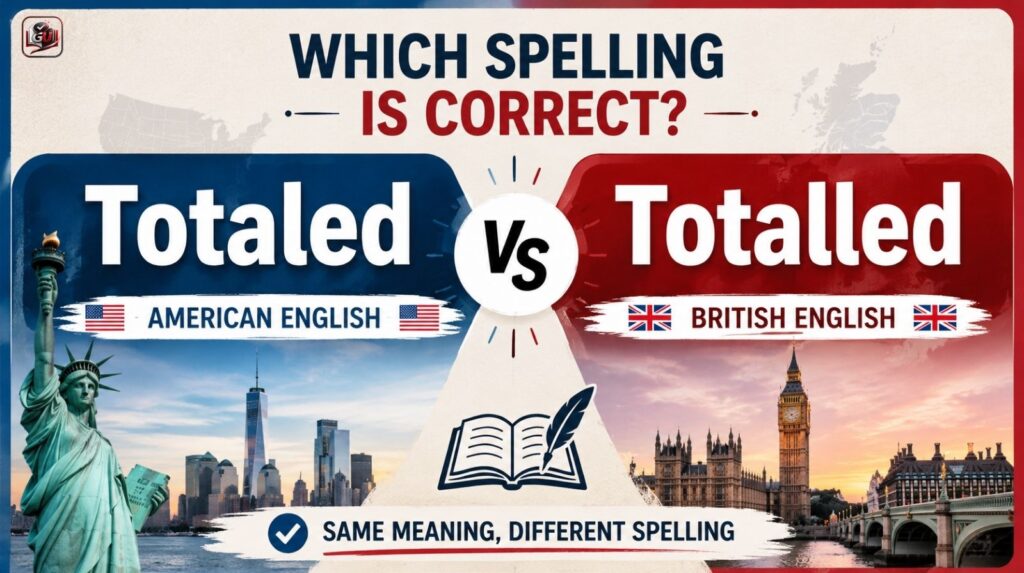
Have you ever seen someone write “the car was totaled” while another person wrote “the car was totalled”? At first glance, one of them may seem like a spelling mistake. However, both versions are actually correct they simply follow different English spelling conventions.
This difference often confuses writers, students, bloggers, and professionals who want their writing to appear polished and grammatically accurate. Choosing the wrong version for your audience can make your content seem inconsistent, especially in professional or international communication.
In this guide, you’ll learn the difference between totaled vs totalled, discover when each spelling is appropriate, see real-world examples, and learn an easy trick to remember which one to use.
What Do “Totaled” and “Totalled” Mean?
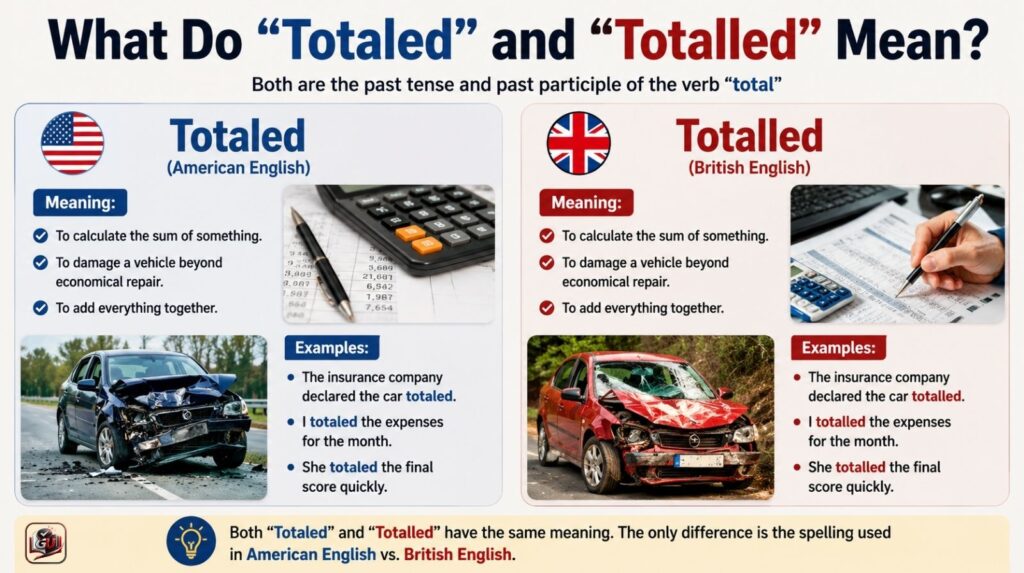
The words totaled and totalled are different spellings of the past tense and past participle of the verb total.
Both mean:
- To calculate the sum of something.
- To damage a vehicle beyond economical repair.
- To add everything together.
The only difference is where the spelling is used.
Totaled (American English)
In American English, the preferred spelling is totaled, with one l.
Examples:
- The insurance company declared the car totaled.
- I totaled the expenses for the month.
- She totaled the final score quickly.
American dictionaries and style guides consistently recommend this spelling.
Totalled (British English)
In British English, the preferred spelling is totalled, with two l’s.
Examples:
- His motorcycle was totalled in the accident.
- We totalled the figures before submitting the report.
- The storm totalled several vehicles.
British publishers, schools, and newspapers generally follow this version.
Totaled vs Totalled: The Main Difference
The meanings are exactly the same.
The only distinction is regional spelling.
| Feature | Totaled | Totalled |
|---|---|---|
| Meaning | Same | Same |
| American English | ✅ Preferred | ❌ Rare |
| British English | ❌ Less common | ✅ Preferred |
| Canadian English | Mostly Totaled | Sometimes Totalled |
| Australian English | Rare | Preferred |
Quick answer:
- Writing for an American audience? Use totaled.
- Writing for a British, Australian, or many Commonwealth audiences? Use totalled.
Why Do Americans Use One “L” While British English Uses Two?
This difference follows a common spelling rule between American and British English.
American English Rule
American English often keeps only one l before adding -ed.
Examples:
- Travel → Traveled
- Cancel → Canceled
- Fuel → Fueled
- Total → Totaled
British English Rule
British English frequently doubles the l before adding -ed.
Examples:
- Travel → Travelled
- Cancel → Cancelled
- Fuel → Fuelled
- Total → Totalled
This isn’t unique to the word total it’s part of a broader spelling pattern.
Examples in Everyday Writing
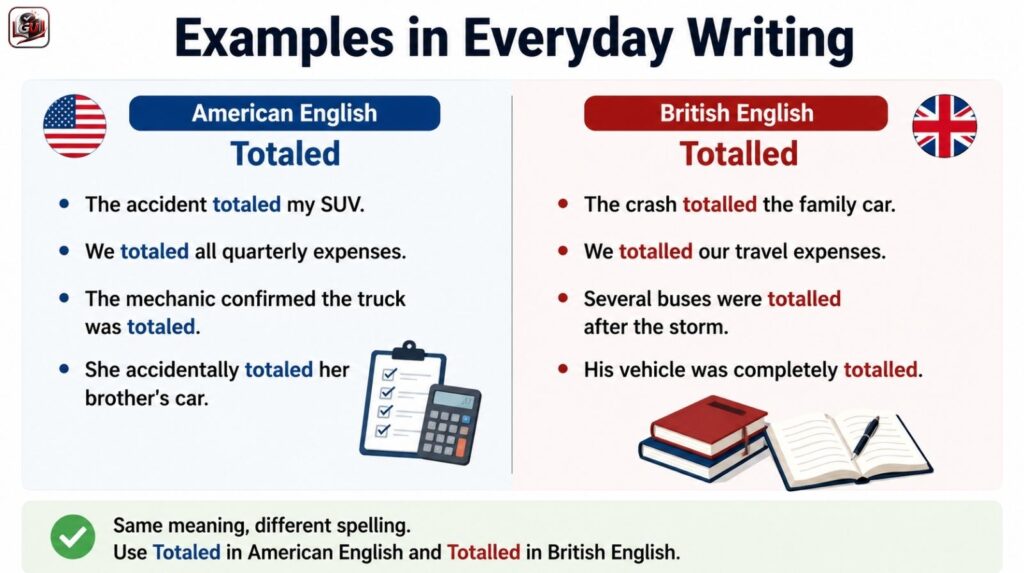
Let’s compare both spellings in real sentences.
American Examples
- The accident totaled my SUV.
- We totaled all quarterly expenses.
- The mechanic confirmed the truck was totaled.
- She accidentally totaled her brother’s car.
British Examples
- The crash totalled the family car.
- We totalled our travel expenses.
- Several buses were totalled after the storm.
- His vehicle was completely totalled.
Notice that the meaning never changes.
Only the spelling does.
Case Study: An International Automotive Blog
A transportation blog published articles for readers worldwide. Initially, every article used American spelling, including “totaled.”
After expanding to readers in the UK and Australia, editors noticed comments pointing out the American spelling. Some readers even assumed the articles contained spelling errors.
The editorial team solved the issue by localizing content based on audience location. American readers continued seeing “totaled,” while UK and Australian readers saw “totalled.”
See Also: Straight vs Strait Difference: Which Is Correct And How To Use Them?
Within several months, engagement from international readers improved because the writing matched local language expectations. More importantly, readers viewed the content as more trustworthy and professionally edited.
This example highlights an important SEO lesson. Although both spellings are correct, matching your audience’s preferred English variant improves readability, user experience, and credibility. Search engines increasingly reward content that aligns with user intent and audience expectations, making regional spelling consistency an important part of content optimization.
Usage Statistics (2025–2026)
Recent language usage trends continue to show clear regional preferences.
- Totaled dominates searches originating from the United States.
- Totalled remains the preferred spelling across the United Kingdom.
- Australian and New Zealand publications overwhelmingly use totalled.
- Canadian publications use both spellings, though American influence has increased usage of totaled online.
- Modern grammar tools automatically suggest the spelling that matches the selected language setting.
These trends demonstrate that neither spelling is incorrect. Instead, each reflects the conventions of a different variety of English.
How to Remember the Correct Spelling
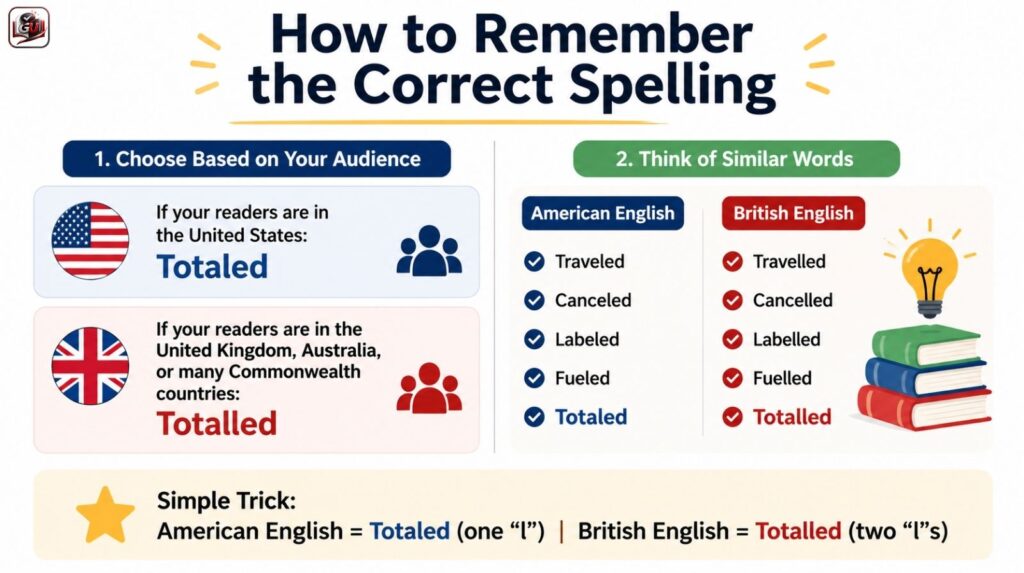
If remembering the difference feels difficult, use this simple trick.
Choose Based on Your Audience
If your readers are in the United States:
✅ Totaled
If your readers are in the United Kingdom, Australia, or many Commonwealth countries:
✅ Totalled
Think of Similar Words
American English:
- Traveled
- Labeled
- Canceled
- Totaled
British English:
- Travelled
- Labelled
- Cancelled
- Totalled
Grouping similar spelling patterns makes them much easier to remember.
See Also: Payed vs Paid: Difference And Which One Is Correct?
Common Mistakes to Avoid
Many writers accidentally mix spelling styles in one article.
Avoid mistakes like these:
❌ The car was totalled, but we later totaled the expenses.
Choose one regional spelling and stay consistent throughout your writing.
Also avoid assuming one version is “wrong.”
Both spellings are accepted by major dictionaries.
FAQs
q. Is “totaled” correct?
A: Yes. Totaled is the standard American English spelling.
q. Is “totalled” incorrect?
A: No. It is the standard British English spelling.
q. Which spelling should I use for SEO?
A: Use the spelling that matches your target audience. If your website primarily serves American readers, choose totaled. For UK audiences, use totalled.
q. Does the meaning change?
A: No. Both words have identical meanings.
q. Which spelling appears in American dictionaries?
A: American dictionaries almost always list totaled as the preferred spelling.
q. Can I use both in the same article?
A: Only if you’re specifically discussing spelling differences. Otherwise, choose one version and remain consistent.
Final Thoughts
The debate between totaled vs totalled isn’t about right versus wrongi t’s about American English versus British English.
If your audience is in the United States, totaled is the correct choice. If you’re writing for readers in the United Kingdom, Australia, or other Commonwealth countries, totalled is the preferred spelling.
Understanding these regional differences helps improve clarity, professionalism, and consistency in your writing. Whether you’re creating blog posts, academic papers, business documents, or website content, selecting the spelling that matches your audience will make your writing more natural and trustworthy.
Whenever you’re unsure, simply remember this rule:
- American English → Totaled
- British English → Totalled
By following this simple guideline, you’ll always choose the correct spelling for your readers.
👉Keep learning with more easy grammar lessons on GrammerUpdate.com

Noor Fatima is a professional blogger specializing in spelling correction and grammar guidance. She creates clear, practical content to help readers avoid common mistakes, strengthen writing skills, and communicate with confidence in everyday and professional settings.