
Have you ever typed “copywrite” when you actually meant “copyright”? If so, you’re far from alone. Thousands of people search for copyright vs copywrite every month because the two words sound almost identical. However, despite their similar pronunciation, they have completely different meanings.
Using the wrong term can create confusion in academic writing, business documents, blog posts, legal discussions, and even job applications. Fortunately, understanding the difference is much easier than it seems.
In this guide, you’ll learn exactly what copyright and copywrite mean, when each word should be used, common mistakes to avoid, practical examples, and an easy trick to remember the correct spelling forever.
What Is the Difference Between Copyright and Copywrite?
The simplest way to understand the difference is this:
| Term | Meaning | Correct Usage |
|---|---|---|
| Copyright | Legal protection for original creative works | ✅ Correct word in legal and publishing contexts |
| Copywrite | Writing advertising or marketing copy (rare industry term or misspelling) | ⚠ Usually incorrect when referring to intellectual property |
Quick Answer (Featured Snippet)
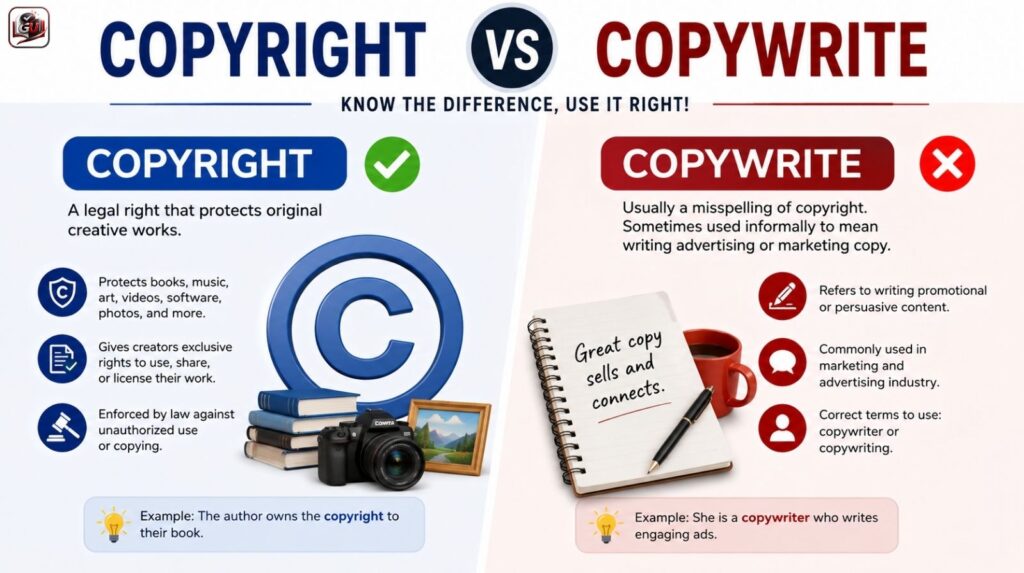
Copyright is a legal right that protects original works like books, music, software, videos, and artwork. Copywrite is usually a misspelling of copyright, although it may occasionally refer to writing marketing copy in informal industry usage.
What Does Copyright Mean?
Copyright is a legal concept that protects creators of original works. It gives creators exclusive rights to reproduce, distribute, display, perform, or license their work.
Copyright applies to many forms of creative content, including:
- Books
- Blog articles
- Songs
- Movies
- Paintings
- Software
- Photography
- Digital artwork
- Online courses
- Podcasts
Once an original work is created and fixed in a tangible form, copyright protection generally begins automatically in many countries.
Why Copyright Matters
Copyright helps creators:
- Protect their intellectual property
- Prevent unauthorized copying
- Earn income through licensing
- Control how their work is distributed
- Take legal action against infringement
Examples
Correct:
- The photographer owns the copyright to every image.
- Authors automatically receive copyright protection for original books.
- Our company registered the copyright for the software.
Incorrect:
- The company owns the copywrite.
What Does Copywrite Mean?
This is where confusion begins.
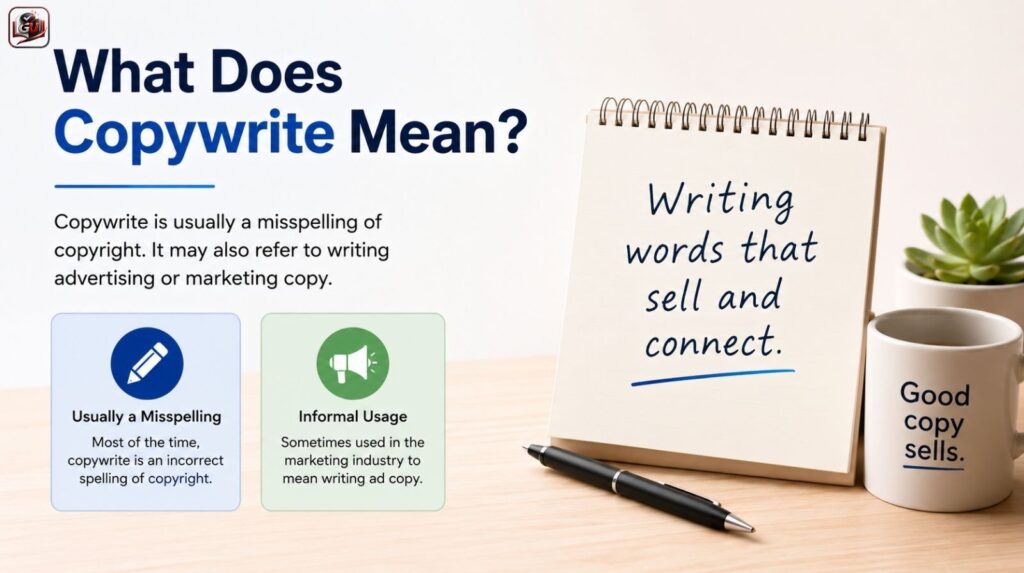
In most situations, copywrite is simply a spelling mistake.
People accidentally replace right with write because both words sound the same.
However, there is one limited exception.
Some advertising professionals occasionally use copywrite informally to describe the act of writing advertising copy.
For example:
- She copywrites sales emails.
- He copywrites landing pages.
Even so, professional writers almost always use:
- copywriter
- copywriting
- write copy
instead of the verb copywrite.
Why It’s Usually Wrong
If you’re discussing:
- legal ownership
- intellectual property
- publishing
- books
- music
- software
- photography
the correct word is always copyright.
Copyright vs Copywrite: Side-by-Side Comparison
| Feature | Copyright | Copywrite |
|---|---|---|
| Part of Speech | Noun | Rare verb / common misspelling |
| Related To | Intellectual property law | Marketing copy |
| Common Usage | Very common | Extremely rare |
| Appears in Legal Documents | Yes | No |
| Used by Government Agencies | Yes | No |
| Often Misspelled As | Copywrite |
Why Do People Confuse Copyright and Copywrite?
Several reasons explain this common mistake.
They Sound Exactly Alike
English contains many homophones.
Examples include:
- Their vs There
- Brake vs Break
- Right vs Write
Since right and write share the same pronunciation, people naturally confuse them.
Autocorrect Doesn’t Always Help
Some spell checkers don’t flag “copywrite” because it resembles real words like:
- copywriter
- copywriting
As a result, the typo often goes unnoticed.
Marketing Vocabulary Adds Confusion
People familiar with:
- copywriter
- copywriting
- advertising copy
sometimes mistakenly believe copywrite is the legal term.
It isn’t.
Common Mistakes to Avoid
Many beginners accidentally make these errors.
Mistake #1: Using Copywrite in Legal Writing
❌ The company owns the copywrite.
✅ The company owns the copyright.
Mistake #2: Confusing Copywriting with Copyright
Copywriting means writing persuasive marketing content.
Copyright protects original creative works.
These are unrelated concepts.
Mistake #3: Assuming Copyright Requires Registration
Many people believe copyright only exists after registration.
In reality, copyright protection is automatic in many countries once an original work is created. Registration may provide additional legal benefits, but it is not always required for protection.
Real-Life Example: A Small Business Learned the Difference
Imagine a freelance graphic designer named Sarah who created a unique logo for a local café. After completing the project, she proudly added the design to her online portfolio. A few months later, she discovered another business using an almost identical version of her logo without permission.
While preparing to contact the business owner, Sarah wrote, “I own the copywrite to this logo.” Her attorney quickly corrected the wording to “I own the copyright to this logo,” explaining that the legal protection comes from copyright law not the term “copywrite.”
Because Sarah had clear records showing when she created the logo and her agreement with the client, she was able to demonstrate ownership of the original work. The issue was resolved through a formal request, and the unauthorized business removed the copied design.
This situation highlights an important lesson: understanding the correct legal term isn’t just about spelling. Using the proper language helps you communicate clearly with clients, legal professionals, and licensing organizations while protecting your creative work.
Copyright in the Digital Age
As more content is published online, copyright has become increasingly important. Blog posts, YouTube videos, podcasts, digital illustrations, online courses, and software are all examples of works that may receive copyright protection.
Creators should remember that simply finding content on the internet does not mean it is free to copy or reuse. Respecting copyright helps support original creators and reduces the risk of legal disputes.
Best Practices for Content Creators
- Create original work whenever possible.
- Credit sources appropriately when required.
- Use licensed images, music, and graphics.
- Understand fair use limitations before reusing content.
- Keep records of your original creations.
Data & Statistics (2025–2026)
The importance of understanding copyright continues to grow as digital publishing expands.
- Millions of new websites and blog posts are published every year, increasing the need for proper copyright awareness.
- Searches for “copyright infringement” and related legal topics remain consistently high, reflecting growing concern among creators and businesses.
- AI-generated and user-generated content have prompted governments and organizations worldwide to update copyright guidance between 2025 and 2026.
- Digital creators, educators, software developers, and online businesses now place greater emphasis on protecting intellectual property than ever before.
These trends show why knowing the correct term copyright, not copywrite is increasingly important in today’s digital environment.
How to Remember the Correct Spelling
A simple memory trick can help you avoid this mistake forever.
Think about the purpose of each word:
- Copyright = Right to protect creative work.
- Write = Writing words or content.
If you’re talking about legal ownership, choose copyright.
If you’re talking about creating marketing content, use copywriting or copywriter not copywrite.
FAQs
Q. Is copywrite ever correct?
A: In most cases, no. It is usually a misspelling of copyright. Some people use it informally as a verb related to writing advertising copy, but this usage is uncommon.
Q. Which spelling should I use in legal documents?
A: Always use copyright when referring to intellectual property rights.
Q. Is copyright automatic?
A: In many countries, copyright protection begins automatically when an original work is created and fixed in a tangible form. Registration may provide additional legal advantages depending on local laws.
Q. What’s the difference between copywriting and copyright?
A: Copywriting is the process of writing persuasive marketing or advertising content. Copyright is the legal protection granted to original creative works.
Q. Why do spell checkers sometimes miss “copywrite”?
A: Because “copywrite” resembles legitimate words such as “copywriter” and “copywriting,” some spelling tools may not flag it as an error.
Q. Can I copyright my blog posts?
A: Yes. Original blog posts are generally protected by copyright as soon as they are created, although the exact legal rules vary by jurisdiction.
Conclusion
Understanding the difference between copyright vs copywrite is essential for writers, students, business owners, marketers, and content creators. Although the two words sound identical, they refer to entirely different concepts.
Copyright is the legal protection granted to original creative works, while copywrite is usually a spelling mistake and should rarely be used. Remember that legal rights involve “right,” not “write.”
Whether you’re publishing articles, creating videos, designing graphics, or writing software, using the correct terminology helps you communicate professionally and protects your credibility. Before publishing your next project, double-check that you’ve written copyright whenever you’re referring to intellectual property rights.
👉Keep learning with more easy grammar lessons on GrammerUpdate.com

Noor Fatima is a professional blogger specializing in spelling correction and grammar guidance. She creates clear, practical content to help readers avoid common mistakes, strengthen writing skills, and communicate with confidence in everyday and professional settings.