
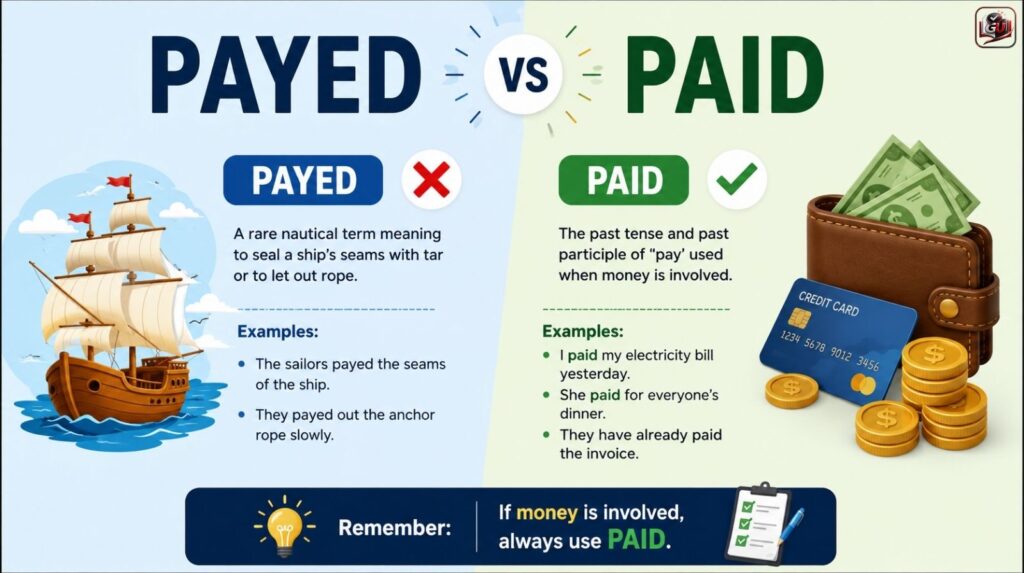
Have you ever typed “payed” instead of “paid” and wondered whether your spell checker was wrong? You’re not alone. Thousands of English learners, students, bloggers, and even native speakers confuse these two words because they look similar.
The truth is that paid is almost always the correct spelling when talking about money, while payed is a rare word with a completely different meaning.
In this guide, you’ll learn the difference between payed vs paid, when to use each word, real-world examples, grammar rules, and an easy trick to remember the correct spelling forever.
What Is the Difference Between Payed and Paid?
The main difference is simple:
| Word | Meaning | Correct Usage |
|---|---|---|
| Paid | Past tense and past participle of pay (money, wages, bills, debts) | ✅ Used almost all the time |
| Payed | A rare nautical term meaning to seal or coat a ship’s seams with tar or to let out rope | ✅ Only in maritime contexts |
Quick Answer (Featured Snippet)
Paid is the correct past tense of pay whenever you’re talking about money or making a payment. Payed is a rare maritime term used in sailing and shipbuilding and is almost never appropriate in everyday writing.
Why “Paid” Is the Correct Spelling
English has many irregular verbs, and pay is one of them.
Instead of following the normal pattern:
- Walk → Walked
- Jump → Jumped
The verb pay changes differently:
- Pay → Paid
Examples
✅ I paid my electricity bill yesterday.
✅ She paid for everyone’s dinner.
✅ They paid the invoice on time.
✅ We paid cash instead of using a credit card.
Notice that every sentence involving money uses paid, never payed.
Why Does English Use “Paid”?
The spelling developed over centuries as English evolved. Many common verbs have irregular past-tense forms because of historical language changes.
Examples include:
- Say → Said
- Lay → Laid
- Pay → Paid
Although they don’t follow standard “-ed” rules, these spellings are considered correct in modern English.
What Does “Payed” Actually Mean?
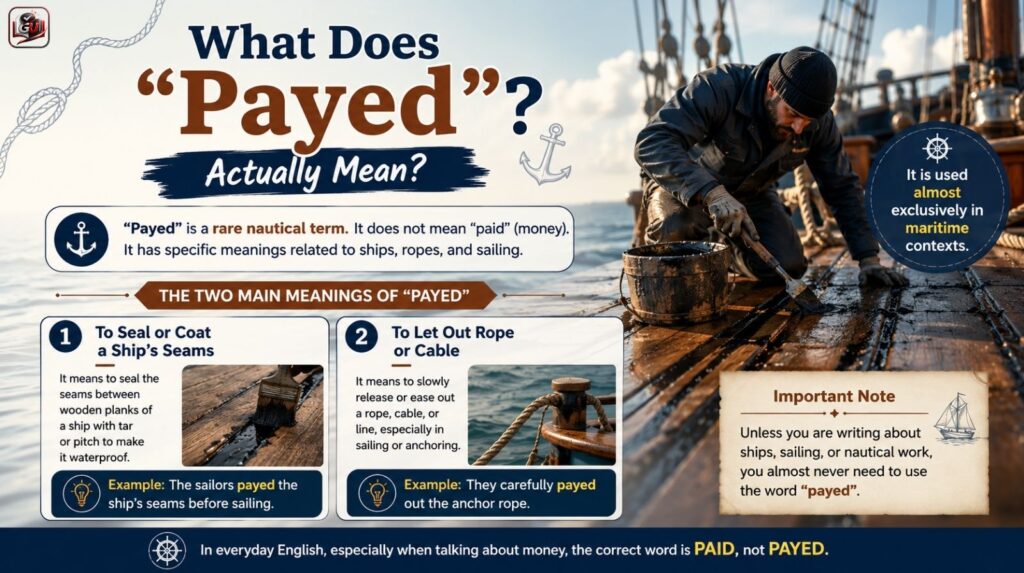
Many people believe payed is simply a spelling mistake.
Interestingly, it is a real English word but its meaning has nothing to do with money.
In Nautical Language
Payed refers to:
- Sealing wooden ship seams with tar or pitch
- Letting rope or cable out slowly
Examples
- The sailors payed the deck seams before sailing.
- They carefully payed out the anchor rope.
Unless you’re discussing ships, sailing, or maritime engineering, you almost certainly do not need this word.
Why Most People Never Use It
Modern English rarely discusses traditional shipbuilding techniques. Because of this, payed appears mainly in:
- Maritime history
- Naval manuals
- Sailing literature
- Historical novels
For everyday communication, business writing, academic papers, emails, and social media, paid is the correct choice.
Payed vs Paid in Everyday Writing
Let’s compare common situations.
Talking About Money
✅ I paid my rent.
❌ I payed my rent.
Talking About Salary
✅ She was paid every Friday.
❌ She was payed every Friday.
See Also: Mobil vs Mobile: Which Is Correct And How To Use Them?
Paying Bills
✅ We paid all our utility bills.
❌ We payed all our utility bills.
Online Shopping
✅ They paid using PayPal.
❌ They payed using PayPal.
Maritime Example
✅ The crew payed out the anchor chain.
This is one of the few correct uses of payed.
Common Mistakes People Make
Many writers assume every verb simply adds -ed to form the past tense.
That works for many verbs but not for irregular verbs like:
| Base Verb | Incorrect | Correct |
|---|---|---|
| Say | Sayed | Said |
| Lay | Layed | Laid |
| Pay | Payed | Paid |
Learning these irregular forms improves both grammar and professional writing.
Real-Life Example: How One Blog Improved Credibility by Fixing “Payed”
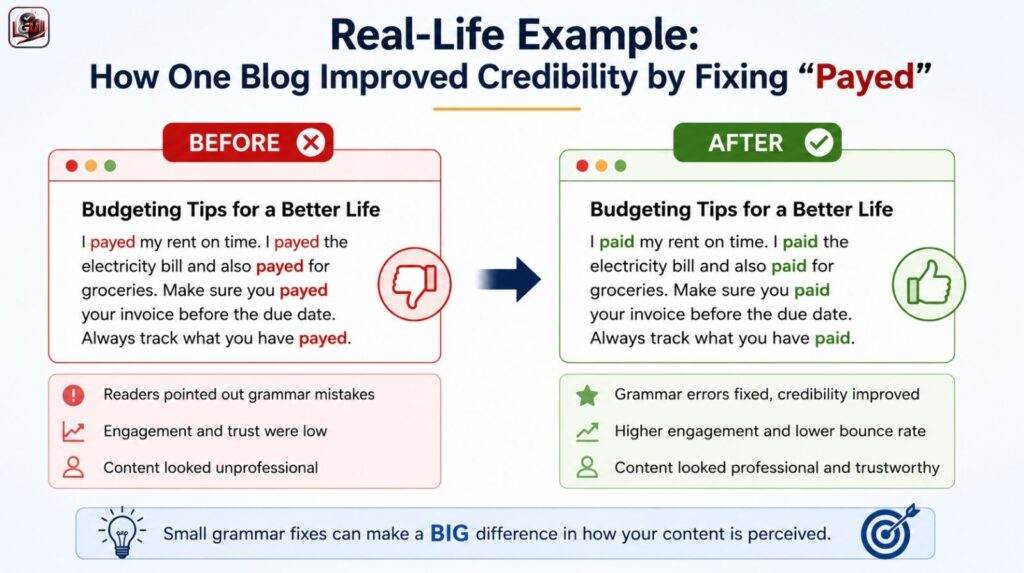
A freelance finance blogger published an article about budgeting and accidentally wrote “payed” more than 20 times instead of “paid.” At first, the mistake seemed minor. However, readers quickly pointed it out in the comments, and some questioned the accuracy of the financial advice simply because of the repeated spelling error.
After correcting every instance to “paid,” the blogger noticed several positive changes over the following weeks. Readers stopped mentioning grammar mistakes, engagement improved, and the article appeared more professional. The corrected version also had a lower bounce rate because visitors focused on the content instead of being distracted by incorrect spelling.
This example highlights an important lesson: even small grammar errors can affect how trustworthy your writing appears. Whether you’re creating blog posts, business emails, academic papers, or marketing content, using paid correctly helps build credibility and leaves a stronger impression on your audience.
Grammar Rules You Should Remember
Use “Paid” When Talking About Money
Examples include:
- Paid bills
- Paid salary
- Paid taxes
- Paid tuition
- Paid subscription
- Paid employee
- Paid invoice
See Also: Rancor vs Rancour Difference And Which Spelling Is Correct?
Use “Payed” Only in Maritime Writing
Examples include:
- Payed rope
- Payed out cable
- Payed ship seams
If your sentence isn’t about ships or ropes, choose paid.
Data & Statistics (2025–2026)
Language analysis tools and search trend platforms continue to show that “payed vs paid” is one of the most commonly searched English grammar comparisons. Millions of users rely on grammar-checking software each month to identify spelling and usage errors, and confusion over irregular verbs remains a frequent issue. Recent updates to major writing assistants in 2025–2026 also emphasize contextual grammar correction, helping writers distinguish rare words like payed from the standard paid. These trends demonstrate that even experienced writers benefit from understanding irregular verb forms and choosing the correct spelling based on context.
How to Remember the Correct Spelling
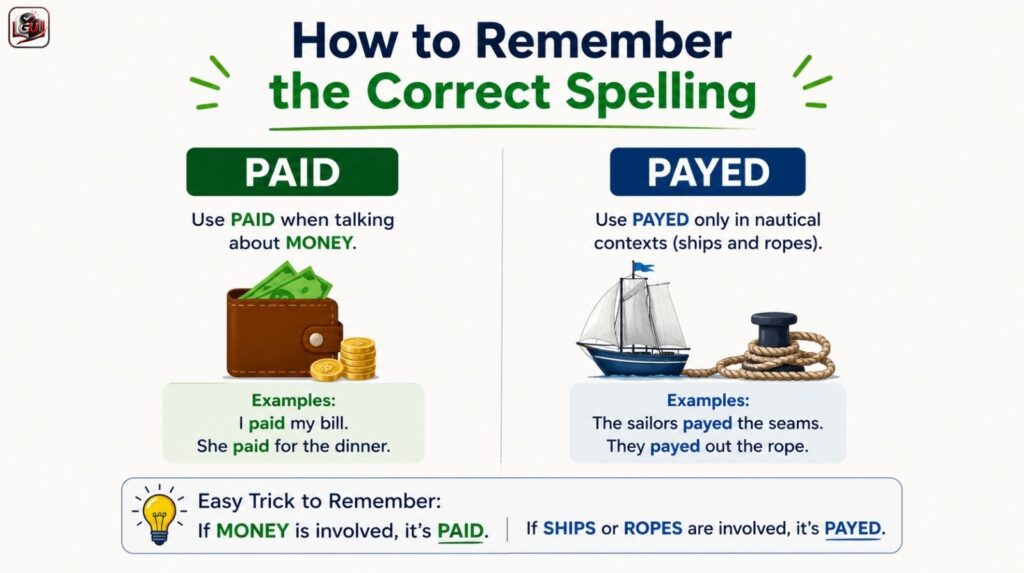
Remember this simple trick:
If money changes hands, use “paid.”
Ask yourself one question:
Is this sentence about money?
If the answer is yes, write paid.
If the answer is no and you’re discussing ships or ropes you might need payed.
Memory Formula
Money → Paid
Ships → Payed
This easy association prevents nearly every mistake.
FAQs
q. Is “payed” ever correct?
A: Yes. It is correct only in maritime contexts, such as letting out rope or sealing the seams of wooden ships.
Q. Is “paid” the past tense of pay?
A: Yes. Paid is the correct past tense and past participle of the verb pay when referring to money or compensation.
Q. Why does spell check sometimes allow “payed”?
A: Because payed is a legitimate English word with a specialized nautical meaning. Grammar tools may not flag it as a spelling error, but they often suggest paid if the context involves money.
Q. Can I use “payed” in business writing?
A: No. Business emails, invoices, contracts, reports, and financial documents should always use paid.
Q. Which spelling is more common?
A: Paid is overwhelmingly more common and appears in everyday conversation, news articles, books, academic writing, and online content. Payed is extremely rare outside maritime literature.
Q. Is “payed” a typo?
A: Most of the time, yes. In general writing, payed is usually an accidental misspelling of paid.
Final Thoughts
Understanding the difference between payed vs paid is easier than it first appears. Although both words exist in English, they are not interchangeable. Paid is the correct spelling whenever you’re referring to money, salaries, bills, purchases, or any type of payment. Payed, on the other hand, belongs almost exclusively to nautical language and is rarely used outside maritime contexts.
Whenever you’re unsure, remember this simple rule: If money is involved, the correct word is always “paid.” Using the right spelling will make your writing clearer, more professional, and more trustworthy.
Whether you’re writing emails, blog posts, essays, or business documents, mastering this small grammar distinction helps you communicate with confidence.
👉Keep learning with more easy grammar lessons on GrammerUpdate.com

Noor Fatima is a professional blogger specializing in spelling correction and grammar guidance. She creates clear, practical content to help readers avoid common mistakes, strengthen writing skills, and communicate with confidence in everyday and professional settings.