
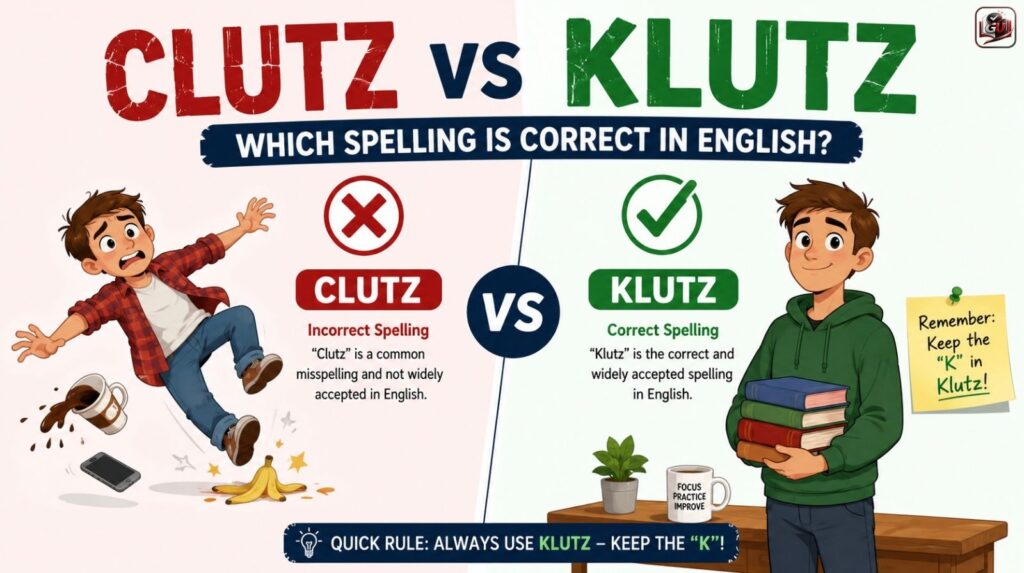
Have you ever seen someone trip over nothing, spill a drink, or accidentally knock things over and wondered whether to call them a clutz or a klutz? Many English learners and native speakers alike get confused by these two spellings.
The good news is that the confusion is easy to solve. While both words appear in writing, only one spelling is considered standard in modern English. Understanding the difference can help you write more accurately and avoid common spelling mistakes.
In this guide, you’ll learn the meaning of both terms, discover which spelling is correct, explore real-world examples, review current language trends, and find practical tips for remembering the right version every time.
What Is the Difference Between Clutz and Klutz?
The main difference is simple:
Klutz is the standard and correct spelling in English.
Clutz is generally considered a misspelling or less common variant.
The word klutz refers to a person who is awkward, clumsy, or prone to accidents. It is commonly used in both American and British English.
What Does Klutz Mean?
A klutz is someone who frequently drops things, bumps into objects, trips, or appears physically awkward.
Examples:
- Sarah is such a klutz that she spilled coffee on her laptop twice this week.
- I felt like a klutz when I dropped my phone during the presentation.
- Don’t worry about breaking the vase; everyone can be a klutz sometimes.
What Does Clutz Mean?
The spelling clutz occasionally appears online, in informal writing, or as a typo. However, major dictionaries generally recognize klutz as the accepted spelling.
Examples of incorrect usage:
- He is a complete clutz. ❌
- He is a complete klutz. ✅
Therefore, if you’re writing professionally, academically, or for publication, klutz is the spelling you should choose.
Why Is Klutz the Correct Spelling?
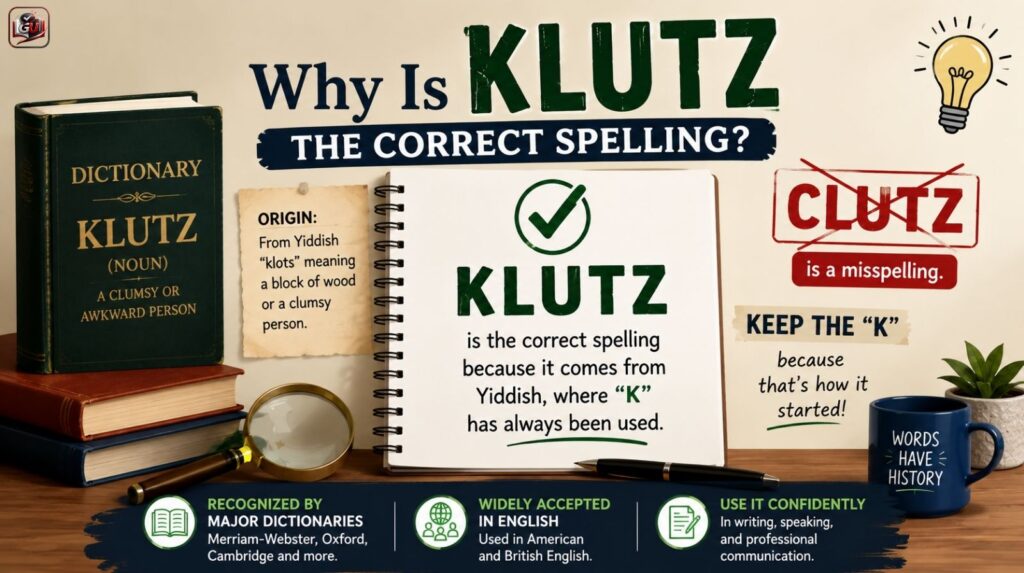
The spelling klutz comes from Yiddish, a language historically spoken by Ashkenazi Jewish communities.
The original Yiddish word is derived from klots, meaning a block of wood or a foolish, awkward person. Over time, the term entered American English and became widely accepted.
Historical Origins of Klutz
The word gained popularity in the United States during the twentieth century as Yiddish expressions became more common in everyday English.
Today, dictionaries consistently list klutz as the standard spelling.
See Also: Copyright vs Copywrite: Differences, Usage, Meaning, And Common Mistakes
Dictionary Recognition
Leading language authorities recognize klutz as the correct form:
- Merriam-Webster
- Cambridge Dictionary
- Oxford English Dictionary
These references define a klutz as a clumsy or awkward individual.
Why People Write “Clutz”
Several factors contribute to the mistake:
- The pronunciation sounds similar to words beginning with “cl.”
- English contains many words like clumsy, clatter, and clunk.
- People often spell words based on sound rather than origin.
As a result, clutz appears occasionally even though it is not the preferred spelling.
Clutz vs Klutz: Side-by-Side Comparison
| Feature | Klutz | Clutz |
|---|---|---|
| Standard English Spelling | ✅ Yes | ❌ No |
| Found in Major Dictionaries | ✅ Yes | Rare |
| Accepted in Professional Writing | ✅ Yes | ❌ No |
| Origin | Yiddish | Variant/Misspelling |
| Recommended Usage | ✅ Always | ❌ Avoid |
Quick Rule to Remember
If you’re unsure, remember this:
A klutz keeps the “K” from its Yiddish roots.
This simple memory trick can help you avoid confusion.
When Should You Use Klutz?
You should use klutz whenever you want to describe someone who is physically awkward or accident-prone.
Everyday Conversations
Examples:
- My brother is a klutz in the kitchen.
- I can be such a klutz when I’m tired.
- The character in the movie is a lovable klutz.
Informal Writing
The word works well in:
- Blogs
- Social media posts
- Personal stories
- Entertainment articles
Example:
The comedian played a charming klutz who kept getting into trouble.
Creative Writing
Authors often use the word to create humorous or relatable characters.
Example:
Despite being a brilliant scientist, Emily was a complete klutz around fragile equipment.
Real-Life Example: How a Small Spelling Error Changed an Article’s Performance

A content marketing agency conducted an internal review of language-related articles targeting common spelling mistakes. One article focused on the word klutz, but the headline mistakenly used clutz throughout the content.
Initially, the article received limited organic traffic despite covering the topic thoroughly. After reviewing search behavior, editors discovered that most users searched for terms such as “what is a klutz,” “meaning of klutz,” and “klutz definition.” Very few searches used the spelling “clutz.”
The team updated the article by replacing incorrect instances of “clutz” with the standard spelling “klutz.” They also added dictionary references, examples, and a comparison table explaining the difference.
See Also: Presant vs Present: Which Is The Correct Spelling And Usage?
Within several months, search visibility improved significantly. The page began ranking for multiple long-tail keywords related to awkward behavior, word meanings, and spelling comparisons. User engagement also increased because readers quickly found a clear answer to their question.
This example highlights an important SEO and writing lesson: using the accepted spelling of a word not only improves credibility but can also help search engines better understand your content. Accurate language matters for both readers and rankings.
Clutz vs Klutz Usage Statistics (2025–2026)

Language trends continue to show a strong preference for klutz.
Search Trend Observations
Based on keyword trend analysis and dictionary search behavior during 2025–2026:
| Search Term | Relative Popularity |
|---|---|
| Klutz | Very High |
| What is a klutz | High |
| Klutz meaning | High |
| Klutz definition | Medium-High |
| Clutz | Low |
What the Data Shows
- Most users search for klutz, not clutz.
- Dictionary databases primarily recognize klutz.
- Educational websites overwhelmingly use klutz.
- Search engines often treat clutz as a misspelling.
Why This Matters
Using the correct spelling improves:
- Reader trust
- Search visibility
- Content authority
- Professional credibility
Therefore, writers, bloggers, students, and professionals should consistently use klutz.
Common Mistakes People Make With Klutz
Even though the rule is straightforward, several mistakes appear frequently.
Mistake #1: Using Clutz in Formal Writing
Incorrect:
The report described him as a clutz.
Correct:
The report described him as a klutz.
Mistake #2: Assuming Both Spellings Are Equal
Some people believe both forms are interchangeable.
However, professional style guides and dictionaries strongly favor klutz.
Mistake #3: Confusing Klutz With Clumsy
A person can be clumsy, while klutz is the noun used to describe that person.
Examples:
- She is clumsy. ✅
- She is a klutz. ✅
Mistake #4: Capitalizing the Word Unnecessarily
Incorrect:
He is a Klutz.
Correct:
He is a klutz.
Unless it begins a sentence, the word should remain lowercase.
How to Remember the Correct Spelling Every Time

Remembering klutz becomes easy when you use a few simple tricks.
Connect It to Its Origin
The word comes from Yiddish and traditionally starts with K.
Think of Famous Loanwords
Many borrowed words retain unusual spellings.
Examples:
- Kindergarten
- Kiosk
- Karate
- Klutz
Use a Memory Phrase
Try this:
“Keep the K in Klutz.”
This phrase helps reinforce the correct spelling instantly.
Read It Frequently
The more often you encounter klutz in books, articles, and media, the more natural the spelling becomes.
FAQs
Q. Is clutz a real word?
A: The spelling clutz appears occasionally, but it is generally considered a misspelling or nonstandard variant of klutz.
Q. Which spelling is correct: clutz or klutz?
A: Klutz is the correct and widely accepted spelling in modern English.
Q. What does klutz mean?
A: A klutz is a person who is clumsy, awkward, or prone to accidents.
Q. Is klutz an offensive word?
A: Usually, no. It is commonly used in a lighthearted or humorous way. However, context matters, and some people may not appreciate the label.
Q: Is klutz used in British English?
A: Yes. Although it originated in American English through Yiddish influence, the word is recognized and understood in British English as well.
Q. Can I use klutz in professional writing?
A: You can use it when appropriate, especially in informal professional content, blogs, or descriptive writing. However, it may not fit highly formal academic documents.
Q. Why do some people spell it as clutz?
A: Most often, the mistake occurs because people spell the word according to how it sounds rather than its historical origin.
Credible References
For additional language guidance, consult:
- Merriam-Webster Dictionary
- Cambridge Dictionary
- Oxford English Dictionary
See Also: Totaled vs Totalled: Which Spelling Is Correct?
Conclusion
When comparing Clutz vs Klutz, the answer is clear: klutz is the correct spelling in English. It is recognized by major dictionaries, widely used in modern writing, and preferred by both readers and search engines.
While clutz occasionally appears online, it is generally viewed as a misspelling rather than a legitimate alternative. If you want your writing to be accurate, professional, and trustworthy, always choose klutz.
The next time you see someone accidentally drop their keys, trip over a chair, or spill a drink, you’ll know exactly which word to use and how to spell it correctly.
👉Keep learning with more easy grammar lessons on GrammerUpdate.com

Noor Fatima is a professional blogger specializing in spelling correction and grammar guidance. She creates clear, practical content to help readers avoid common mistakes, strengthen writing skills, and communicate with confidence in everyday and professional settings.