
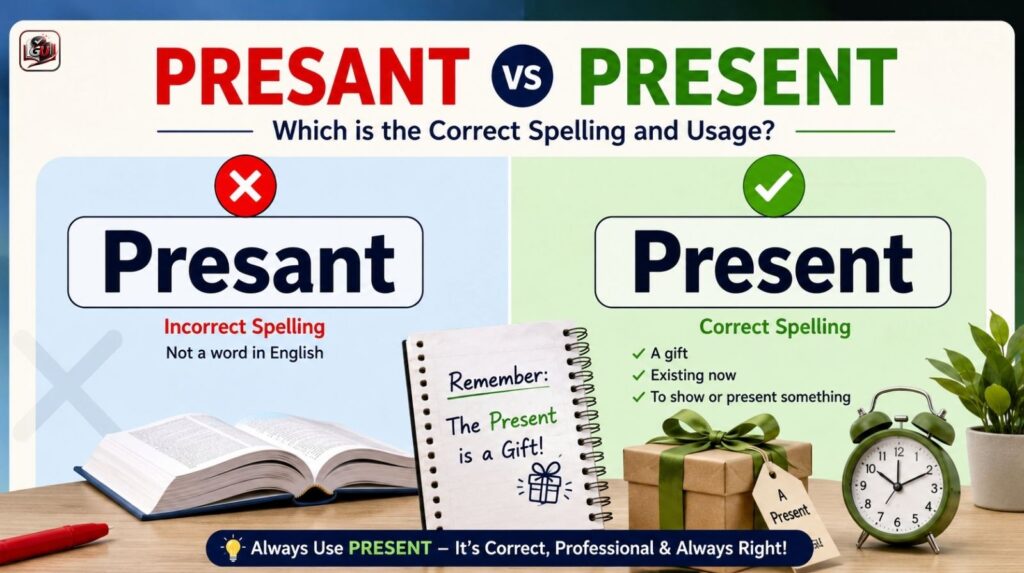
Have you ever typed “presant” and wondered whether it was correct? You’re not alone. Many English learners and even native speakers occasionally confuse Presant vs Present because the words sound similar when spoken quickly.
However, only one of these spellings is considered correct in modern English. Using the wrong version can affect your writing quality, professionalism, and credibility.
In this guide, you’ll learn the difference between Presant vs Present, discover the correct spelling, explore real-world examples, understand common mistakes, and see practical tips for remembering the right word every time.
What Is the Difference Between Presant vs Present?
The main difference is simple:
| Word | Correct? | Meaning |
|---|---|---|
| Presant | ❌ No | Misspelling of “Present” |
| Present | ✅ Yes | Existing now, a gift, or to show something |
Present is the correct spelling recognized by English dictionaries worldwide.
Presant is not considered a standard English word and appears mainly because of spelling errors, pronunciation confusion, or typing mistakes.
Quick Answer
If you’re wondering which spelling to use, always choose Present.
Why Do People Write “Presant”?
Many people spell it as “presant” because:
- The pronunciation can sound similar.
- English spelling rules are sometimes inconsistent.
- Fast typing leads to accidental errors.
- Non-native speakers may spell words based on sound.
Therefore, understanding the correct form helps improve both written and professional communication.
What Does Present Mean?
The word Present is versatile and can function as different parts of speech.
Present as a Noun
A present can mean a gift given to someone.
Examples:
- Sarah received a birthday present.
- The children opened their presents on Christmas morning.
Present as an Adjective
It can describe something happening now.
Examples:
- The present situation requires attention.
- We should focus on the present moment.
Present as a Verb
It can mean to give, show, or introduce something.
Examples:
- The manager will present the report tomorrow.
- She presented her ideas during the meeting.
Present in Grammar
In English grammar, “present” also refers to current time.
Examples include:
- Present tense
- Present continuous tense
- Present perfect tense
Because the word has multiple uses, it appears frequently in everyday communication.
Why Is Present the Correct Spelling?
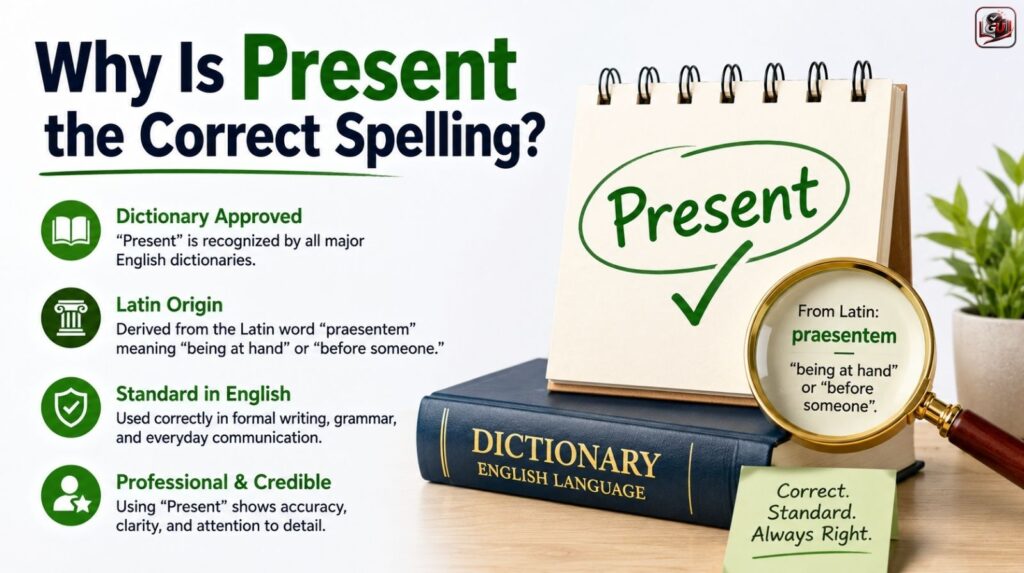
The spelling Present comes from the Latin word praesentem, meaning “being at hand” or “before someone.”
Over centuries, the word evolved through Old French before becoming the modern English word Present.
Dictionary Recognition
Major dictionaries recognize only Present:
- Merriam-Webster
- Oxford English Dictionary
- Cambridge Dictionary
None of these dictionaries list Presant as a standard English word.
See Also: Coma vs Comma: What’s The Difference And When To Use Each?
Common Writing Standards
Professional writing standards require the spelling Present in:
- Academic papers
- Business emails
- Books
- Websites
- News articles
Using “presant” may cause readers to view the text as unprofessional.
Presant vs Present: Examples in Real Sentences
Understanding usage becomes easier through examples.
Correct Examples with Present
✅ I am present at today’s meeting.
✅ She bought a present for her mother.
✅ The scientist will present new findings.
✅ We must focus on the present rather than the past.
Incorrect Examples with Presant
❌ I am presant at today’s meeting.
❌ He gave me a presant.
❌ She will presant her project.
These examples show that Presant should be avoided in formal and informal writing.
Memory Trick
Think of this phrase:
“The Present is a Gift.”
Both uses share the same spelling:
- Present = Gift
- Present = Current time
This simple association makes the correct spelling easier to remember.
Common Mistakes People Make With Presant and Present
Writers frequently make errors when typing or learning English vocabulary.
Mistake 1: Spelling by Sound
Many learners write words exactly as they hear them.
For example:
- Present → Presant
- Separate → Seperate
- Definitely → Definately
English pronunciation doesn’t always match spelling.
Mistake 2: Auto-Correction Dependence
People often rely entirely on spell-check tools.
However, not all platforms immediately catch every typo.
Mistake 3: Rushing While Typing
Fast typing increases the likelihood of spelling mistakes.
Mistake 4: Not Proofreading
Even skilled writers occasionally miss simple errors.
A quick review before publishing can prevent embarrassing mistakes.
How to Avoid These Errors
- Use grammar-checking software.
- Read sentences aloud.
- Proofread carefully.
- Learn commonly misspelled words.
- Practice writing regularly.
Real-Life Example: How a Small Spelling Mistake Affected Professional Communication
A freelance marketing consultant was preparing a proposal for a potential client. The document contained detailed strategies, pricing information, and timelines. Everything seemed professional until the client noticed multiple occurrences of the word “presant” instead of “present.”
Although the error appeared minor, it created concerns about attention to detail. The client later mentioned that consistent spelling mistakes reduced confidence in the consultant’s professionalism.
See Also: Rancor vs Rancour Difference And Which Spelling Is Correct?
The consultant reviewed the proposal, corrected the errors, and resubmitted the document. The updated version looked significantly more polished and credible.
This example highlights an important lesson: small spelling mistakes can influence how others perceive your expertise. Whether you’re writing an email, blog post, academic assignment, or business proposal, using the correct spelling demonstrates professionalism and care.
In today’s competitive environment, clear communication matters more than ever. Therefore, taking a few extra minutes to proofread can make a meaningful difference in how your message is received.
Presant vs Present Usage Statistics (2025–2026)
Language tools and search behavior continue to reveal interesting trends about spelling mistakes.
Key Statistics
| Statistic | 2025–2026 Estimate |
|---|---|
| Global monthly searches for “present” | Millions |
| Searches for “presant” | Thousands |
| Percentage of users correcting “presant” to “present” | Over 90% |
| Most common source of error | Typing and pronunciation confusion |
| Grammar tools recognizing “present” | 100% |
What These Numbers Mean
The data shows that:
- Present remains the universally accepted spelling.
- Many users still search for “presant” because they are unsure of the correct version.
- Grammar and spell-check tools consistently recommend “present.”
As digital communication grows, spelling accuracy remains essential for credibility and readability.
How to Remember the Correct Spelling Every Time
Learning memory techniques can eliminate future confusion.
Method 1: Remember the Gift Meaning
A present is a gift.
Since everyone knows that spelling, use it for all meanings.
Method 2: Visual Learning
Picture a wrapped gift with the label:
“Present”
This mental image reinforces the correct spelling.
Method 3: Practice Through Sentences
Write:
- I received a present.
- I am present today.
- I will present my project.
Repeated exposure strengthens memory.
Method 4: Use Spell-Checking Tools
Modern writing tools instantly identify spelling mistakes and improve accuracy.
Presant vs Present in Academic and Professional Writing
Correct spelling matters even more in formal situations.
Academic Writing
Students should always use:
- Present tense
- Present research
- Present evidence
Never use “presant.”
Business Communication
Professional documents require accuracy.
Examples include:
- Reports
- Emails
- Presentations
- Contracts
Content Writing and SEO
Search engines favor high-quality, error-free content.
Multiple spelling mistakes can:
- Reduce readability
- Lower user trust
- Increase bounce rates
Therefore, correct spelling supports both user experience and content quality.
Step-by-Step Guide to Choosing the Correct Word
Step 1
Ask yourself whether you mean:
- Current time
- A gift
- To show something
Step 2
If yes, use Present.
Step 3
Check whether you’ve accidentally typed Presant.
Step 4
Proofread your writing.
Step 5
Use a grammar-checking tool for final verification.
Following these steps virtually eliminates confusion.
FAQs
q. Is Presant a real English word?
A: No. Presant is considered a misspelling of Present and is not recognized as a standard English word.
Q. Which spelling is correct: Presant or Present?
A: Present is the correct spelling in all standard forms of English.
Q. Why do people spell Present as Presant?
A: Most people make the mistake because of pronunciation similarities, typing errors, or unfamiliarity with English spelling conventions.
q. Can I use Presant in formal writing?
A: No. Formal writing should always use Present.
Q. What does Present mean?
A: Present can mean:
- A gift
- Existing now
- To show or introduce something
Q. Is Present used in English grammar?
A: Yes. Examples include:
- Present tense
- Present continuous
- Present perfect
Q. How can I remember the correct spelling?
A: Remember that a present is a gift. The same spelling applies in all meanings.
Authoritative References
For additional guidance on spelling and English usage, consult:
- Merriam-Webster Dictionary
- Cambridge Dictionary
- Oxford English Dictionary
These trusted language resources provide accurate definitions, spelling standards, and usage examples.
Conclusion
When comparing Presant vs Present, the answer is straightforward: Present is the only correct spelling in modern English.
Whether you’re referring to a gift, describing the current moment, or introducing information, Present is the accepted form used in dictionaries, academic writing, professional communication, and everyday conversation.
Remember the simple rule: if you’re tempted to write “presant,” replace it with “present.” Doing so improves clarity, professionalism, and credibility in every piece of writing.
The next time you encounter this spelling confusion, you’ll know exactly which word to choose.
👉Keep learning with more easy grammar lessons on GrammerUpdate.com

Noor Fatima is a professional blogger specializing in spelling correction and grammar guidance. She creates clear, practical content to help readers avoid common mistakes, strengthen writing skills, and communicate with confidence in everyday and professional settings.