
Have you ever paused while writing and wondered whether gray or grey is the correct spelling? You’re not alone. This is one of the most common spelling questions in English, especially for writers, students, bloggers, and professionals who want their content to look polished and accurate.
The confusion exists because both words refer to the same color, yet different English-speaking regions prefer different spellings. As a result, many people mistakenly believe one version is wrong.
In this guide, you’ll learn the difference between gray vs grey, where each spelling is used, why both are considered correct, and how to choose the right one for your audience. By the end, you’ll never second-guess this spelling choice again.
What Is the Difference Between Gray and Grey?
The short answer is simple:
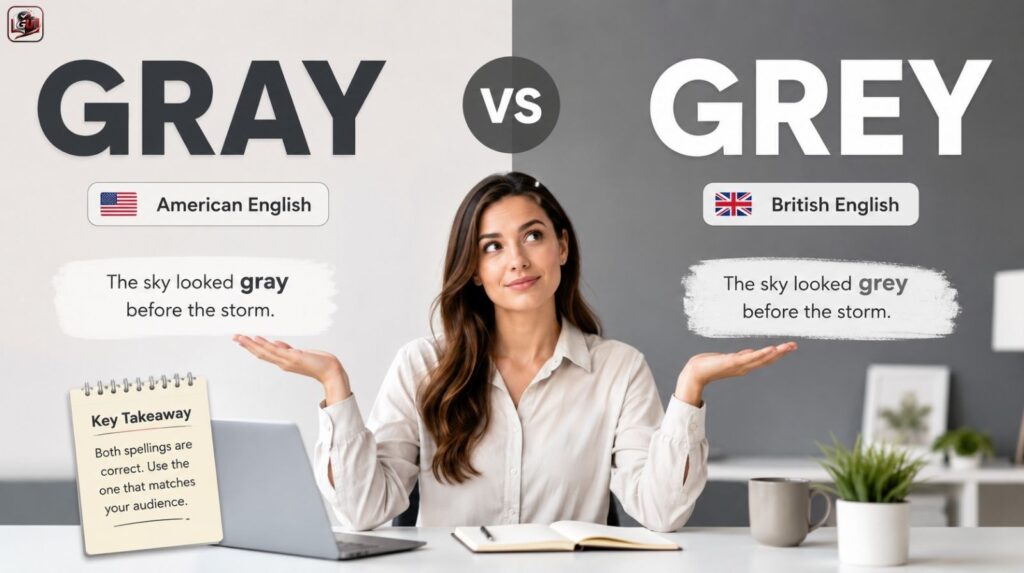
Gray and grey mean exactly the same thing. The only difference is regional spelling preference.
Both words describe the color between black and white on the color spectrum. Neither spelling changes the meaning of the word.
| Spelling | Common Usage |
|---|---|
| Gray | American English |
| Grey | British English, Canadian English, Australian English |
For example:
American English:
- The sky looked gray before the storm.
- She painted the room gray.
British English:
- The sky looked grey before the storm.
- She painted the room grey.
The meaning remains identical in every sentence.
Why Do Two Spellings Exist?
The existence of multiple spellings is common in English.
Many words evolved differently after British settlers established communities in North America. Over time, spelling conventions changed.
British English Preserved “Grey”
The spelling grey has been used in English for centuries and appears in many historical British texts.
Examples include:
- Grey clouds
- Grey stone buildings
- Grey hair
British dictionaries continue to list grey as the preferred spelling.
American English Adopted “Gray”
In the United States, spelling reforms promoted by lexicographer Noah Webster encouraged simpler and more standardized spellings.
As American English developed, gray became the dominant form.
Today, most American publications, schools, and style guides recommend gray.
Language Naturally Evolves
English constantly changes over time. Just as we see differences between:
- Color vs Colour
- Favor vs Favour
- Center vs Centre
We also see:
- Gray vs Grey
Both spellings remain accepted worldwide.
Gray vs Grey: Which Spelling Is Correct?
The Correct Answer
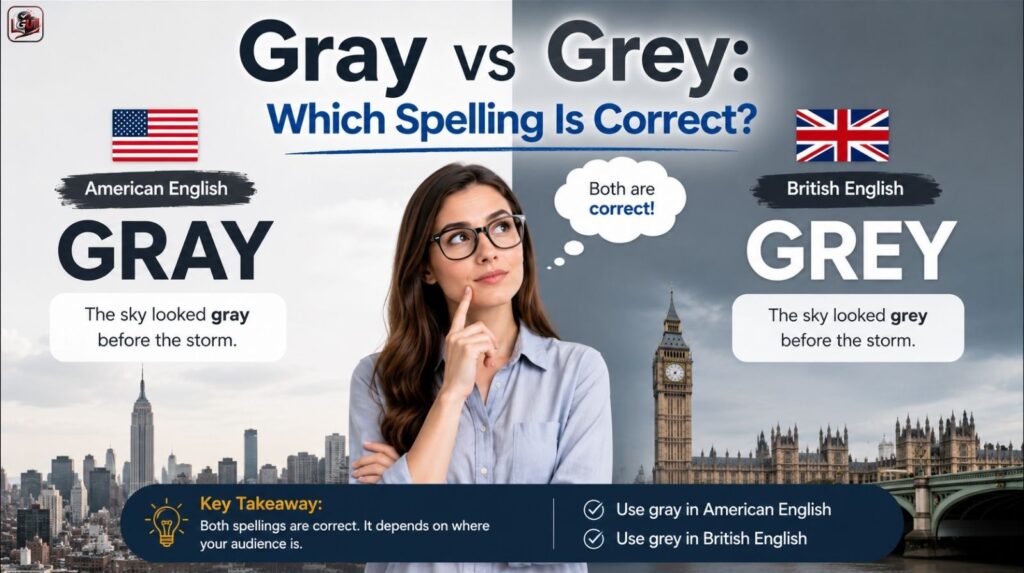
Both spellings are correct.
However, the preferred version depends on your audience.
Use “Gray” If You Write for Americans
American readers expect:
- Gray hair
- Gray skies
- Gray sweater
Using “gray” aligns with American spelling standards.
Use “Grey” If You Write for British Audiences
British readers expect:
- Grey hair
- Grey skies
- Grey jumper
Using “grey” feels more natural in British English.
Consistency Matters Most
The biggest mistake is mixing both spellings in the same document.
For example:
❌ The gray cat sat beside the grey wall.
Instead, choose one style and stick with it:
✅ The gray cat sat beside the gray wall.
OR
✅ The grey cat sat beside the grey wall.
How to Remember the Difference Between Gray and Grey
Many writers use simple memory tricks.
Memory Trick #1: A for America
The word gray contains the letter A.
Think:
A = America
Therefore:
- Gray = American English
See Also: Envolved vs Involved: Which Is Correct In English?
Memory Trick #2: E for England
The word grey contains the letter E.
Think:
E = England
Therefore:
- Grey = British English
Why This Trick Works
This simple association helps writers instantly identify which spelling fits their audience.
Many editors and teachers recommend this technique because it is easy to remember and rarely fails.
Gray vs Grey in Different Industries

Although the general rule is based on geography, certain industries have their own conventions.
Design and Graphic Design
Design software often follows American spelling.
You may see:
- Gray scale
- Gray background
- Gray gradient
Many digital design platforms default to American English terminology.
Fashion Industry
Fashion publications vary based on location.
Examples:
- Gray suit (United States)
- Grey suit (United Kingdom)
Science and Technology
Scientific journals generally use the spelling style required by their publication guidelines.
Therefore:
- American journals often use gray.
- British journals often use grey.
Branding Can Break the Rules
Some companies intentionally choose a spelling regardless of geography.
Brand names often prioritize marketing and uniqueness over language rules.
Real-Life Example: How Audience Location Affected Website Traffic
A digital marketing agency working with international clients noticed inconsistent engagement across different regions.
The company published blog posts using American English spelling, including the word “gray.” While traffic from the United States remained strong, user engagement from the United Kingdom and Australia was slightly lower than expected.
The content team decided to run an experiment.
For several months, they created localized versions of key articles. American visitors saw pages using “gray,” while British and Australian visitors saw versions using “grey.”
See Also: It’s Called vs It Called: Which Phrase Is Grammatically Correct?
The results were interesting.
Readers spent more time on localized content and showed improved trust in the information. Feedback surveys revealed that visitors felt the content was written specifically for them rather than copied from another region.
Although the spelling difference was small, it contributed to a better user experience.
This example highlights an important lesson for content creators:
Language preferences matter. Choosing the appropriate spelling for your target audience can improve readability, credibility, and engagement.
For bloggers, businesses, and SEO professionals, understanding regional spelling differences can help create content that feels more natural to readers.
Gray vs Grey Usage Statistics (2025–2026)
Recent language analysis tools and search trend data show clear regional preferences.
United States
The spelling gray overwhelmingly dominates online searches, educational materials, and media publications.
United Kingdom
The spelling grey remains the standard choice across newspapers, schools, and websites.
Global Usage Trends
English-speaking countries generally follow one of these patterns:
| Region | Preferred Spelling |
|---|---|
| United States | Gray |
| United Kingdom | Grey |
| Canada | Grey |
| Australia | Grey |
| New Zealand | Grey |
Language trend studies continue to show that regional spelling preferences remain strong despite increased globalization. Writers targeting international audiences should consider local expectations when publishing content.
Sources:
- Google Trends
- Merriam-Webster Dictionary
- Oxford English Dictionary
Common Mistakes People Make With Gray and Grey
Assuming One Spelling Is Wrong
Many people incorrectly think only one spelling is acceptable.
In reality:
✔ Gray is correct.
✔ Grey is correct.
Mixing Spellings in One Document
Switching between both spellings creates inconsistency.
Example:
❌ Gray walls with grey furniture.
Choose one version instead.
Ignoring Audience Preferences
A British audience expects “grey.”
An American audience expects “gray.”
Matching your audience improves professionalism.
Forgetting Style Guide Rules
Businesses, publishers, and universities often require specific spelling conventions.
Always follow the chosen style guide.
Gray vs Grey Comparison Table
| Feature | Gray | Grey |
|---|---|---|
| Meaning | Color between black and white | Color between black and white |
| Correct Spelling | Yes | Yes |
| American English | Preferred | Less common |
| British English | Less common | Preferred |
| Canadian English | Less common | Preferred |
| Australian English | Less common | Preferred |
| SEO Targeting US Audience | Recommended | Not ideal |
| SEO Targeting UK Audience | Not ideal | Recommended |
How to Choose the Right Spelling

Step 1: Identify Your Audience
Ask yourself:
Who will read this content?
Step 2: Check Regional Standards
Use:
- Gray for American readers
- Grey for British readers
Step 3: Follow Brand Guidelines
Many companies have established style guides.
Follow those guidelines consistently.
Step 4: Stay Consistent
Once you choose a spelling, use it throughout the entire document.
Consistency improves readability and professionalism.
FAQs
Q. Is gray or grey more correct?
A: Neither is more correct. Both spellings are accepted in English.
Q. Why do Americans use gray?
A: American English adopted “gray” as the standard spelling over time, particularly through dictionary standardization.
Q. Why do British people use grey?
A: British English retained “grey” as the preferred historical spelling.
Q. Do gray and grey mean different things?
A: No. Both words describe the same color.
Q. Is grey used in Canada?
A: Yes. Canadian English generally prefers “grey,” although “gray” also appears occasionally.
Q. Which spelling should I use for SEO?
A: Use the spelling your target audience searches most often. For U.S. audiences, use “gray.” For UK audiences, use “grey.”
Q. Can I use both spellings in one article?
A: It’s best not to. Consistency improves readability and professionalism.
Conclusion
When it comes to gray vs grey, the good news is that both spellings are correct. The difference isn’t about meaning it’s about location and language preference.
Use gray when writing for American audiences and grey when targeting readers in the United Kingdom, Canada, Australia, or other regions that follow British English conventions. Most importantly, stay consistent throughout your writing.
Whether you’re creating blog content, academic papers, marketing materials, or social media posts, understanding gray vs grey helps you communicate more effectively and build credibility with your audience.
The next time you see gray or grey, you’ll know exactly which spelling to choose.
👉Keep learning with more easy grammar lessons on GrammerUpdate.com

Noor Fatima is a professional blogger specializing in spelling correction and grammar guidance. She creates clear, practical content to help readers avoid common mistakes, strengthen writing skills, and communicate with confidence in everyday and professional settings.