
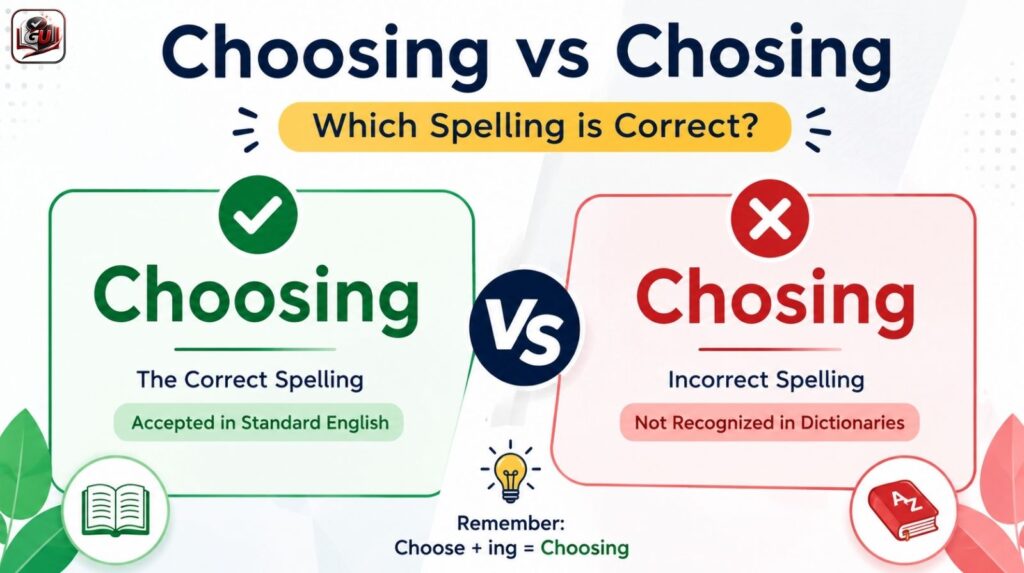
Have you ever paused while writing and wondered whether it should be Choosing or Chosing? You’re not alone. This is a common spelling mistake that many students, writers, bloggers, and English learners make because both words can look correct at first glance.
However, only one spelling is accepted in standard English. Understanding the difference is important because even small spelling errors can make your writing appear less professional and harder to trust.
In this guide, you’ll learn the correct spelling, why people often write Chosing instead of Choosing, and simple tricks to remember the right form. You’ll also see real examples that make it easy to use Choosing correctly in everyday writing.
What Is the Correct Spelling: Choosing or Chosing?
The correct spelling is Choosing.
❌ Chosing (Incorrect)
✅ Choosing (Correct)
The word choosing is the present participle and gerund form of the verb choose.
Why Is Choosing Correct?
The base verb is choose.
When adding -ing to verbs ending in -e, English grammar usually drops the final e before adding -ing.
Examples:
| Base Verb | Correct -ing Form |
|---|---|
| Make | Making |
| Write | Writing |
| Drive | Driving |
| Choose | Choosing |
Therefore:
Choose + ing = Choosing
Not Chosing.
Quick Answer
If you’re wondering which spelling to use, remember:
Choosing is always correct. Chosing is a spelling mistake.
Understanding the Meaning of Choosing
The word choosing refers to the act of selecting, deciding, or picking one option from several possibilities.
Definition of Choosing
Choosing (verb/gerund):
The process of making a decision between two or more options.
Examples in Sentences
- She is choosing a university for her master’s degree.
- We spent hours choosing the right color for the house.
- Choosing healthy foods can improve your overall well-being.
- He enjoys choosing books for his collection.
Everyday Uses of Choosing
The word appears frequently in:
- Academic writing
- Business communication
- Marketing content
- Online shopping
- Personal decision-making
Because the term is so common, spelling it correctly is important for professionalism and credibility.
Why Do People Write “Chosing” Instead of “Choosing”?
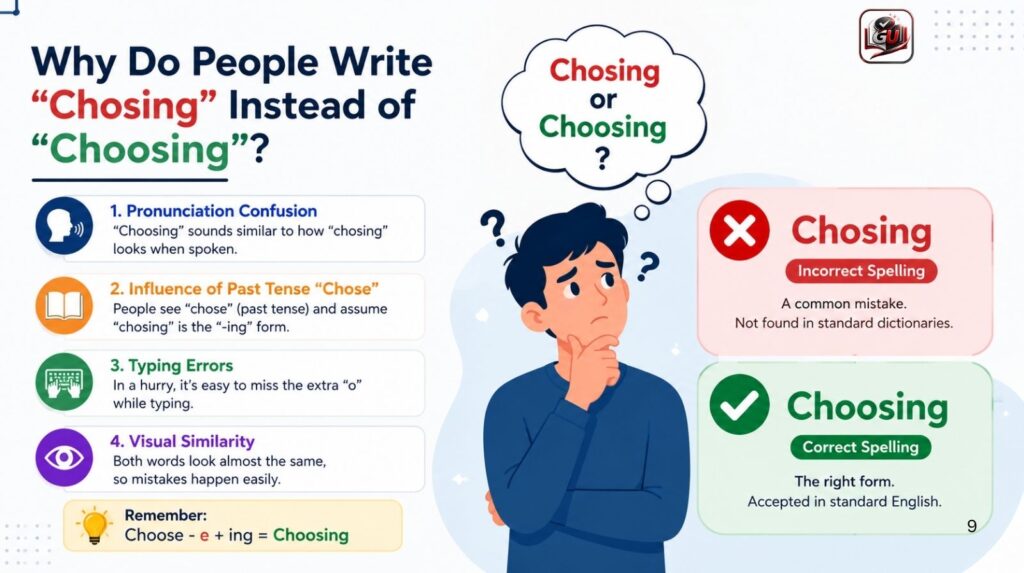
Misspellings often happen because English pronunciation does not always match spelling patterns.
The Pronunciation Confusion
When spoken, “choosing” sounds similar to how many people imagine “chosing” should be written.
This leads writers to accidentally omit the second o.
Influence of Past Tense Forms
Many people confuse:
- Choose
- Chose
- Choosing
Here’s the difference:
| Word | Meaning |
|---|---|
| Choose | Present tense |
| Chose | Past tense |
| Choosing | Present participle/Gerund |
Because chose contains only one “o” sound in spelling, writers sometimes incorrectly create chosing.
Fast Typing Errors
Another common cause is simple typing speed. Writers often skip letters accidentally when drafting emails, articles, or social media posts.
Spell-check tools usually catch the error, but not always.
Choosing vs Chosing: Key Differences
Understanding the distinction becomes easier when viewed side by side.
| Feature | Choosing | Chosing |
|---|---|---|
| Correct English spelling | ✅ Yes | ❌ No |
| Found in dictionaries | ✅ Yes | ❌ No |
| Accepted in formal writing | ✅ Yes | ❌ No |
| Derived from “choose” | ✅ Yes | ❌ Incorrect formation |
| Recommended for SEO content | ✅ Yes | ❌ No |
Which One Should You Use?
Always use Choosing.
Avoid using Chosing in:
- Blog posts
- Academic assignments
- Business documents
- Website content
- Professional emails
Using incorrect spellings may reduce reader trust and make content appear less polished.
How to Remember the Correct Spelling of Choosing
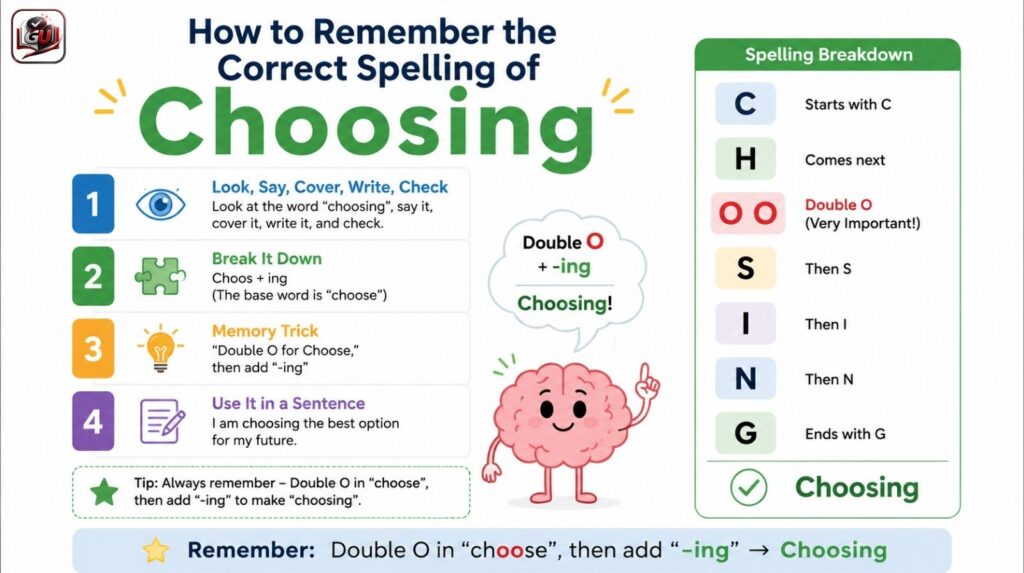
Many writers benefit from simple memory tricks.
Remember the Root Word
Start with:
Choose
Notice there are already two “o” letters.
When adding -ing, only the final e disappears.
Choose → Choosing
The double “o” stays.
Use This Simple Formula
Choose – e + ing = Choosing
This rule works every time.
Think About Similar Words
Consider these examples:
- Move → Moving
- Drive → Driving
- Write → Writing
- Choose → Choosing
The pattern remains consistent.
Read It Out Loud
Mentally picture the original word choose whenever you write choosing.
This helps prevent accidentally writing chosing.
Real-Life Example: How a Small Spelling Mistake Affected Website Performance
A content marketing agency conducted an internal review of several educational articles published on its blog. The team discovered that one article targeting a spelling-related keyword consistently underperformed compared to similar content.
After reviewing the page, editors found multiple instances where the word choosing had been mistakenly written as chosing. Although readers could still understand the intended meaning, the repeated error created several problems.
First, users began leaving comments pointing out the spelling mistake. This reduced the article’s perceived credibility. Second, educational websites were less likely to link to the page because it appeared unprofessional. Third, search engines increasingly prioritize content quality and user experience. Pages containing obvious spelling mistakes can create a weaker impression of expertise and trustworthiness.
The team corrected the spelling, updated examples, and improved readability. Within the following months, engagement metrics improved noticeably. Readers spent more time on the page, and the content attracted additional backlinks from educational resources.
This example demonstrates how a seemingly minor spelling mistake can affect reader trust, content authority, and overall performance. Correct spelling is not just about grammar it also supports professionalism and user confidence.
Why Correct Spelling Matters for SEO and Online Writing
Search engines have become increasingly sophisticated in evaluating content quality.
User Experience Signals
Readers expect professionally written content.
When users notice spelling mistakes, they may:
- Leave the page quickly
- Question the author’s expertise
- Avoid sharing the content
Content Credibility
Accurate spelling supports E-E-A-T principles:
- Experience
- Expertise
- Authoritativeness
- Trustworthiness
These qualities help establish confidence among readers and search engines.
2025–2026 Content Quality Trends
Recent guidance from search quality experts continues to emphasize helpful, reliable, and people-first content. High-quality websites focus on accuracy, readability, and trust signals rather than keyword stuffing. Research from industry leaders such as Google and HubSpot also highlights the importance of user experience and content quality in long-term SEO success.
External References
For further reading:
- Google Search Central: Content Quality Guidelines
- HubSpot Content Marketing Resources
- Grammarly Writing and Grammar Guides
These sources provide valuable insights into effective writing and content optimization practices.
Common Examples of Choosing in Everyday Writing
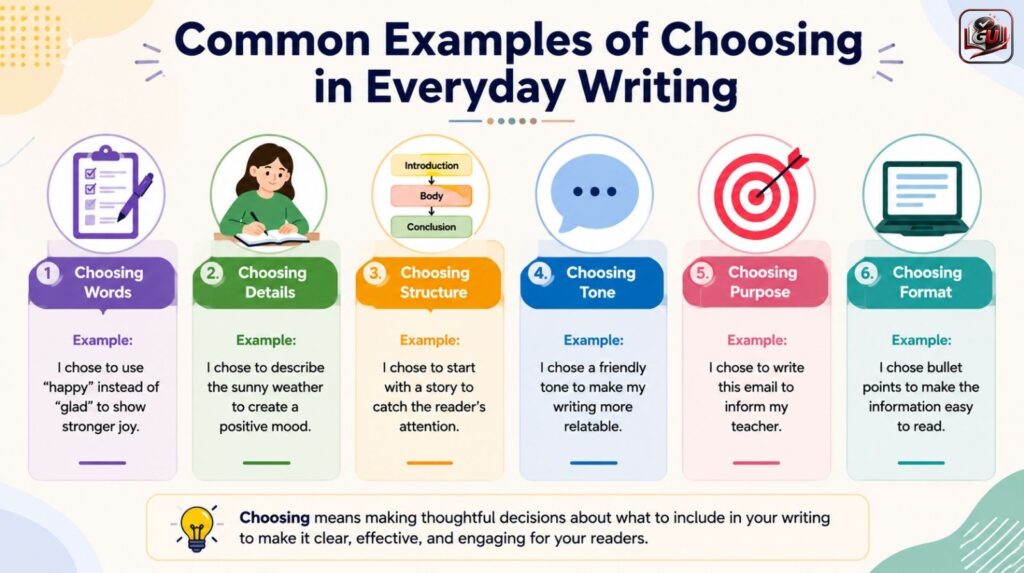
Below are practical examples showing correct usage.
Education
- Students are choosing courses for the next semester.
- She is choosing a research topic.
Business
- The company is choosing a new software provider.
- Managers are choosing candidates for interviews.
Personal Life
- We are choosing a destination for our vacation.
- He spent the afternoon choosing a birthday gift.
Digital Marketing
- Customers are choosing brands based on online reviews.
- Businesses are choosing SEO strategies carefully.
Notice that every example uses choosing, never chosing.
Step-by-Step Guide to Avoid the Chosing Mistake
Step 1: Identify the Base Verb
The original word is:
Choose
Step 2: Remove the Final E
Choose → Choos
Step 3: Add ING
Choos + ing
Step 4: Form the Correct Word
Choosing
Step 5: Proofread Before Publishing
Always run a spelling check before publishing:
- Blog posts
- Emails
- Academic papers
- Social media content
This simple process can eliminate many common writing errors.
FAQs
Q. Is Chosing a Real Word?
A: No. Chosing is not recognized as a standard English word. It is considered a spelling mistake.
Q. Why Do People Spell Choosing as Chosing?
A: Most errors occur because writers confuse choose, chose, and choosing, or accidentally omit one “o”.
Q. What Is the Difference Between Chose and Choosing?
A: Chose is the past tense of choose.
Example:
- She chose the blue dress.
Choosing refers to the ongoing act of selecting.
Example:
- She is choosing a blue dress.
Q. Is Choosing Grammatically Correct?
A: Yes. Choosing is the correct present participle and gerund form of choose.
Q. Can Using Chosing Hurt SEO?
A: Repeated spelling errors may reduce content quality, user trust, and overall credibility. Therefore, using the correct spelling is recommended.
Q. How Can I Remember the Correct Spelling?
A: Remember the root word choose. Keep both “o” letters and simply remove the final “e” before adding -ing.
Q. Is Choosing Used in Formal Writing?
A: Yes. It is widely used in academic, business, professional, and everyday writing.
Conclusion
When comparing Choosing vs Chosing, the answer is simple: Choosing is the correct spelling, while Chosing is incorrect.
The confusion often comes from mixing up choose, chose, and choosing, but the rule is straightforward. Start with choose, remove the final e, and add -ing to form choosing.
Whether you are writing blog posts, emails, academic papers, or website content, using the correct spelling improves professionalism, readability, and credibility. Most importantly, it helps readers focus on your message rather than your mistakes.
The next time you find yourself debating between Choosing and Chosing, remember: the correct choice is always Choosing.
👉Keep learning with more easy grammar lessons on GrammerUpdate.com

Noor Fatima is a professional blogger specializing in spelling correction and grammar guidance. She creates clear, practical content to help readers avoid common mistakes, strengthen writing skills, and communicate with confidence in everyday and professional settings.