
If you’ve ever paused while writing and wondered whether to use long term or long-term, you’re not alone.
Many writers, students, business professionals, and content creators frequently encounter this grammar question. At first glance, both versions seem correct. However, using the wrong form can make your writing look less polished and professional.
The good news is that the difference is actually simple once you understand the rule.
In this guide, you’ll learn exactly when to use long term, when to use long-term, why the hyphen matters, and how to avoid one of the most common English writing mistakes. By the end, you’ll be able to use both forms confidently in emails, articles, reports, academic papers, and everyday communication.
Quick Answer: Long Term vs Long-Term
Here’s the short answer:
| Usage | Correct Form | Example |
|---|---|---|
| As a compound adjective before a noun | Long-term | A long-term strategy |
| As a noun phrase or expression | Long term | In the long term, costs decrease |
| After the noun in many cases | Long term | The plan is long term |
Most modern dictionaries and style guides treat long-term as a hyphenated adjective and long term as a noun phrase. (Merriam-Webster)
What Does Long Term Mean?
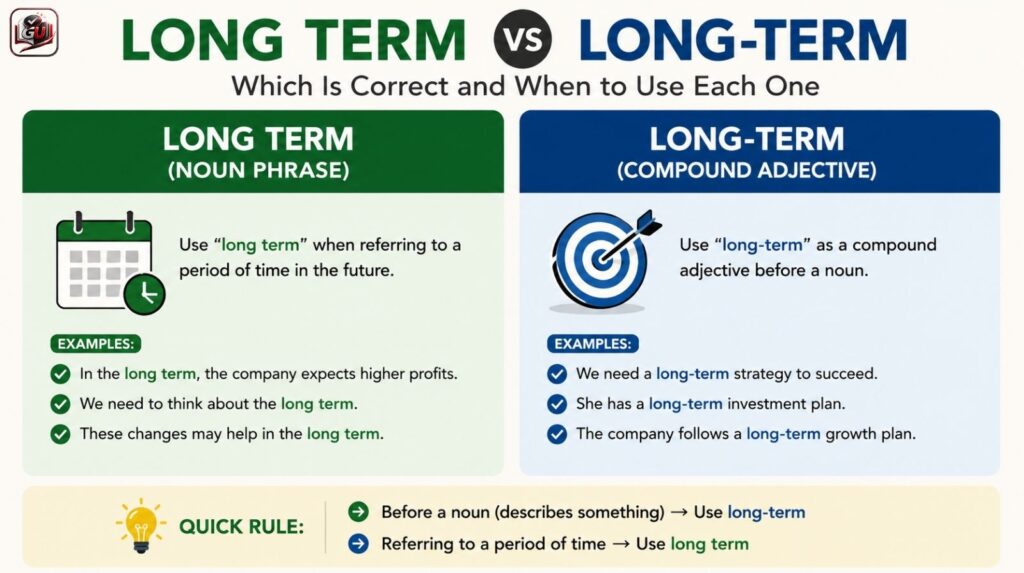
The phrase long term refers to an extended period of time in the future.
It functions primarily as a noun phrase and commonly appears in expressions such as:
- In the long term
- For the long term
- Over the long term
Examples of Long Term
- Investing for the long term usually reduces risk.
- The company is thinking about the long term.
- These changes may help in the long term.
In these examples, the phrase refers to a future period rather than describing another noun. That’s why no hyphen is needed.
Common Expressions Using Long Term
Some frequently used phrases include:
- In the long term
- For the long term
- Over the long term
- Thinking long term
These expressions are widely accepted in professional, academic, and everyday English.
What Does Long-Term Mean?
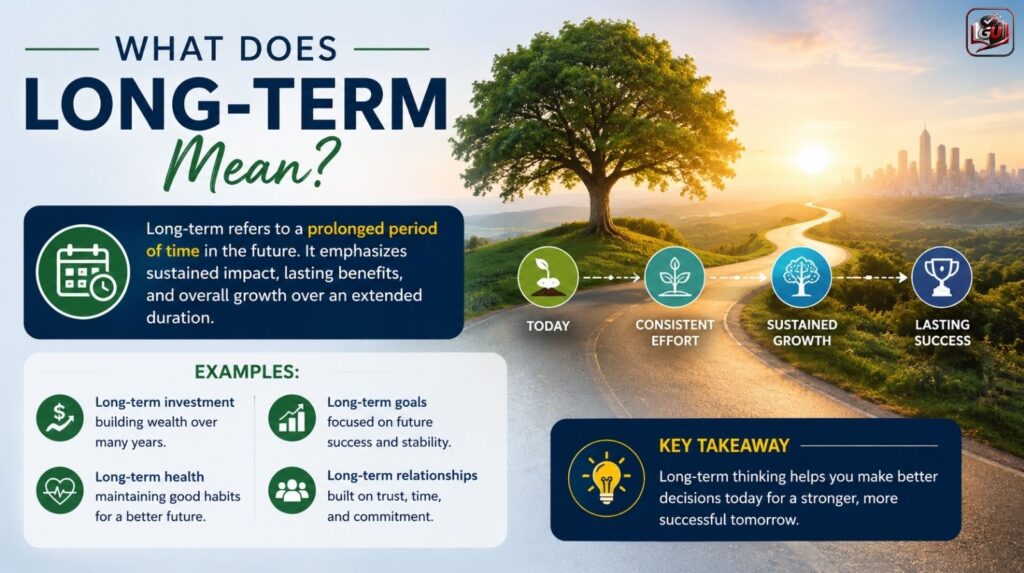
Long-term is a compound adjective.
A compound adjective occurs when two or more words work together to describe a noun. In English grammar, compound adjectives that appear before a noun are often hyphenated for clarity.
Examples of Long-Term
- We need a long-term solution.
- She has a long-term investment plan.
- The company follows a long-term growth strategy.
- Scientists are studying the long-term effects of the treatment.
In each example, “long-term” directly modifies a noun.
Why the Hyphen Matters
Consider these sentences:
- We need a long-term plan.
- We need a long term plan.
While readers may understand both, the hyphen clearly signals that “long-term” works as one adjective describing “plan.” Style guides generally recommend the hyphenated version in this situation. (Merriam-Webster)
The Grammar Rule Behind Long Term vs Long-Term
Understanding the grammar rule makes this topic much easier.
Use Long-Term Before a Noun
When the phrase modifies a noun directly, use a hyphen.
Examples:
- Long-term goals
- Long-term planning
- Long-term relationships
- Long-term care
- Long-term success
The hyphen helps readers recognize that the words function together as a single modifier. (Merriam-Webster)
Use Long Term as a Noun Phrase
When you’re referring to an extended future period, don’t use a hyphen.
Examples:
- Think about the long term.
- In the long term, profits may rise.
- The project is beneficial for the long term.
After the Noun
English style guides often remove hyphens when the compound adjective appears after the noun.
Examples:
- Their strategy is long term.
- The impact will be long term.
Although some publishers keep the hyphen for consistency, the open form is common in this position. (Merriam-Webster)
Real-Life Example: How a Marketing Team Fixed a Costly Writing Mistake
A mid-sized digital marketing agency was preparing a series of reports for a major client. The reports focused heavily on growth forecasting, investment planning, and customer retention strategies.
Throughout the documents, different team members used varying forms of the phrase. Some wrote “long term strategy,” others used “long-term strategy,” and a few switched between the two without any pattern.
During the client’s review process, the inconsistency was noticed by the company’s editorial department. While the mistake wasn’t severe enough to affect the project’s outcome, it raised concerns about attention to detail and editorial standards.
The agency decided to create an internal style guide. The rule was simple:
- Use long-term when describing a noun.
- Use long term when referring to a period of time.
After implementing the guideline, the company improved consistency across blog posts, white papers, case studies, and client reports.
The lesson is straightforward: grammar mistakes may seem minor, but consistent writing strengthens professionalism, credibility, and trust. In industries where communication matters, small details can influence how readers perceive expertise.
Long Term vs Long-Term Examples in Everyday Writing
Understanding real-world examples can help you remember the difference.
Business Writing
Correct:
- We need a long-term business strategy.
- The company focuses on the long term.
Academic Writing
Correct:
- Researchers examined the long-term effects of the medication.
- Results may become clearer in the long term.
Personal Finance
Correct:
- A long-term investment often outperforms short-term speculation.
- Retirement planning requires thinking about the long term.
Healthcare
Correct:
- Doctors continue monitoring long-term side effects.
- Patients benefit in the long term.
These examples reflect how the phrase appears in professional communication across multiple industries.
Common Mistakes People Make
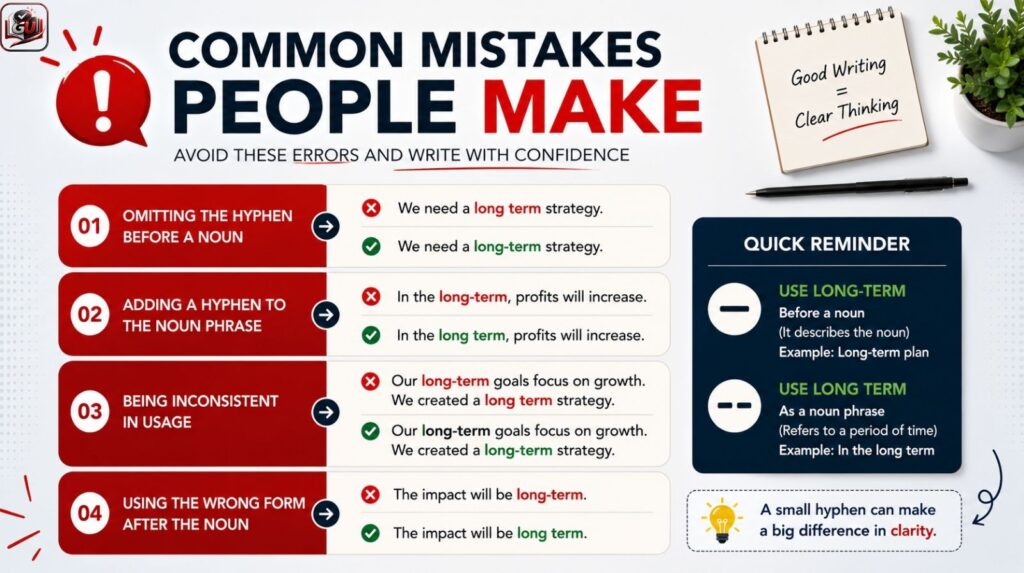
Many writers know the rule but still make errors because they write quickly.
Mistake #1: Omitting the Hyphen Before a Noun
Incorrect:
- We need a long term strategy.
Correct:
- We need a long-term strategy.
Mistake #2: Adding a Hyphen to the Noun Phrase
Incorrect:
- In the long-term, profits will increase.
Correct:
- In the long term, profits will increase.
Mistake #3: Being Inconsistent
Incorrect:
- Our long-term goals focus on growth.
- We created a long term strategy.
Correct:
- Our long-term goals focus on growth.
- We created a long-term strategy.
Consistency improves readability and professionalism.
2025–2026 Writing and Search Trends: Why Grammar Still Matters
Some writers assume grammar has become less important in the age of digital content. However, recent publishing and SEO trends suggest the opposite.
Google continues emphasizing helpful, trustworthy, and user-focused content through its search quality systems. Clear writing improves readability, user experience, and credibility three factors that contribute to content quality. (Reddit)
Professional publishers, educational institutions, and major brands still rely on established grammar standards because:
- Readers trust polished content more.
- Consistent formatting improves comprehension.
- Well-edited content reduces ambiguity.
- Strong writing supports authority and expertise.
For SEO professionals, grammar isn’t merely about correctness it helps create content that users find easier to understand and engage with.
How to Remember the Difference
If you struggle to remember the rule, use this simple trick.
Ask Yourself One Question
Is the phrase describing a noun?
If yes:
✅ Use long-term
Example:
- A long-term commitment
If no:
✅ Use long term
Example:
- Thinking about the long term
Memory Formula
Think:
“Before a noun = add the hyphen.”
Examples:
- Long-term goal
- Long-term plan
- Long-term success
But:
- In the long term
- For the long term
- Over the long term
This shortcut works almost every time.
Authoritative Grammar References
Major language authorities support the distinction between the two forms.
- Merriam-Webster Dictionary lists long-term as a hyphenated adjective. (Merriam-Webster)
- Britannica Dictionary distinguishes between long-term (adjective) and long term (noun). (Encyclopedia Britannica)
- Merriam-Webster Hyphenation Guide explains how compound modifiers are commonly hyphenated before nouns. (Merriam-Webster)
FAQs
Q. Is long-term always hyphenated?
A: No. It is typically hyphenated when used as a compound adjective before a noun, such as “long-term investment.”
Q. Is long term grammatically correct?
A: Yes. It is correct when used as a noun phrase, especially in expressions like “in the long term.”
Q. Which form is more common?
A: Both are common because they serve different grammatical purposes. The correct choice depends on context.
Q. Do style guides agree on this rule?
A: Most dictionaries and grammar references follow the distinction between the adjective form (long-term) and noun phrase (long term). (Merriam-Webster)
Q. Should I write long-term goals or long term goals?
A: Use long-term goals because the phrase modifies the noun “goals.”
Q. Is “in the long-term” correct?
A: Most style guides prefer in the long term without a hyphen.
Q. What about long-term planning?
A: “Long-term planning” is correct because “long-term” describes the noun “planning.”
Conclusion
So, Long Term vs Long-Term: Which Is Correct?
The answer is that both are correct, but they are used differently.
Use long-term when the phrase acts as an adjective before a noun:
- Long-term strategy
- Long-term investment
- Long-term success
Use long term when referring to an extended period of time:
- In the long term
- For the long term
- Thinking about the long term
Remember the simple rule: if it describes a noun, add the hyphen. If it refers to time itself, leave the hyphen out.
Mastering this distinction will make your writing clearer, more professional, and more grammatically accurate. The next time you encounter the phrase, you’ll know exactly which version belongs in your sentence.
👉Keep learning with more easy grammar lessons on GrammerUpdate.com

Noor Fatima is a professional blogger specializing in spelling correction and grammar guidance. She creates clear, practical content to help readers avoid common mistakes, strengthen writing skills, and communicate with confidence in everyday and professional settings.