
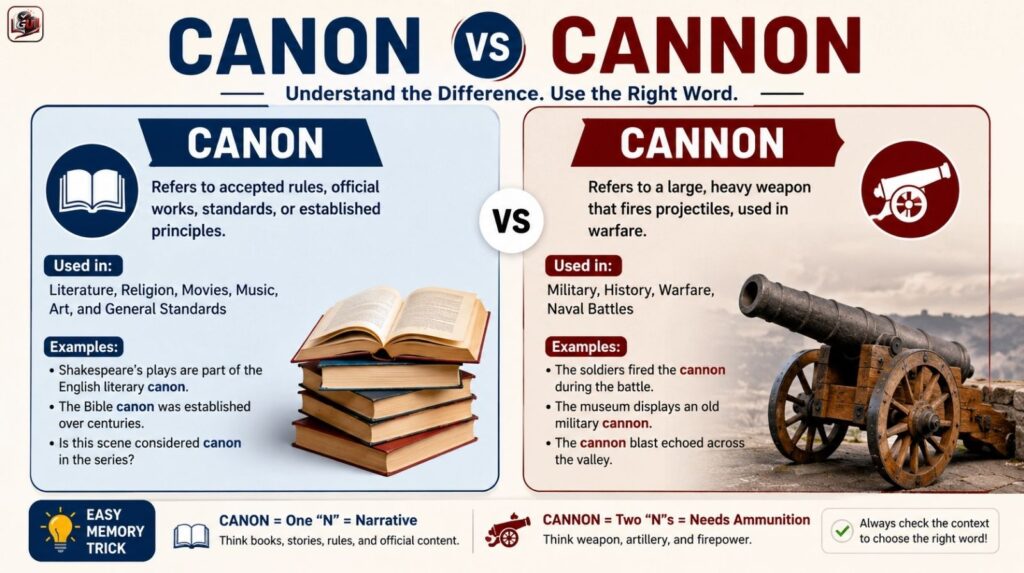
Have you ever seen the words canon and cannon and wondered whether they mean the same thing? Since they differ by only one letter, many writers accidentally confuse them. However, these words have completely different meanings and are used in very different contexts.
Understanding the difference between canon vs cannon is important for students, writers, bloggers, and anyone who wants to improve their English skills. Using the wrong word can change the meaning of a sentence and create confusion for readers.
In this guide, you’ll learn what each word means, when to use it, how to remember the difference, common mistakes to avoid, and real-world examples that make the distinction easy to understand.
What Is the Difference Between Canon and Cannon?
The simplest way to understand canon vs cannon is this:
| Word | Meaning | Example |
|---|---|---|
| Canon | A rule, accepted work, official collection, or established principle | The novel became part of the literary canon. |
| Cannon | A large gun used in warfare | The cannon fired across the battlefield. |
Quick Definition of Canon
Canon refers to a recognized standard, rule, or collection of important works. It is commonly used in literature, religion, music, and entertainment.
Example:
- Shakespeare’s plays are part of the English literary canon.
- The event is considered canon in the movie series.
Quick Definition of Cannon
Cannon is a large weapon that fires heavy projectiles. It has historically been used in military battles and naval warfare.
Example:
- Soldiers loaded the cannon before the attack.
- The museum displays a 19th-century cannon.
Featured Snippet Answer
Canon means an accepted rule, standard, or official collection of works, while cannon refers to a large artillery weapon used in warfare. Although the words sound similar, their meanings are completely different.
Understanding the Meaning of Canon
The word canon comes from ancient Greek and Latin roots meaning “rule” or “measuring rod.” Over time, it evolved into a term used to describe accepted standards or officially recognized works.
Canon in Literature
In literature, a canon refers to works considered important and influential.
Examples:
- Many universities teach books from the Western literary canon.
- Jane Austen’s novels belong to the English canon.
Canon in Religion
Religious canon refers to texts officially recognized as authentic and authoritative.
Examples:
- The Bible canon was established over centuries.
- Scholars debate the inclusion of certain books in the canon.
Canon in Movies and TV Shows
Modern entertainment frequently uses the term canon.
Examples:
- Fans asked whether the new storyline is canon.
- The director confirmed the episode is part of the official canon.
Canon in Music and Art
Canon can also describe established artistic standards or compositions.
For example, Johann Pachelbel’s famous composition is known as Canon in D Major.
Understanding the Meaning of Cannon
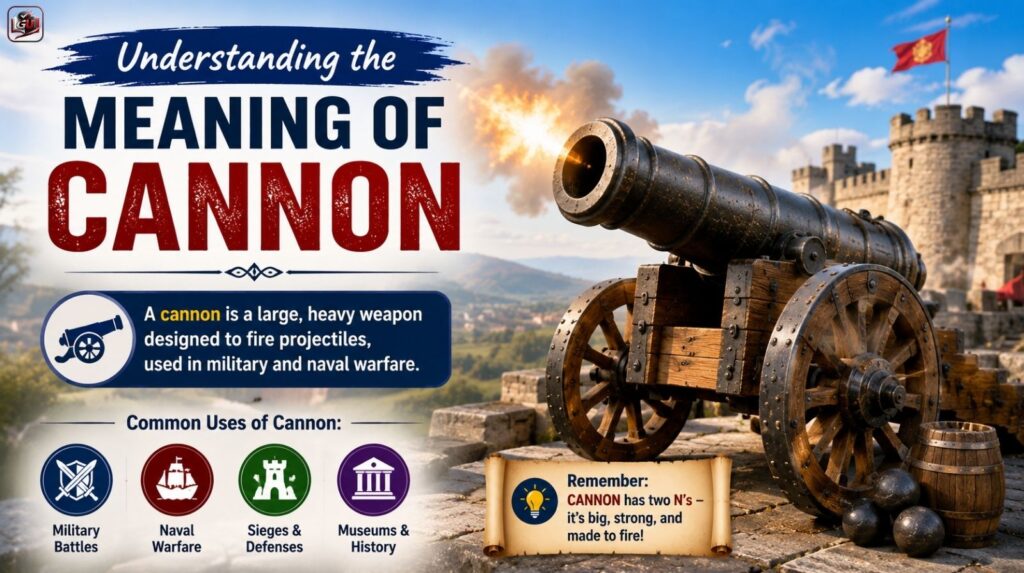
Unlike canon, cannon is a physical object used as a weapon.
The History of Cannons
Cannons first appeared in warfare during the medieval period and became increasingly powerful over time.
They played major roles in:
- Castle sieges
- Naval battles
- Military campaigns
- National defense systems
Modern Uses of Cannons
While traditional cannons are less common today, modern artillery evolved from cannon technology.
Examples include:
- Ceremonial military salutes
- Historical reenactments
- Museum exhibits
- Battlefield memorials
Examples of Cannon in Sentences
- The army positioned a cannon on the hill.
- Visitors examined an old naval cannon.
- The cannon blast echoed across the harbor.
Canon vs Cannon: Side-by-Side Comparison
Understanding the differences becomes easier when viewed together.
| Feature | Canon | Cannon |
|---|---|---|
| Part of Speech | Noun | Noun |
| Meaning | Rule, standard, accepted work | Large artillery weapon |
| Common Fields | Literature, religion, media, music | Military, history, warfare |
| Physical Object? | No | Yes |
| Associated With | Official recognition | Firepower |
| Example | Literary canon | Battlefield cannon |
Easy Memory Trick
Remember:
Canon = One “N” = Narrative
Think about stories, books, movies, and official content.
Cannon = Two “N”s = Needs ammunition
The extra “n” can remind you of a larger object like a weapon.
Real-Life Example: How One Letter Changed the Meaning
A content editor working for an entertainment website once published an article discussing whether a new movie storyline was part of a famous franchise’s official continuity. The intended headline was:
“Is the New Story Canon?”
However, due to a simple spelling error, the headline appeared as:
“Is the New Story Cannon?”
Readers immediately became confused because the article was discussing movie lore, not military weapons. Several comments pointed out the mistake, and some readers even joked about “explosive storytelling.”
The editor corrected the error within a few hours, but the incident highlighted how easily similar-looking words can create misunderstandings.
This example demonstrates why understanding canon vs cannon matters, especially in digital publishing, journalism, blogging, and academic writing. Search engines and readers both expect accurate word usage. A small spelling mistake can affect credibility, user experience, and even SEO performance.
Writers who carefully distinguish between canon and cannon are more likely to produce clear, professional content that readers trust.
Why People Confuse Canon and Cannon
Several factors contribute to confusion.
Similar Pronunciation
Both words sound almost identical in many accents.
Only One Letter Difference
The extra “n” is easy to overlook during typing or proofreading.
Spell Check Limitations
Since both words are correctly spelled English words, spell-check tools may not detect misuse.
Context Is Essential
The correct choice depends entirely on what you’re discussing.
For example:
✔ The story is part of the canon.
✔ The soldiers fired the cannon.
Usage Statistics and Language Trends (2025–2026)
Language usage data from major publishing platforms and search trends shows growing interest in commonly confused words, especially among students, bloggers, and content creators.
Recent search trend analysis indicates that grammar-related searches increased significantly between 2025 and 2026 as more people use digital tools for writing and content creation.
Frequently searched comparisons include:
- Affect vs Effect
- Their vs There
- Complement vs Compliment
- Canon vs Cannon
According to language-learning industry reports and educational publishing trends, articles explaining confusing word pairs continue to attract millions of readers annually because accurate communication remains essential in academic, professional, and online environments.
This trend highlights why understanding subtle distinctions like canon vs cannon can improve writing quality and reader confidence.
Trusted References
For further reading:
- Merriam-Webster Dictionary
- Cambridge Dictionary
- Oxford Learner’s Dictionaries
How to Use Canon and Cannon Correctly
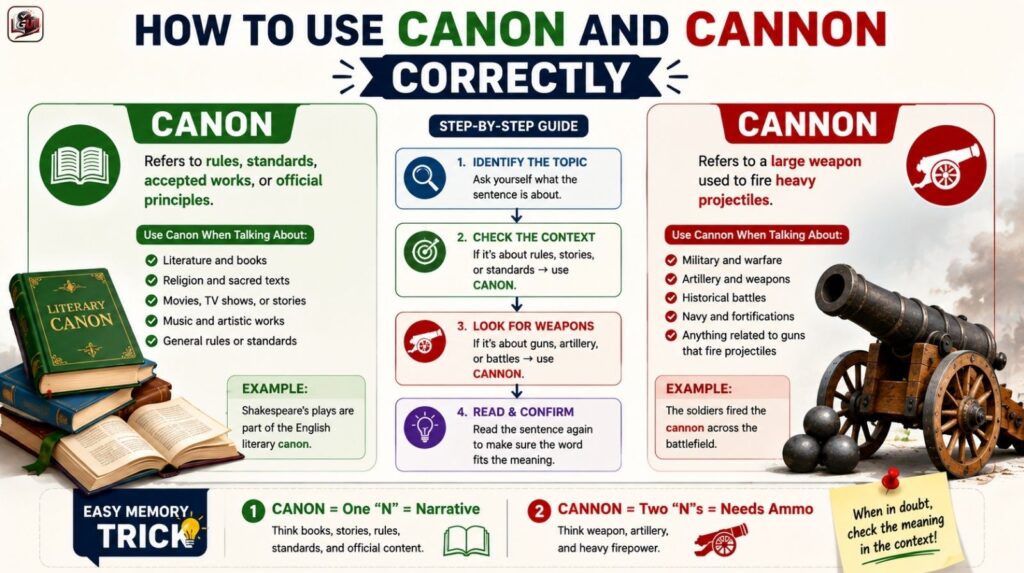
Follow these simple steps whenever you’re unsure.
Step 1: Identify the Topic
Ask yourself what you’re discussing.
If it’s about:
- Books
- Movies
- Religion
- Standards
- Official works
Use canon.
Step 2: Check for Weapons
If the topic involves:
- Military equipment
- Artillery
- Historic battles
- Weapons
Use cannon.
Step 3: Read the Sentence Again
A quick reread often reveals whether the word makes sense in context.
Step 4: Use the Memory Trick
Canon = stories and standards.
Cannon = weapon and warfare.
Common Mistakes to Avoid
Mistake #1: Using Cannon for Movie Lore
❌ The episode is now cannon.
✔ The episode is now canon.
Mistake #2: Using Canon for Weapons
❌ The soldiers fired the canon.
✔ The soldiers fired the cannon.
Mistake #3: Trusting Spell Check Alone
Because both words exist in English, spelling tools may not catch the error.
Always verify the context.
FAQs
Q. Is canon or cannon used for movies?
A: Canon is used for movies, TV shows, books, and fictional universes because it refers to officially accepted content.
Q. What does cannon mean?
A: A cannon is a large artillery weapon designed to fire projectiles.
Q. Why are canon and cannon often confused?
A: They have similar pronunciations and differ by only one letter.
Q. Is the Bible considered a canon?
A: Yes. Religious scholars use the term canon to describe officially recognized sacred texts.
Q. Can cannon be used figuratively?
A: Occasionally, but its primary meaning remains a military weapon.
Q. How do I remember the difference between canon and cannon?
A: Remember that cannon has an extra “n,” representing a larger object like a weapon.
Q. Which word is more common online today?
A: Both are common, but canon appears frequently in entertainment discussions, while cannon is more common in historical and military contexts.
Conclusion
Understanding the difference between canon vs cannon is easier once you know their meanings. Canon refers to accepted rules, standards, or officially recognized works, while cannon refers to a large weapon used in warfare.
Although they sound similar, they belong to completely different categories of language. By focusing on context and using simple memory tricks, you can avoid one of the most common English spelling mistakes.
The next time you encounter canon vs cannon, you’ll know exactly which word belongs in your sentence. If you’re serious about improving your writing skills, continue learning commonly confused words and practice using them in real-world situations.
👉Keep learning with more easy grammar lessons on GrammerUpdate.com

Noor Fatima is a professional blogger specializing in spelling correction and grammar guidance. She creates clear, practical content to help readers avoid common mistakes, strengthen writing skills, and communicate with confidence in everyday and professional settings.