
Have you ever written “emaculate” and then paused, wondering if it was actually correct? It’s a surprisingly common mistake. Because emaculate and immaculate look and sound similar, many writers, students, and English learners use them interchangeably without realizing that one of them isn’t a standard English word at all.
While the difference may seem minor, using the wrong spelling can make your writing appear less polished, especially in academic, professional, or business settings. That’s why understanding the distinction between emaculate vs immaculate is more important than many people think.
In this guide, you’ll discover which spelling is correct, what immaculate really means, why emaculate is considered a misspelling, and how to avoid this mistake in everyday writing. By the end, you’ll be able to use the correct word with confidence and improve the overall quality of your English.
What Is the Difference Between Emaculate and Immaculate?
Quick Answer
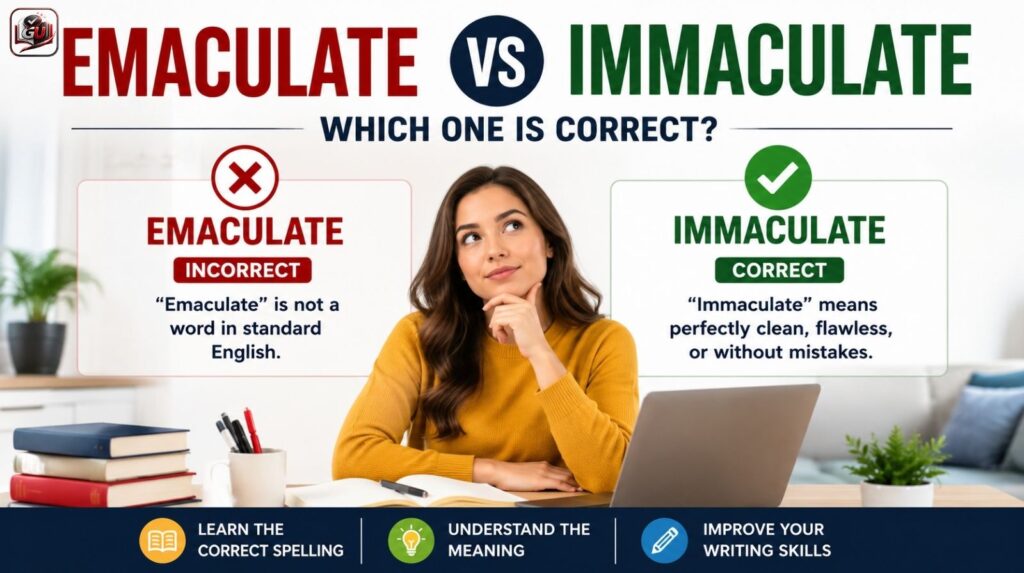
Immaculate is the correct English word.
Emaculate is generally considered a misspelling of immaculate and does not appear in standard English dictionaries.
| Word | Correct? | Meaning |
|---|---|---|
| Immaculate | ✅ Yes | Perfectly clean, flawless, or without mistakes |
| Emaculate | ❌ No | Misspelling of immaculate |
Why People Confuse These Words
Several factors contribute to this confusion:
- Similar pronunciation
- Typing errors
- Autocorrect mistakes
- Lack of familiarity with the word “immaculate”
Because the words look alike, many writers accidentally drop the initial “im” sound and write emaculate instead.
What Does Immaculate Mean?

The word immaculate means:
- Extremely clean
- Perfectly neat
- Free from flaws
- Without mistakes or imperfections
Origin of the Word
The term comes from the Latin word immaculatus, meaning “unstained” or “spotless.”
Over time, English adopted the word to describe something perfectly clean or free from defects.
Examples of Immaculate in Sentences
- Her kitchen was absolutely immaculate.
- The hotel room looked immaculate when we arrived.
- He submitted an immaculate report with no errors.
- The athlete maintained an immaculate record throughout the season.
- The garden appeared immaculate after weeks of careful maintenance.
In each example, the word describes something exceptionally clean, perfect, or flawless.
Why Is Emaculate Incorrect?
No Recognition in Standard Dictionaries
Major dictionaries do not recognize emaculate as a standard English word.
You will not find it in sources such as:
- Merriam-Webster
- Cambridge Dictionary
- Oxford Learner’s Dictionaries
Instead, these references list immaculate as the correct spelling.
Common Reasons for the Error
Typographical Mistakes
Many people simply miss the first “im” and type “e” instead.
Pronunciation Confusion
Fast speech can sometimes make the beginning of the word sound unclear.
Memory-Based Spelling
Writers often spell unfamiliar words according to how they sound rather than how they are actually written.
Immaculate Meaning Across Different Contexts
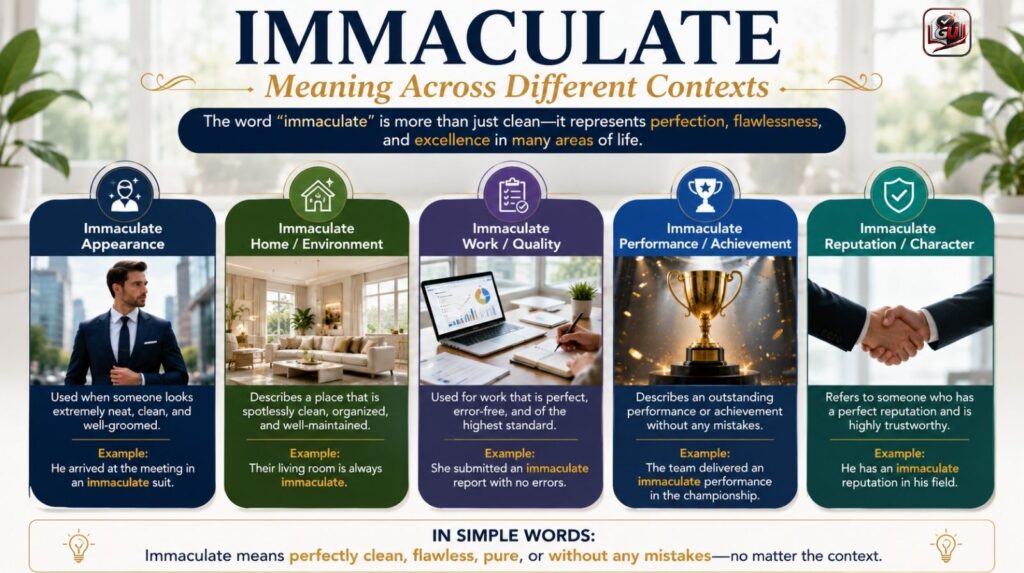
The word immaculate is versatile and can be used in many situations.
Immaculate Appearance
Used when someone looks extremely neat and well-groomed.
Example:
- She arrived at the interview in an immaculate suit.
Immaculate Home
Used for a perfectly clean house.
Example:
- Their apartment remained immaculate despite having three children.
Immaculate Work
Used to describe error-free work.
Example:
- The editor praised the writer’s immaculate grammar.
Immaculate Performance
Used in sports, business, or academics.
Example:
- The team delivered an immaculate performance in the championship game.
Emaculate vs Immaculate: Side-by-Side Comparison
Spelling Comparison
| Feature | Emaculate | Immaculate |
|---|---|---|
| Standard English Word | No | Yes |
| Found in Dictionaries | No | Yes |
| Accepted in Academic Writing | No | Yes |
| Correct Grammar | No | Yes |
| Recommended Usage | Never | Always |
Pronunciation Comparison
| Word | Pronunciation |
|---|---|
| Immaculate | ih-MAK-yuh-lut |
| Emaculate | Not recognized |
Usage Comparison
Incorrect:
- The room was emaculate.
- She kept an emaculate house.
Correct:
- The room was immaculate.
- She kept an immaculate house.
Real-Life Writing Example: How a Small Spelling Error Can Affect Professional Communication
Imagine a marketing professional preparing a proposal for a major client. The document is polished, visually appealing, and filled with valuable insights. In one section, the writer describes the company’s office as having an “emaculate environment.”
Although readers still understand the intended meaning, the spelling mistake immediately stands out.
Many hiring managers, clients, and editors pay close attention to details. A simple spelling error can create an impression that the document was not carefully reviewed.
In competitive industries, small mistakes sometimes influence credibility. For example, recruiters often review hundreds of applications. When they encounter misspellings in resumes or cover letters, they may question the applicant’s attention to detail.
Now imagine the same sentence written correctly:
“The company maintains an immaculate working environment.”
The sentence appears professional, polished, and trustworthy.
This example demonstrates why understanding the difference between emaculate vs immaculate matters. Even minor spelling mistakes can affect how your writing is perceived, especially in academic, professional, and business settings.
Language Statistics and Spelling Trends (2025–2026)
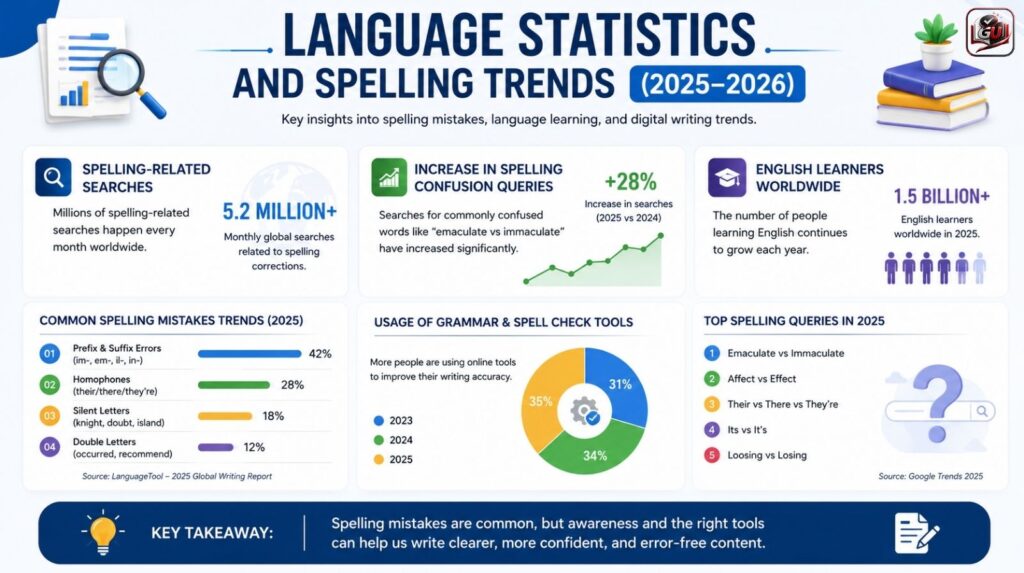
Recent language-learning and search trend data show that spelling confusion remains one of the most common challenges for English learners.
Key Findings
- Millions of spelling-related searches occur every month worldwide.
- Grammar and spelling correction tools continue to be among the most-used writing technologies in 2025.
- Search interest for commonly confused words has increased as more people create online content.
- Educational platforms report that spelling errors involving prefixes are among the most frequent mistakes made by learners.
According to language resources and writing platforms, users frequently search for questions such as:
- Is emaculate a word?
- How do you spell immaculate?
- What does immaculate mean?
- Emaculate vs immaculate difference
These trends highlight the importance of understanding correct spelling and usage in modern communication.
How to Remember the Correct Spelling
Method 1: Focus on the Prefix
Remember that the word starts with:
IM + maculate
Not:
EM + maculate
Method 2: Visual Memory Trick
Think:
Immaculate = I’M Accurate
Both words begin with “Im.”
This simple memory association helps many learners remember the correct spelling.
Method 3: Read the Word Frequently
Repeated exposure improves spelling retention.
You can reinforce learning by:
- Reading books
- Writing sentences
- Using vocabulary apps
- Practicing spelling exercises
Common Mistakes to Avoid
Mistake #1: Writing Emaculate in Formal Documents
Always use immaculate in professional writing.
Mistake #2: Assuming Spell Check Will Catch Everything
Some programs may overlook unusual spelling errors depending on context.
Mistake #3: Memorizing Pronunciation Instead of Spelling
English pronunciation is not always a reliable guide for spelling.
Mistake #4: Ignoring Dictionary Verification
When unsure, verify unfamiliar words using trusted dictionaries.
FAQs
Q. Is emaculate a real word?
A: No. Emaculate is not recognized as a standard English word and is generally considered a misspelling of immaculate.
Q. Which spelling is correct: emaculate or immaculate?
A: Immaculate is the correct spelling.
Q. What does immaculate mean?
A: It means perfectly clean, flawless, spotless, or free from mistakes.
Q. Why do people write emaculate?
A: People often write emaculate because of pronunciation confusion, typing errors, or unfamiliarity with the correct spelling.
Q. Can I use emaculate in academic writing?
A: No. Academic, professional, and formal writing should always use immaculate.
Q. Is immaculate a positive word?
A: Yes. It is typically used as a compliment to describe cleanliness, perfection, or excellence.
Q. What is a synonym for immaculate?
A: Common synonyms include:
- Spotless
- Perfect
- Flawless
- Pristine
- Neat
- Clean
Conclusion
When comparing emaculate vs immaculate, the answer is simple: immaculate is the only correct spelling in modern English. The word describes something perfectly clean, flawless, or free from mistakes, while emaculate is merely a common misspelling.
Understanding this distinction can improve your writing, strengthen your professional communication, and help you avoid embarrassing spelling errors. Whenever you’re unsure, remember that dictionaries, style guides, and grammar experts consistently recognize immaculate as the correct form.
The next time you encounter emaculate vs immaculate, you’ll know exactly which word to use and why it matters.
👉Keep learning with more easy grammar lessons on GrammerUpdate.com

Noor Fatima is a professional blogger specializing in spelling correction and grammar guidance. She creates clear, practical content to help readers avoid common mistakes, strengthen writing skills, and communicate with confidence in everyday and professional settings.