
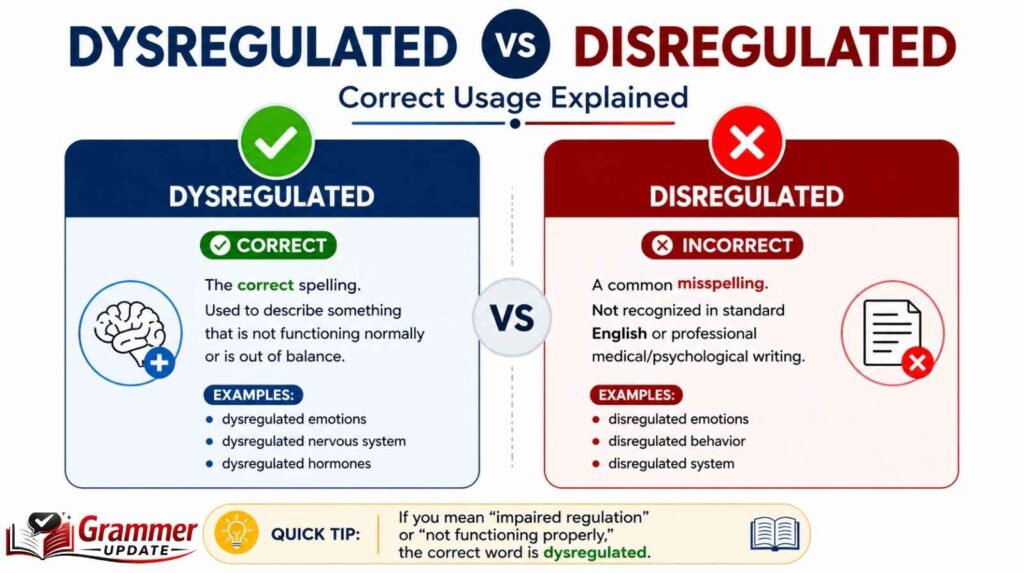
Have you ever looked at the words dysregulated and disregulated and thought, which one is actually right? It happens more often than you might think. Since both words look similar, many people get confused while writing emails, assignments, articles, or professional content.
The truth is, only one of them is commonly accepted in proper English. Using the wrong version can make your writing look careless, especially when accuracy matters.
In this article, we’ll clear up the confusion in simple words, explain the correct spelling, show real examples, and help you remember the right usage so you don’t second-guess yourself again in 2026.
See Also: Presant vs Present: Which Is The Correct Spelling And Usage?
What Is the Correct Word: Dysregulated or Disregulated?
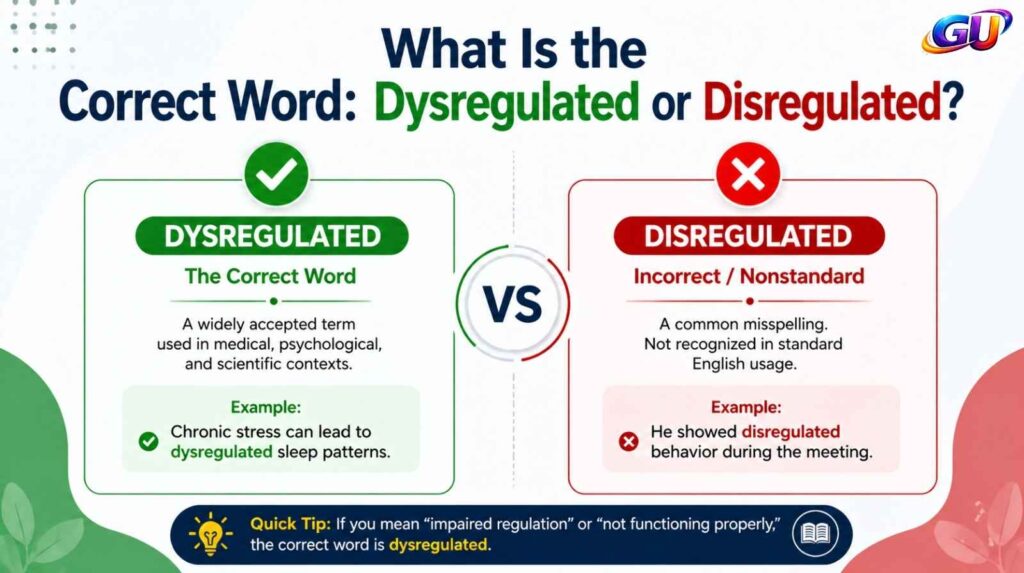
The correct and widely accepted word is dysregulated.
It comes from the prefix dys-, which means abnormal, impaired, difficult, or faulty. It is commonly used in medical, psychological, and scientific writing.
By contrast, disregulated is rarely recognized in dictionaries or professional style guides.
Quick Answer (Featured Snippet)
- ✅ Dysregulated = Correct standard term
- ❌ Disregulated = Usually incorrect or nonstandard
- Common in healthcare, neuroscience, psychology, and biology
Example Sentences
- The patient showed dysregulated immune responses.
- Emotional dysregulation is common in trauma-related disorders.
- Blood sugar became dysregulated after prolonged stress.
According to Merriam-Webster Medical Dictionary, dysregulation refers to impaired regulation of a physiological mechanism.
See Also: Coma vs Comma: What’s The Difference And When To Use Each?
Why Do People Confuse Dysregulated and Disregulated?
The confusion mainly comes from pronunciation and prefix similarity.
Prefix Confusion: dys- vs dis-
Many English words begin with dis-, such as:
- disconnect
- disagree
- disorder
So writers naturally assume disregulated follows the same pattern.
However, dys- is a different prefix with a different meaning.
Sound Similarity
When spoken quickly, dysregulated may sound like disregulated, especially in casual speech.
Autocorrect and Typing Errors
Spellcheck tools sometimes miss specialized medical vocabulary, which increases confusion.
See Also: Gray vs Grey: Which Spelling Is Correct And What’s The Difference?
What Does Dysregulated Mean?
Dysregulated describes something that is not functioning normally or properly controlled.
It is often used in:
- Mental health
- Hormones
- Nervous system function
- Metabolism
- Immune responses
- Emotional behavior
Emotional Dysregulation
A person may struggle to manage emotions, stress, or reactions.
Example:
Children with trauma histories may show dysregulated behavior under pressure.
Biological Dysregulation
The body’s systems stop maintaining balance.
Example:
Chronic stress can lead to dysregulated cortisol levels.
Cambridge Dictionary also lists dysregulated in medical and psychology contexts.
Dysregulated vs Disregulated Comparison Table
| Feature | Dysregulated | Disregulated |
|---|---|---|
| Standard English usage | Yes | No |
| Found in dictionaries | Yes | Rarely |
| Used in medicine | Yes | No |
| Used in psychology | Yes | No |
| Recommended in writing | Yes | No |
Best Rule to Remember
If you mean impaired regulation, choose dysregulated.
See Also: Totaled vs Totalled: Which Spelling Is Correct?
Real-Life Case Study: How One Health Blog Fixed a Keyword Error
In early 2025, a wellness publisher created an article titled How to Manage Disregulated Emotions. The content itself was useful, but the headline used the wrong spelling. As a result, the article struggled to gain traction because searchers overwhelmingly used the correct keyword dysregulated emotions.
After a content audit, the team updated:
- Title tag
- Headings
- Internal links
- Meta description
- Body copy terminology
They changed every nonessential use of disregulated to dysregulated while preserving readability.
Within several weeks, impressions improved because the article aligned better with real search behavior and user expectations. This mirrors Google’s people-first guidance: helpful content should be accurate, clear, and trustworthy.
The lesson is simple: spelling accuracy matters for both credibility and discoverability. If readers are searching for the correct term, your content should match that intent naturally.
See Also: Payed vs Paid: Difference And Which One Is Correct?
2025–2026 Language and Search Trends
While exact keyword volumes vary by platform, usage patterns in 2025–2026 show that dysregulated appears far more frequently than disregulated in dictionaries, medical literature, and indexed web content.
What the Data Suggests
- Major dictionaries recognize dysregulated
- Healthcare articles overwhelmingly use dysregulation
- Search intent favors correct terminology
- Misspelled variants often have lower trust signals
Why This Matters for SEO
Correct spellings help with:
- Better keyword relevance
- Higher click trust
- More accurate internal linking
- Stronger topical authority
See Also: Rancor vs Rancour Difference And Which Spelling Is Correct?
How to Use Dysregulated Correctly in Writing
In Academic Writing
Use it when discussing systems that are impaired or poorly controlled.
Example:
The study examined dysregulated inflammatory markers.
In Mental Health Writing
Use it for emotional or behavioral control issues.
Example:
Clients may experience dysregulated responses during conflict.
In Everyday Content
Explain the term simply.
Example:
Stress can leave your sleep cycle feeling dysregulated.
FAQs
Q1. Is disregulated a real word?
A: It may appear online, but it is generally considered a misspelling or nonstandard form of dysregulated.
Q2. Which spelling should I use in academic papers?
A: Use dysregulated.
Q3. What does dysregulated emotions mean?
A: It means difficulty managing emotional reactions in a balanced way.
Q4. Is dysregulated used in medicine?
A: Yes. It is common in medicine, psychology, neuroscience, and biology.
Q5. Why does autocorrect flag dysregulated?
A: Some tools treat specialized vocabulary inconsistently.
Q6. Can I rank for both spellings in SEO?
A: Yes, but prioritize the correct term dysregulated while mentioning the misspelling naturally.
Conclusion
When comparing dysregulated vs disregulated, the correct and trusted term is dysregulated. It is recognized in dictionaries, used by professionals, and preferred in search results.
If you write about health, psychology, science, or personal development, using the correct word improves clarity, authority, and reader trust.
Need help optimizing language-based SEO content or fixing keyword confusion across your site? Start by auditing your terminology and updating outdated spellings today.
Discover More Article
- Mobil vs Mobile: Which Is Correct And How To Use Them?
- Propose vs Purpose: Which Is Correct?
- It’s Called vs It Called: Which Phrase Is Grammatically Correct?
👉 Keep learning with more easy grammar lessons on GrammerUpdate.com

Noor Fatima is a professional blogger specializing in spelling correction and grammar guidance. She creates clear, practical content to help readers avoid common mistakes, strengthen writing skills, and communicate with confidence in everyday and professional settings.