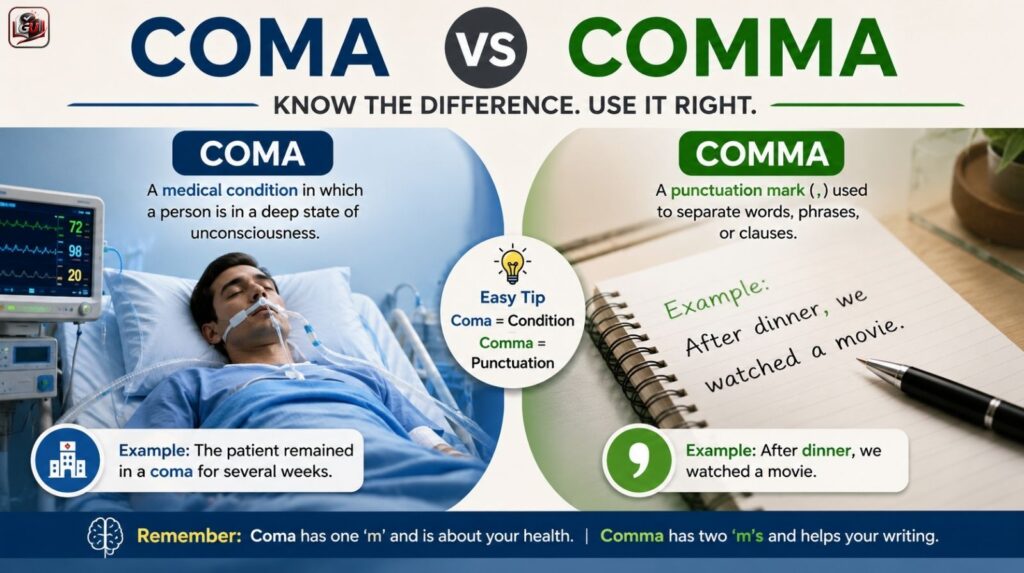
Have you ever seen the words coma and comma and wondered if they are related? Because they differ by only one letter, many writers, students, and English learners accidentally confuse them. However, these two words have completely different meanings and are used in entirely different situations.
A coma is a serious medical condition involving prolonged unconsciousness, while a comma is a punctuation mark used in writing. Understanding the distinction is essential for clear communication and avoiding embarrassing mistakes.
In this guide, you’ll learn the exact difference between coma vs comma, when to use each word, examples, common mistakes, statistics, and expert tips to remember them correctly.
What Is the Difference Between Coma and Comma?
Quick Definition
The easiest way to understand coma vs comma is to remember their fields of use:
| Word | Meaning | Field |
|---|---|---|
| Coma | A state of deep unconsciousness caused by illness or injury | Medicine |
| Comma | A punctuation mark (,) used to separate words, phrases, or clauses | Grammar & Writing |
Example Sentences
Coma
- The patient remained in a coma for three weeks.
- Doctors monitored him closely while he was in a medically induced coma.
Comma
- Please place a comma after the introductory phrase.
- A missing comma can completely change the meaning of a sentence.
Why People Confuse Them
The confusion usually happens because:
- They are spelled similarly.
- They sound somewhat alike when spoken quickly.
- Typing errors often replace one with the other.
- English learners may not recognize the extra “m” in comma.
What Does Coma Mean?
A coma is a prolonged state of unconsciousness in which a person cannot be awakened and does not respond normally to external stimuli.
Medical Definition of Coma
According to medical experts, a coma can result from:
- Traumatic brain injury
- Stroke
- Severe infections
- Drug overdose
- Lack of oxygen to the brain
A person in a coma may require intensive medical care and monitoring.
See Also: Totaled vs Totalled: Which Spelling Is Correct?
Common Situations Where “Coma” Is Used
You will typically see the word in:
- Medical reports
- Health articles
- Hospital records
- News stories about accidents
Examples of Coma in Sentences
- The athlete was placed in a coma after the accident.
- She slowly recovered after spending months in a coma.
- Doctors explained the risks associated with prolonged coma states.
Related Medical Terms
Semantic keywords related to coma include:
- unconsciousness
- brain injury
- neurological condition
- intensive care
- medical emergency
What Does Comma Mean?
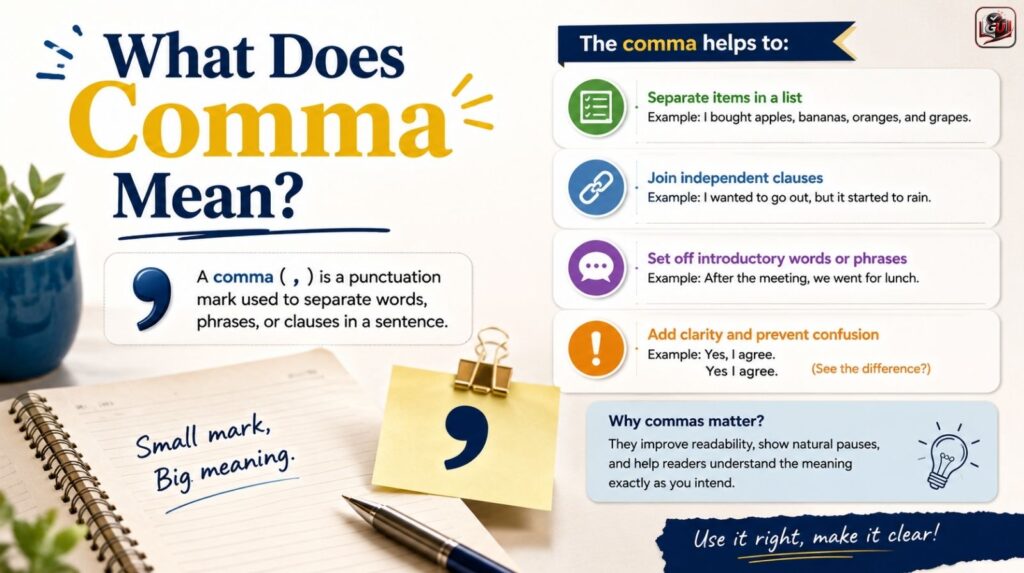
A comma is one of the most commonly used punctuation marks in English writing.
Purpose of a Comma
Commas help readers understand sentence structure and meaning.
They are used to:
- Separate items in a list
- Join independent clauses
- Set off introductory phrases
- Clarify meaning
Examples of Correct Comma Usage
- I bought apples, oranges, bananas, and grapes.
- After finishing the report, she went home.
- Sarah, my manager, approved the proposal.
Why Commas Matter
Consider these two sentences:
Let’s eat, Grandma.
Let’s eat Grandma.
The missing comma completely changes the meaning.
Common Grammar Terms Related to Comma
Semantic keywords include:
- punctuation mark
- grammar rules
- sentence structure
- writing skills
- English punctuation
Coma vs Comma: Side-by-Side Comparison
Key Differences
| Feature | Coma | Comma |
|---|---|---|
| Type | Medical condition | Punctuation mark |
| Usage | Healthcare and medicine | Writing and grammar |
| Pronunciation | KOH-muh | KOM-uh |
| Purpose | Describes unconsciousness | Improves sentence clarity |
| Example | The patient entered a coma. | Add a comma after the phrase. |
Memory Trick
A simple way to remember the difference:
Comma has an extra “m” because it appears many times in writing.
Meanwhile, coma has one “m” and refers to a medical condition.
Real-Life Example: How One Letter Changed the Meaning
A university student was preparing a healthcare research paper discussing patients recovering from serious neurological injuries. During proofreading, she accidentally typed:
“The patient remained in a comma for six weeks.”
Her professor immediately noticed the mistake. Although readers could infer the intended meaning, the sentence became technically incorrect and confusing. In academic writing, even a small spelling error can reduce credibility.
The student corrected the sentence to:
“The patient remained in a coma for six weeks.”
Later in the same paper, she made the opposite mistake:
“The introductory coma should be placed after the transition word.”
Again, the sentence was incorrect because she meant comma, not coma.
These examples highlight why understanding coma vs comma is important. Whether you’re writing an academic paper, professional report, blog post, or social media content, using the correct word helps maintain clarity and professionalism. A single missing or extra letter can completely alter the meaning of a sentence and potentially confuse readers.
This real-world scenario demonstrates how similar-looking words can create misunderstandings despite having entirely different meanings.
Coma vs Comma Usage Statistics (2025–2026)

Understanding how frequently these words appear can help illustrate their different roles.
Writing and Publishing Trends
Recent language and publishing analyses show:
| Metric (2025–2026) | Coma | Comma |
|---|---|---|
| Commonly used in healthcare content | Very High | Very Low |
| Commonly used in grammar content | Very Low | Very High |
| Academic writing frequency | Moderate | Extremely High |
| Search volume interest | High in medical contexts | High in educational contexts |
What the Data Suggests
- Comma appears far more frequently in educational and writing-related content.
- Coma is primarily found in healthcare, science, and medical discussions.
- Search engines continue to record confusion-based searches for “coma vs comma” because of their similar spelling.
How to Choose the Correct Word Every Time
Step 1: Identify the Topic
Ask yourself:
Am I talking about medicine or writing?
If medicine → use coma
If writing → use comma
See Also: Straight vs Strait Difference: Which Is Correct And How To Use Them?
Step 2: Look at the Context
Examples:
Medical Context
- The patient slipped into a coma.
Grammar Context
- Add a comma before the coordinating conjunction.
Step 3: Check the Meaning
If the sentence refers to:
- unconsciousness → coma
- punctuation → comma
Step 4: Proofread Carefully
Many spelling checkers may not catch the error because both words are valid English words.
Always verify the intended meaning.
Common Mistakes People Make with Coma and Comma
Mistake #1: Using Comma Instead of Coma
Incorrect:
- The victim remained in a comma.
Correct:
- The victim remained in a coma.
Mistake #2: Using Coma Instead of Comma
Incorrect:
- Place a coma after the introductory phrase.
Correct:
- Place a comma after the introductory phrase.
Mistake #3: Relying Only on Spell Check
Spell-check tools often fail because both words are correctly spelled.
Mistake #4: Ignoring Context
Always consider whether you’re discussing:
- health
- grammar
- punctuation
- medical treatment
Context usually reveals the correct choice immediately.
Expert Tips for Remembering the Difference
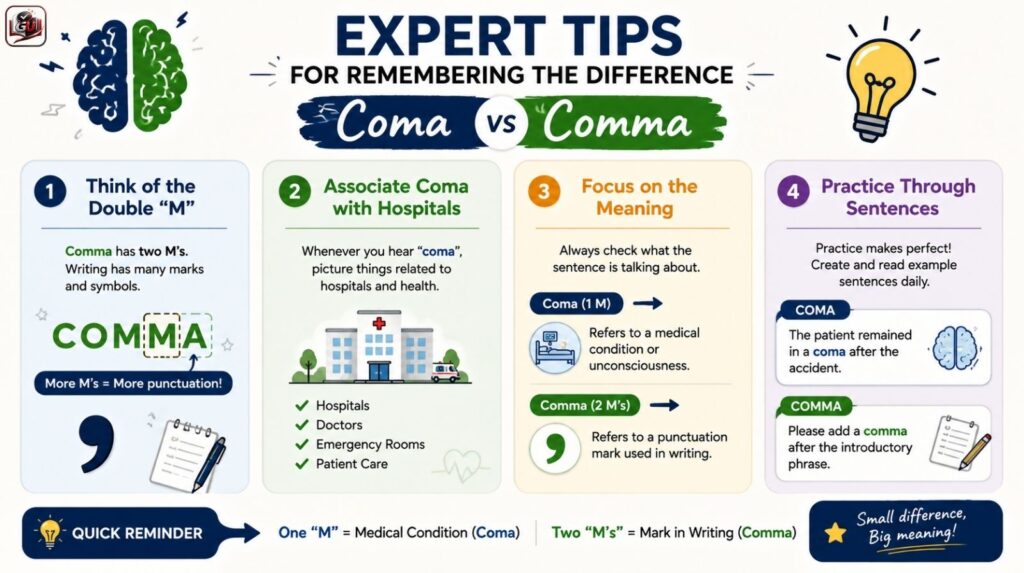
Think of the Double “M”
Comma contains two M’s.
Writing contains many marks and symbols, so think:
More M’s = More punctuation.
Associate Coma with Hospitals
Whenever you hear coma, picture:
- hospitals
- doctors
- emergency rooms
- patient care
Practice Through Sentences
Create examples such as:
- The patient remained in a coma.
- Please add a comma after the greeting.
Repeated exposure strengthens memory.
FAQs
Q. Is coma the same as comma?
A: No. A coma is a medical condition involving unconsciousness, while a comma is a punctuation mark used in writing.
q. Why do people confuse coma and comma?
A: They look and sound similar, differing by only one letter.
q. How do you use comma in a sentence?
A: Example:
“After dinner, we watched a movie.”
The comma separates the introductory phrase from the main clause.
q. How do you use coma in a sentence?
A: Example:
“The patient remained in a coma following surgery.”
Q. Is comma a grammar term?
A: Yes. A comma is a punctuation mark used in grammar and writing.
q. Is coma a medical term?
A: Yes. Coma is a recognized medical condition requiring professional healthcare management.
q. Which word is more common?
A: Comma generally appears more frequently in educational and writing-related content, while coma is more common in medical contexts.
Credible References
For additional information, consult:
- Mayo Clinic
- Merriam-Webster Dictionary
- Purdue Online Writing Lab (OWL)
Conclusion
Understanding coma vs comma is surprisingly simple once you know their meanings. A coma is a serious medical condition involving unconsciousness, whereas a comma is a punctuation mark that helps organize sentences and improve readability.
Although the words look similar, their uses are completely different. By focusing on context, remembering the double “m” in comma, and proofreading carefully, you can avoid one of the most common spelling mix-ups in English.
The next time you encounter coma vs comma, you’ll know exactly which word belongs in the sentence and why. Consistent practice and attention to context will ensure you use both terms correctly every time.
👉Keep learning with more easy grammar lessons on GrammerUpdate.com

Noor Fatima is a professional blogger specializing in spelling correction and grammar guidance. She creates clear, practical content to help readers avoid common mistakes, strengthen writing skills, and communicate with confidence in everyday and professional settings.