
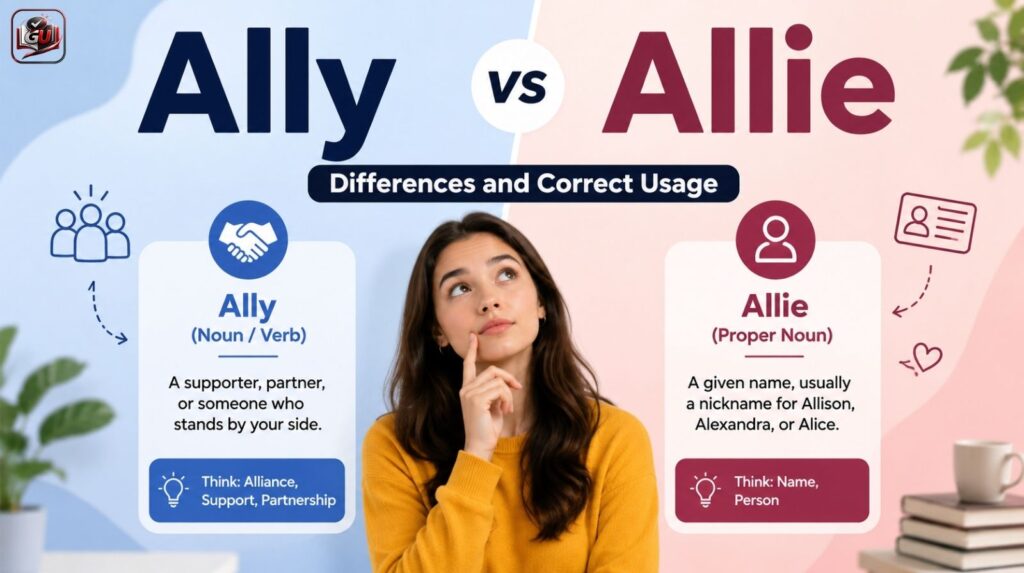
Have you ever come across the words Ally and Allie and wondered if they mean the same thing? You’re not alone. Because these words sound identical and differ by only one letter, many writers, students, and English learners mix them up.
The tricky part is that both are correct spellings but they have completely different meanings. One refers to a supporter or partner, while the other is usually a person’s name. Using the wrong one can make your writing confusing and sometimes even change the meaning of an entire sentence.
Whether you’re writing an email, an academic paper, a social media post, or everyday content, understanding the difference between Ally and Allie can help you communicate more clearly and confidently. In this guide, you’ll learn what each word means, when to use it, common mistakes to avoid, real-life examples, and simple memory tricks to remember the correct spelling every time.
What Is the Difference Between Ally and Allie?
Quick Answer
The primary difference is simple:
| Word | Meaning | Part of Speech |
|---|---|---|
| Ally | A person, group, or country that supports another | Noun / Verb |
| Allie | A given name, usually a nickname for Allison, Alexandra, or Alice | Proper Noun |
Example Sentences
- Canada is a strong ally of several Western nations.
- She became my closest ally during the project.
- Allie is attending the conference next week.
- My friend Allie loves reading mystery novels.
The key point is that ally refers to support or partnership, while Allie is typically someone’s name.
Why People Confuse Them
The confusion occurs because:
- They are pronounced similarly.
- They differ by only one letter.
- Spell-checkers may not catch the mistake because both are valid words.
- Many people encounter “Allie” online without realizing it is a personal name.
What Does Ally Mean?
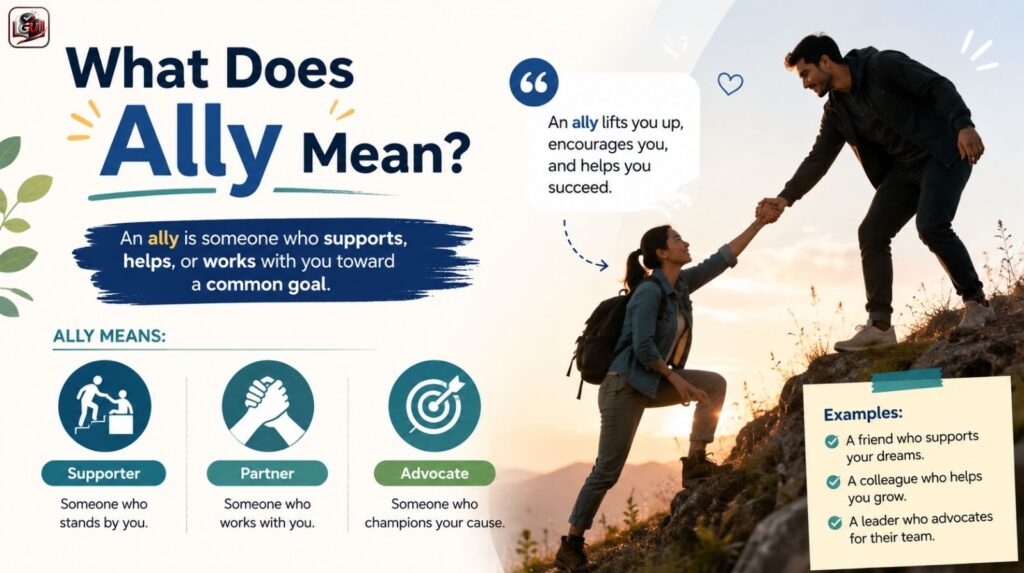
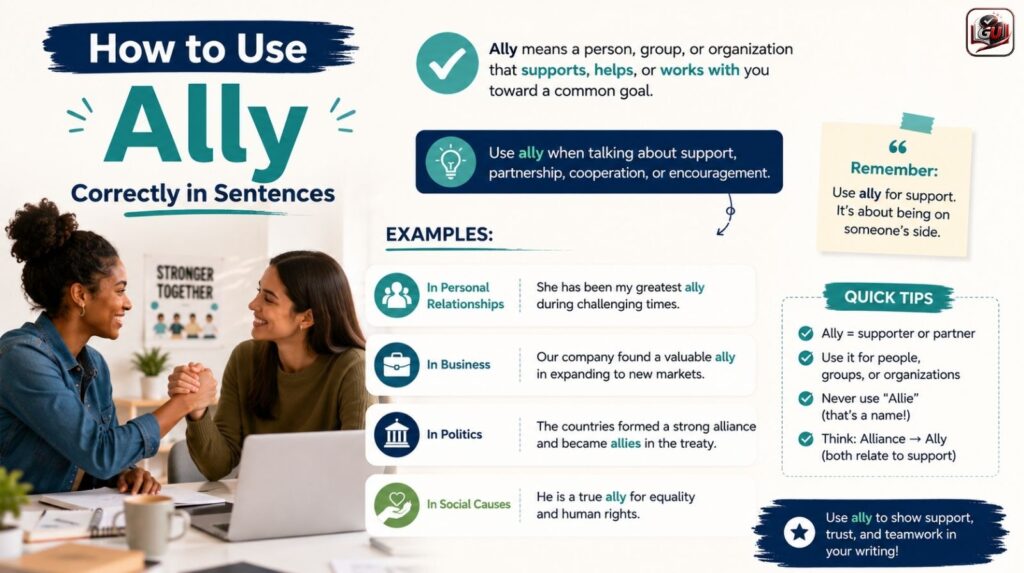
An ally is someone who supports, helps, or cooperates with another person, group, or organization.
The word can function as both a noun and a verb.
Ally as a Noun
When used as a noun, it refers to a supporter or partner.
Examples:
- She was an important ally during the negotiations.
- The company found a valuable business ally.
- The countries remained military allies.
Ally as a Verb
As a verb, ally means to join or unite with someone.
Examples:
- Several organizations decided to ally with the campaign.
- Small businesses often ally together to compete with larger corporations.
Common Contexts Where Ally Is Used
Politics
Countries often form alliances and become allies.
Example:
- France and Germany are long-standing European allies.
Business
Companies partner to achieve shared goals.
Example:
- The startup allied with a larger technology firm.
Social Causes
People support communities and movements.
Example:
- Effective leaders act as allies for underrepresented groups.
What Does Allie Mean?
Allie is generally a personal name rather than a common vocabulary word.
It is often used as a nickname for:
- Allison
- Alexandra
- Alice
- Alina
Examples of Allie as a Name
- Allie graduated from university last year.
- My cousin Allie works as a graphic designer.
- Allie invited everyone to her birthday celebration.
Is Allie Ever Used as a Common Word?
In modern English, “Allie” is overwhelmingly recognized as a personal name.
Unlike “ally,” it does not normally describe support, friendship, or partnership.
Therefore, writing:
❌ She became my Allie.
is usually incorrect unless the person’s actual name is Allie.
The correct version would be:
✅ She became my ally.
Ally vs Allie: Side-by-Side Comparison
| Feature | Ally | Allie |
|---|---|---|
| Meaning | Supporter or partner | Personal name |
| Part of Speech | Noun or Verb | Proper Noun |
| Common Usage | Politics, business, social causes | Referring to a person |
| Capitalization | Usually lowercase | Usually capitalized |
| Example | He became my ally. | Allie became my friend. |
Easy Memory Trick
Remember:
Ally = Alliance
Both begin with “All” and relate to support, cooperation, and partnership.
Allie = Individual
Think of Allie as someone’s name, similar to Katie, Sophie, or Ellie.
Real-Life Example: How One Small Spelling Error Changed the Meaning
A Workplace Communication Case Study
A marketing agency was preparing a partnership announcement with another company. The content team drafted a press release explaining how the new business partner would become a strategic ally in future projects.
However, during editing, a team member accidentally wrote:
“TechVision will become our trusted Allie moving forward.”
At first, nobody noticed the error because spell-check software did not flag the word. After all, “Allie” is a valid name.
When the press release was published, several readers became confused. Some wondered whether “Allie” referred to a person joining the company rather than a business partnership.
The communications team eventually corrected the sentence to:
“TechVision will become our trusted ally moving forward.”
This small change immediately clarified the intended meaning.
The incident highlights an important lesson for writers. English contains many words that are spelled similarly but have entirely different meanings. Relying solely on spell-check software isn’t enough. Understanding context is essential.
Professional editors often review content specifically for these types of errors because a single misplaced letter can alter how readers interpret a message. Whether you’re writing academic papers, business reports, blog posts, or emails, knowing the difference between ally and Allie helps ensure clarity and professionalism.
Ally vs Allie in Modern Writing and Digital Communication
Why This Confusion Is Increasing
The rise of digital communication has made spelling-related confusion more common.
People often:
- Type quickly on mobile devices.
- Depend on autocorrect.
- Read content on social media instead of edited publications.
As a result, words like ally and Allie are frequently mixed up.
Social Media Influence
Social platforms expose users to thousands of names daily.
When people repeatedly see the name “Allie,” they may unconsciously use it when they actually mean “ally.”
Search Trends and User Behavior
Recent language-learning and grammar platforms continue reporting high search interest for commonly confused words. Educational websites note that spelling-related searches remain among the most popular grammar queries as more people create online content and communicate professionally through digital channels.
This trend demonstrates why understanding word distinctions is increasingly important in today’s writing environment.
How to Use Ally Correctly in Sentences
Business
- Our company found a strategic ally in the technology sector.
- The brands allied to expand their market reach.
Education
- Teachers can be valuable allies for student success.
- The counselor became an ally during difficult times.
International Relations
- The nation strengthened ties with its regional allies.
- Several countries allied against a common threat.
Personal Relationships
- A true friend can also be a strong ally.
- She acted as an ally when I needed support.
Common Mistakes to Avoid
Mistake #1: Using Allie Instead of Ally
Incorrect:
❌ He became my trusted Allie.
Correct:
✅ He became my trusted ally.
Mistake #2: Forgetting Capitalization
Incorrect:
❌ allie won the competition.
Correct:
✅ Allie won the competition.
Because Allie is a name, it should generally be capitalized.
Mistake #3: Assuming They Are Variations of the Same Word
Many learners believe Allie is simply another spelling of ally.
This is incorrect.
The two words have separate meanings and functions.
FAQs
Q. Is Ally or Allie the correct spelling?
A: Both spellings are correct, but they mean different things. Ally means a supporter or partner, while Allie is usually a person’s name.
Q. Can Ally be used as a verb?
A: Yes. Ally can function as a verb meaning to join or unite with another person, group, or organization.
Example:
- Several groups allied together.
Q. Is Allie a nickname?
A: Yes. Allie is commonly used as a nickname for Allison, Alexandra, Alice, and similar names.
Q. Why do people confuse Ally and Allie?
A: They look similar, sound alike, and both are valid words, making spelling mistakes easy to overlook.
Q. Is ally commonly used in business?
A: Yes. Businesses often use the term ally to describe strategic partnerships and collaborative relationships.
Q. Can Allie be used in formal writing?
A: Yes, if it refers to a person’s actual name.
Q. How can I remember the difference?
A: Think of ally = alliance (support and partnership). Think of Allie = person’s name.
Conclusion
Understanding the difference between Ally vs Allie is easier once you know their distinct roles in English. An ally is a supporter, partner, or collaborator, while Allie is generally a personal name. Although the words look similar, they serve completely different purposes and should not be used interchangeably.
When writing emails, articles, academic papers, or business documents, always check the context carefully. If you’re talking about support or partnership, use ally. If you’re referring to a person named Allie, use the capitalized proper noun.
Mastering small distinctions like Ally vs Allie can significantly improve your writing accuracy, professionalism, and confidence. The next time you encounter these words, you’ll know exactly which one to choose.
References
- Merriam-Webster Dictionary
- Cambridge Dictionary
- Oxford Learner’s Dictionaries
👉Keep learning with more easy grammar lessons on GrammerUpdate.com

Noor Fatima is a professional blogger specializing in spelling correction and grammar guidance. She creates clear, practical content to help readers avoid common mistakes, strengthen writing skills, and communicate with confidence in everyday and professional settings.