
Have you ever typed a sentence and wondered whether to use propose or purpose? You’re not alone. These two words look somewhat similar and are often confused by English learners, students, writers, and even native speakers.
The confusion usually happens because both words relate to plans, intentions, or goals. However, they have very different meanings and functions in a sentence.
In this guide, you’ll learn the difference between propose vs purpose, when to use each word, common mistakes to avoid, and practical examples that make the distinction easy to remember. By the end, you’ll confidently know which word is correct in any situation.
What Is the Difference Between Propose and Purpose?
Quick Answer
Propose is a verb that means to suggest, recommend, or put forward an idea.
Purpose is usually a noun that means the reason something exists or is done.
| Word | Part of Speech | Meaning | Example |
|---|---|---|---|
| Propose | Verb | To suggest or recommend | I propose a new marketing strategy. |
| Purpose | Noun | A reason or objective | The purpose of this meeting is to discuss sales. |
Understanding this simple distinction can eliminate most usage mistakes.
Why People Confuse Them
Several factors contribute to the confusion:
- Both words are related to intentions or plans.
- They share similar spelling patterns.
- They often appear in business and academic writing.
- English learners may encounter them in similar contexts.
However, their grammatical roles are entirely different.
What Does “Propose” Mean?
The word propose refers to presenting an idea, suggestion, plan, or offer for consideration.
Common Definitions of Propose
According to standard English dictionaries, propose can mean:
- To suggest an idea
- To recommend a course of action
- To offer something for consideration
- To ask someone to marry you
Examples of Propose in Sentences
- I propose a different solution to the problem.
- The committee will propose changes next month.
- She proposed a new budget plan during the meeting.
- He proposed to his partner on their anniversary.
In each example, the word involves presenting an idea or suggestion.
When to Use Propose
Use propose when someone is:
- Suggesting something
- Presenting an idea
- Recommending a plan
- Making a formal offer
For example:
The manager proposed extending the project deadline.
Here, the manager is making a suggestion.
What Does “Purpose” Mean?
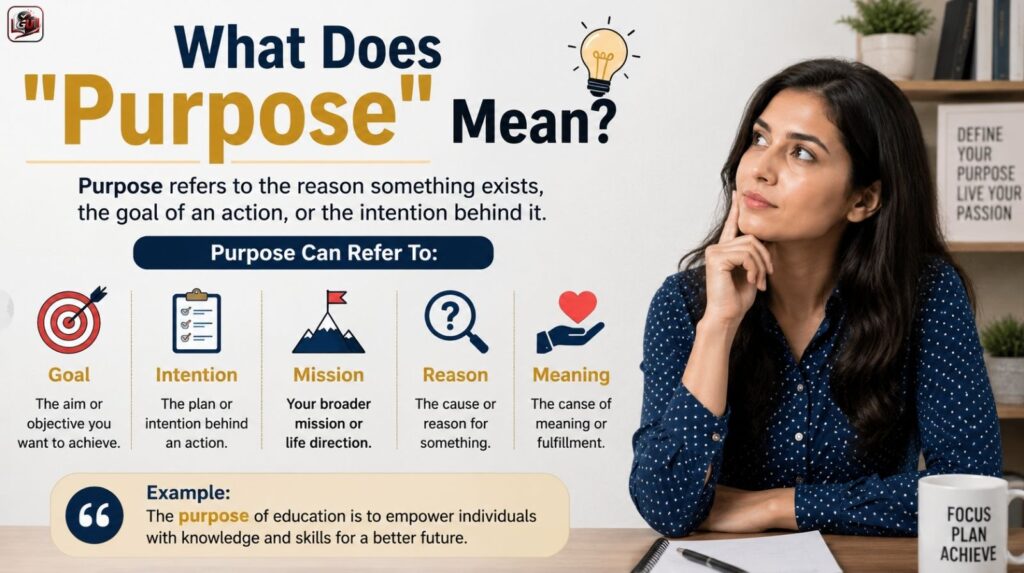
The word purpose refers to a reason, objective, aim, or intended outcome.
Common Definitions of Purpose
Purpose often describes:
- Why something exists
- The goal of an action
- An intended result
- A person’s mission or objective
Examples of Purpose in Sentences
- The purpose of education is to develop knowledge.
- What is the purpose of this report?
- The campaign was created for a specific purpose.
- She found a renewed sense of purpose in her career.
Notice that purpose refers to the reason behind an action rather than the action itself.
When to Use Purpose
Use purpose when discussing:
- Goals
- Intentions
- Objectives
- Reasons
For example:
The purpose of this training program is to improve employee skills.
The sentence explains the reason for the training.
Propose vs Purpose: Side-by-Side Comparison
Understanding the differences becomes easier when viewed together.
Key Differences
| Feature | Propose | Purpose |
|---|---|---|
| Part of Speech | Verb | Noun |
| Meaning | To suggest | A reason or goal |
| Action or Idea? | Action | Idea/Object |
| Common Context | Suggestions, proposals | Objectives, intentions |
| Example | I propose a change. | My purpose is clear. |
Simple Memory Trick
Remember this:
Propose = Present an idea
Purpose = Point of the idea
If you are suggesting something, use propose.
If you are explaining why something exists, use purpose.
Common Mistakes People Make
Many writers accidentally swap these words.
Mistake #1: Using Purpose Instead of Propose
Incorrect:
I purpose a new strategy for the company.
Correct:
I propose a new strategy for the company.
Why?
The speaker is suggesting something, so the verb propose is required.
Mistake #2: Using Propose Instead of Purpose
Incorrect:
The propose of this article is to educate readers.
Correct:
The purpose of this article is to educate readers.
Why?
The sentence refers to the reason for the article, making purpose the correct choice.
Mistake #3: Ignoring Part of Speech
Many errors occur because writers forget whether they need a verb or a noun.
Ask yourself:
- Am I suggesting something? → Use propose
- Am I describing a reason? → Use purpose
Real-Life Example: A Workplace Communication Error
A mid-sized technology company was preparing a major project presentation for a potential client. One team member drafted the proposal and included the sentence:
“We purpose implementing a new customer support platform.”
Although the mistake seemed small, it immediately stood out to stakeholders reviewing the document. Because the proposal was being evaluated alongside submissions from several competitors, even minor language errors affected the company’s professional image.
The project manager corrected the sentence to:
“We propose implementing a new customer support platform.”
Later in the same document, another sentence correctly stated:
“The purpose of the platform is to improve customer satisfaction.”
This example highlights the importance of understanding the distinction. The first sentence required an action verb because the company was suggesting a solution. The second required a noun because it explained the objective behind the solution.
In professional communication, using the wrong word can reduce clarity and credibility. While readers may still understand the intended meaning, correct usage demonstrates attention to detail and strong writing skills.
How to Choose the Correct Word Every Time
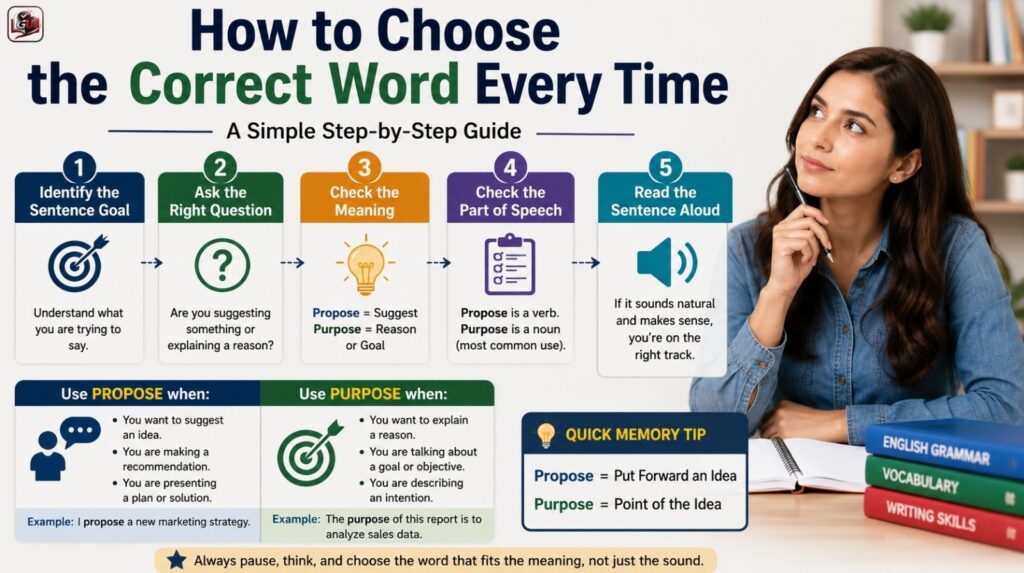
Step 1: Identify the Sentence Goal
Ask yourself:
Are you presenting an idea?
If yes, choose propose.
Example:
I propose a new workflow.
Step 2: Look for the Reason
Are you explaining why something exists?
If yes, choose purpose.
Example:
The purpose of the workflow is efficiency.
Step 3: Check the Grammar
If the word needs to function as a verb, use propose.
If it functions as a noun, use purpose.
Step 4: Read the Sentence Aloud
Reading aloud often reveals mistakes quickly.
Compare:
- I purpose a solution.
- I propose a solution.
The second sounds natural because it is grammatically correct.
Usage Trends and Language Data (2025–2026)
Recent language analysis tools show that confusion between commonly misused English words remains one of the most searched grammar topics online.
Key Findings
- Search interest in word comparisons continues to grow in 2025 and 2026.
- Grammar-related searches receive millions of monthly queries globally.
- Commonly confused words generate high engagement among students and professionals.
- Business communication training increasingly focuses on word-choice accuracy.
Language platforms and educational publishers report that users frequently search for distinctions between similar-looking words because accurate communication remains essential in workplaces, schools, and digital publishing.
As more content is published online, understanding word usage helps writers build credibility and improve readability.
Expert Tips for Remembering the Difference
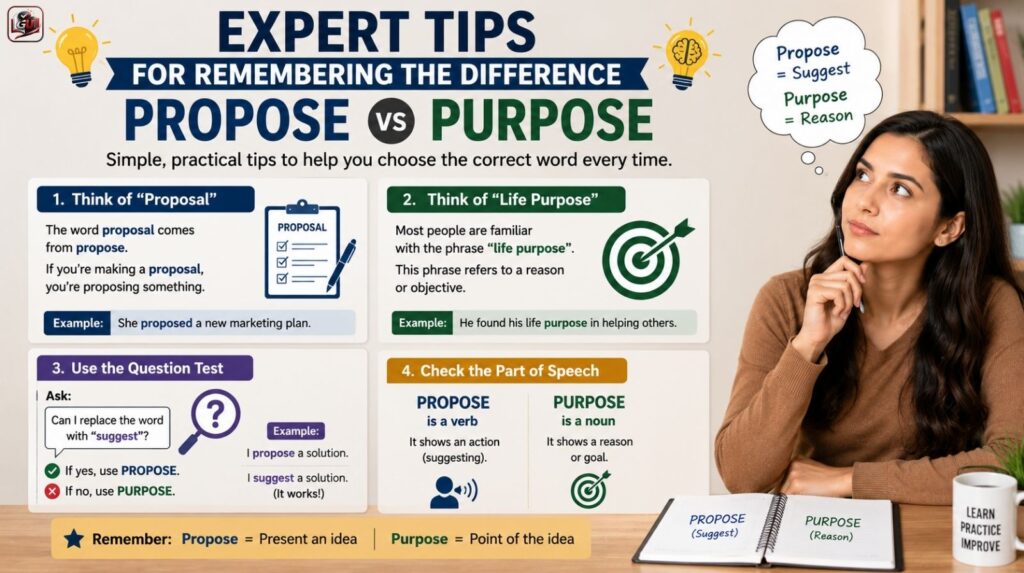
Think of “Proposal”
The word proposal comes from propose.
If you’re making a proposal, you’re proposing something.
Think of “Life Purpose”
Most people are familiar with the phrase:
Life purpose
This phrase refers to a reason or objective, making it easy to remember the meaning of purpose.
Use the Question Test
Ask:
Can I replace the word with “suggest”?
If yes, use propose.
Example:
I propose a solution.
becomes
I suggest a solution.
The sentence still works.
FAQs
Q. Is it propose or purpose an idea?
A: The correct phrase is propose an idea because propose means to suggest something.
Q. What does purpose mean in a sentence?
A: Purpose refers to the reason, goal, or objective behind an action.
Q. Can purpose be used as a verb?
A: Yes, purpose can occasionally function as a verb meaning “intend,” but this usage is less common in modern English.
Example:
She purposed to finish the project early.
Q. Is “I purpose a plan” correct?
A: In modern English, I propose a plan is the preferred and standard expression.
Q. How do I remember propose vs purpose?
A: Remember:
- Propose = Suggest
- Purpose = Reason
Q. Why are propose and purpose often confused?
They have similar spellings and both relate to plans and intentions, which can make them seem interchangeable.
Authoritative References
For additional grammar guidance, consider these trusted resources:
- Merriam-Webster Dictionary
- Cambridge Dictionary
- Purdue Online Writing Lab (OWL)
These sources provide detailed definitions, examples, and grammar explanations used by educators and professional writers worldwide.
Conclusion
Understanding Propose vs Purpose: Which Is Correct? becomes simple once you recognize their different roles in a sentence.
Propose means to suggest or recommend an idea, while purpose refers to a reason, goal, or objective. Although the words share some similarities, they are not interchangeable in most situations.
Whenever you’re unsure, ask yourself whether you’re presenting an idea or explaining a reason. If you’re suggesting something, use propose. If you’re describing an objective, use purpose.
Mastering this distinction will improve your writing, strengthen professional communication, and help you avoid one of the most common English vocabulary mistakes.
👉Keep learning with more easy grammar lessons on GrammerUpdate.com

Noor Fatima is a professional blogger specializing in spelling correction and grammar guidance. She creates clear, practical content to help readers avoid common mistakes, strengthen writing skills, and communicate with confidence in everyday and professional settings.