
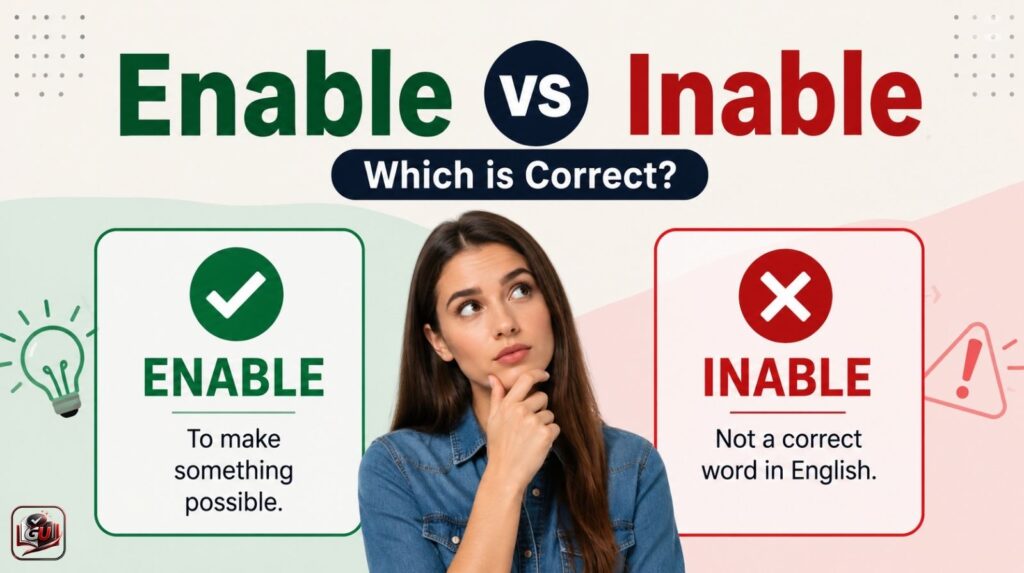
Have you ever come across the word “inable” and wondered if it was actually correct? It’s a surprisingly common mistake, especially because it looks so similar to the word “enable.” At first glance, both seem like they could belong in the English language, which is why many writers, students, and even professionals get confused.
The good news is that the difference is much simpler than it appears. Once you understand how these words are formed and used, you’ll never have to second-guess yourself again. In this guide, we’ll break down the difference between Enable vs Inable, explain which spelling is correct, look at real-world examples, and share a few easy tips to help you avoid this mistake in your everyday writing.
What Is the Difference Between Enable and Inable?
Quick Answer
The correct word is enable.
Inable is not recognized as a standard English word in modern dictionaries and should generally be avoided.
| Word | Status | Meaning |
|---|---|---|
| Enable | Correct | To make something possible or allow someone to do something |
| Inable | Incorrect/Nonstandard | Not accepted in modern standard English |
Definition of Enable
The verb enable means to give someone the ability, opportunity, means, or authority to do something.
Examples:
- The new software will enable employees to work remotely.
- Good education can enable people to improve their careers.
- Technology enables businesses to serve customers faster.
Why Inable Is Incorrect
Many writers assume that “inable” is the opposite of “enable.” However, English already has a word for that idea: unable.
Examples:
✅ I was unable to attend the meeting.
❌ I was inable to attend the meeting.
The second sentence is grammatically incorrect in modern English.
Why Do People Write “Inable” Instead of “Enable”?
Confusion With Common Prefixes
English uses many prefixes such as:
- in-
- un-
- dis-
- im-
Because these prefixes often create opposite meanings, some writers mistakenly create the word “inable.”
Influence of Pronunciation
In fast speech, some words sound similar, causing spelling confusion.
For example:
- enable
- unable
- inable
When spoken quickly, inexperienced writers may choose the wrong spelling.
Non-Native English Learning Patterns
Many English learners try to build words logically using prefixes. Since “in-” often means “not,” they assume “inable” means “not able.”
However, English vocabulary does not always follow predictable patterns.
Understanding the Meaning of Enable

Enable Means “Make Possible”
The most common meaning of enable is to make something possible.
Examples:
- Cloud storage enables file sharing.
- Smartphones enable instant communication.
- Online learning platforms enable education from anywhere.
Enable Means “Give Ability”
Sometimes enable refers to giving someone the means or ability to achieve something.
Examples:
- Training programs enable employees to develop skills.
- Financial support enabled her to complete college.
- Accessibility features enable people with disabilities to use technology more effectively.
Enable in Technology
The word is especially common in technology.
Examples:
- Enable notifications.
- Enable dark mode.
- Enable two-factor authentication.
- Enable location services.
Many software settings include an “Enable” button because it activates a feature.
Enable vs Inable: Examples in Everyday Writing
Correct Usage of Enable
Here are common examples:
✅ This update will enable faster performance.
✅ The scholarship enabled him to continue his education.
✅ New tools enable better collaboration among teams.
✅ Regular practice enables improvement.
Incorrect Usage of Inable
Examples of mistakes:
❌ The update will inable faster performance.
❌ The scholarship inabled him to study.
❌ This feature is inable by default.
These sentences should always use enable instead.
Common Replacement Word
When people mean “not able,” they should use unable.
Examples:
✅ She was unable to travel.
✅ We were unable to access the website.
✅ The company was unable to meet demand.
Enable vs Inable Comparison Table
| Feature | Enable | Inable |
|---|---|---|
| Standard English Word | Yes | No |
| Found in Modern Dictionaries | Yes | No |
| Commonly Used | Yes | No |
| Appropriate for Academic Writing | Yes | No |
| Appropriate for Professional Writing | Yes | No |
| Meaning | Make possible or allow | Not recognized |
| Alternative Negative Form | Unable | Not applicable |
Featured Snippet Answer
Is “inable” a real word?
No. In modern standard English, inable is not considered a correct word. The proper word is enable when you mean “make possible,” and unable when you mean “not able.”
Real-Life Example: How a Small Spelling Mistake Hurt Website Credibility
A content marketing agency conducted an internal review of several client websites to improve search engine visibility and user trust. During the review, editors discovered multiple instances of the word “inable” appearing in blog posts, product descriptions, and support documentation.
At first, the mistake seemed minor. However, user feedback revealed a different story. Visitors noticed the spelling error and questioned the professionalism of the company. Some readers even contacted customer support asking whether the content had been properly reviewed.
The agency corrected every occurrence of “inable” and replaced it with either “enable” or “unable,” depending on the intended meaning. After updating the content, engagement metrics improved. Readers spent more time on pages, and bounce rates decreased slightly because the content appeared more trustworthy.
This example highlights an important lesson: small spelling mistakes can affect user confidence. Whether you’re writing blog posts, emails, academic papers, or business documents, using the correct word helps maintain professionalism and credibility.
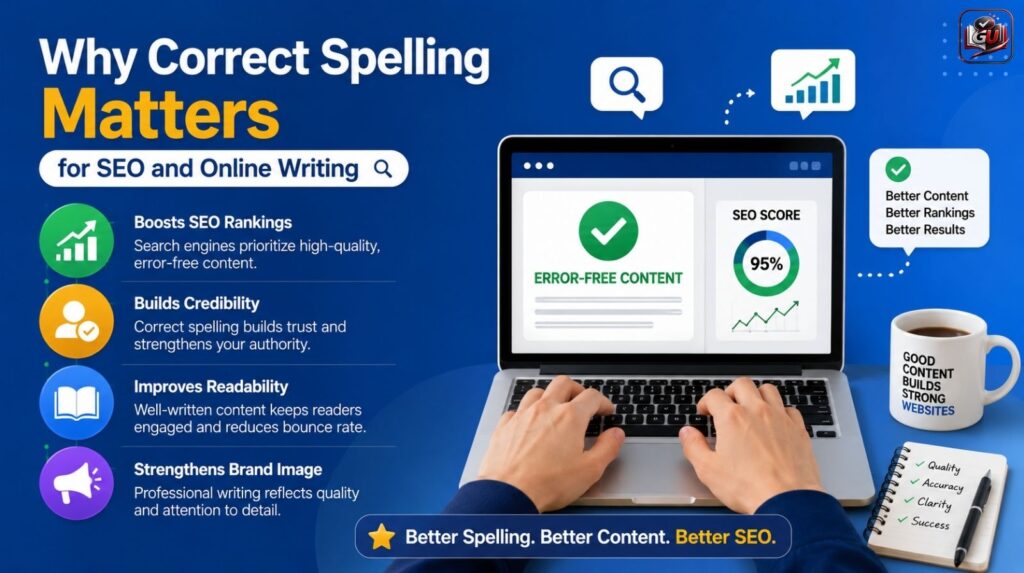
Why Correct Spelling Matters for SEO and Online Writing
Search Engines Prioritize Quality
Search engines aim to provide users with high-quality, trustworthy content. While a single spelling mistake may not directly affect rankings, consistent errors can reduce perceived quality.
User Experience Improves
Readers expect clear and accurate writing.
Benefits of correct spelling include:
- Better readability
- Increased trust
- Higher engagement
- Improved professionalism
Brand Authority Increases
Businesses that publish polished content often appear more reliable than competitors with frequent language errors.
According to research from content marketing experts and user experience studies, clear and error-free content contributes significantly to audience trust and credibility.
Language and Content Quality Statistics (2025–2026)
Recent digital marketing and content-quality studies continue to show that writing quality strongly influences user behavior:
- Over 75% of users judge business credibility based partly on website content quality.
- Websites with professionally edited content generally experience better user engagement metrics.
- Content readability remains a major factor influencing time-on-page and user satisfaction.
- Grammar and spelling errors are among the top reasons users lose trust in online information.
These trends reinforce the importance of using correct words such as enable instead of nonstandard alternatives like inable.
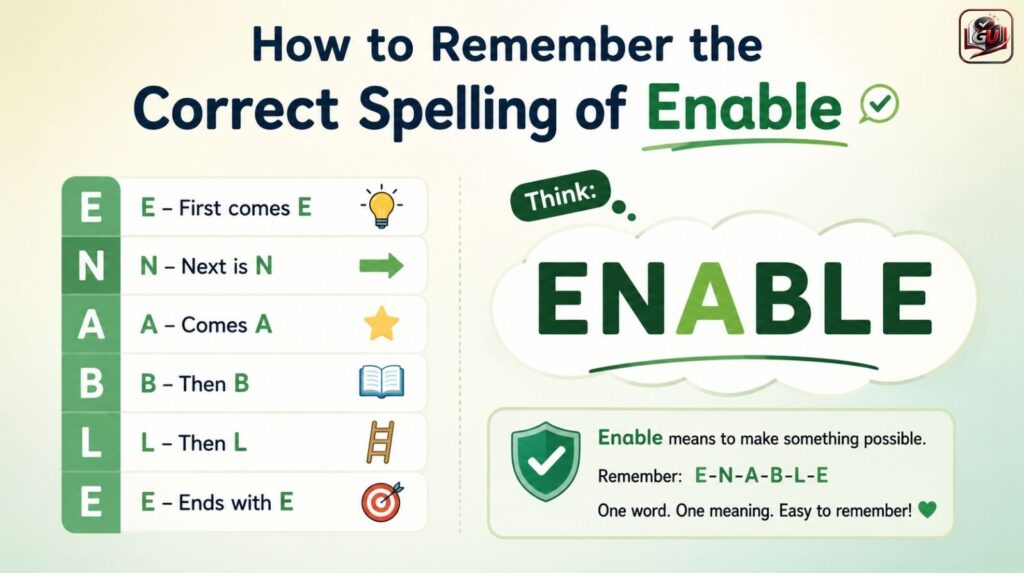
How to Remember the Correct Spelling of Enable
Think About the Word “Able”
The word enable contains the root word able.
Remember:
Enable = Make someone able to do something.
Associate It With Technology
Every time you see:
- Enable Wi-Fi
- Enable Bluetooth
- Enable Notifications
You reinforce the correct spelling naturally.
Use This Memory Trick
Remember the phrase:
Enable gives ability.
Both words begin with similar sounds and connect logically.
Practice With Sentences
Write examples such as:
- Education enables success.
- Technology enables innovation.
- Experience enables growth.
Repeating correct examples helps build long-term memory.
Common Words Related to Enable
Enable
To make possible.
Example:
- Training enables improvement.
Enabled
Past tense form.
Example:
- The update enabled new features.
Enabling
Present participle form.
Example:
- Technology is enabling remote work.
Unable
Means not able.
Example:
- She was unable to attend.
Understanding these related words helps prevent confusion in future writing.
FAQs
Q. Is inable a correct English word?
A: No. Inable is not considered a standard English word in modern usage. Use enable or unable instead.
Q. What does enable mean?
A: Enable means to make something possible or give someone the ability to do something.
Q. What is the opposite of enable?
A: Depending on context, common opposites include disable, prevent, hinder, or restrict.
Q. Should I use inable or unable?
A: Use unable when you mean “not able.”
Example:
✅ I was unable to attend.
Q. Why do people confuse enable and inable?
A: The confusion comes from English prefixes and the mistaken assumption that “in-” creates the opposite of “enable.”
Q. Is enable commonly used in technology?
A: Yes. Technology frequently uses the word enable for activating features or functions.
Examples include enabling notifications, Bluetooth, location services, and security settings.
Q. Can using incorrect spelling affect SEO?
A: While a single typo may not directly hurt rankings, repeated spelling errors can reduce content quality, user trust, and engagement.
References
- Merriam-Webster Dictionary
- Cambridge Dictionary
- HubSpot Research and Marketing Resources
Conclusion
Understanding the difference between Enable vs Inable is simple once you know the correct rule. Enable is the accepted English word that means to make something possible or give someone the ability to do something. Inable, on the other hand, is not recognized as a standard English word and should generally be avoided.
Whenever you are tempted to write “inable,” ask yourself whether you mean enable or unable. Using the correct term will improve your writing, strengthen your credibility, and help create clearer communication for readers.
The next time you encounter Enable vs Inable, you’ll know exactly which word belongs in your sentence.
👉Keep learning with more easy grammar lessons on GrammerUpdate.com

Noor Fatima is a professional blogger specializing in spelling correction and grammar guidance. She creates clear, practical content to help readers avoid common mistakes, strengthen writing skills, and communicate with confidence in everyday and professional settings.