
Many writers get confused between Parents’ vs Parent’s because both words look almost the same, yet they have completely different meanings. A tiny apostrophe might seem unimportant, but placing it in the wrong spot can change the entire sentence.
For example:
- My parent’s car is outside.
- My parents’ car is outside.
Both sentences appear correct at first glance. However, one refers to a single parent, while the other talks about multiple parents. That’s exactly why apostrophe placement matters in English grammar.
The confusion becomes even more common in emails, school writing, blog posts, and everyday conversations. Fortunately, the rule is much simpler than it seems.
In this guide, you’ll learn the exact difference between Parents’ vs Parent’s, when to use each one correctly, common mistakes to avoid, practical examples, and easy memory tricks that make the rules feel natural in everyday writing.
Understanding the Difference Between Parents’ vs Parent’s
The confusion usually happens because both forms show possession. However, the apostrophe placement changes whether the noun is singular or plural.
What Does “Parent’s” Mean?
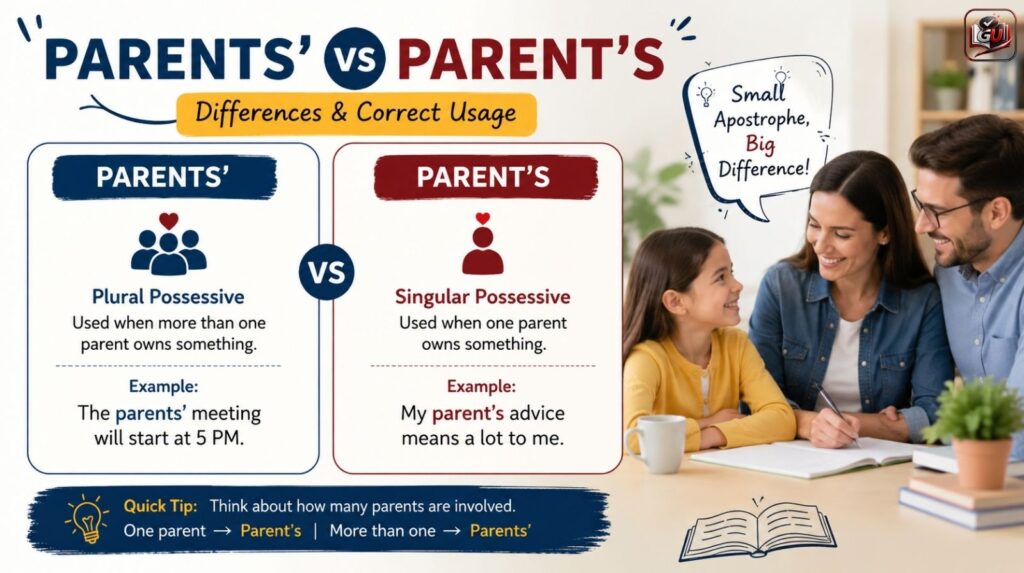
The word Parent’s is singular possessive. It refers to one parent owning something.
Examples of Parent’s
- My parent’s advice helped me succeed.
- The parent’s signature is required.
- One parent’s opinion was enough.
In these examples, only one parent possesses something.
What Does “Parents’” Mean?
The word Parents’ is plural possessive. It refers to multiple parents owning something together.
Examples of Parents’
- The parents’ meeting starts at 6 PM.
- We visited my parents’ house.
- The parents’ decision affected the entire family.
Here, more than one parent shares ownership.
Quick Grammar Rule
| Word | Meaning | Usage |
|---|---|---|
| Parent’s | Singular possessive | One parent owns something |
| Parents’ | Plural possessive | Multiple parents own something |
Why Apostrophe Placement Matters in English Grammar
Apostrophes may look small, but they play a huge role in writing clarity. Incorrect apostrophe usage can confuse readers and even damage credibility in professional or academic writing.
How Grammar Mistakes Affect Communicati
Imagine reading this sentence:
“The parents meeting was canceled.”
This sentence feels incomplete because readers may wonder:
- Is it a meeting for parents?
- Is something belonging to parents?
- Was there only one parent?
Now compare it with:
“The parents’ meeting was canceled.”
The meaning becomes instantly clear.
Common Areas Where Mistakes Happen
Writers often misuse apostrophes in:
- School assignments
- Blog posts
- Social media captions
- Emails
- Website content
- Business documents
Therefore, learning possessive grammar rules improves both readability and professionalism.
Why SEO Writers Should Care
Grammar mistakes can hurt user trust. According to content quality studies shared by Google Search Central, clear and helpful writing improves user experience and content quality signals.
Similarly, HubSpot highlights that grammar errors reduce reader confidence and engagement.
Parent’s vs Parents’: Simple Rule to Remember
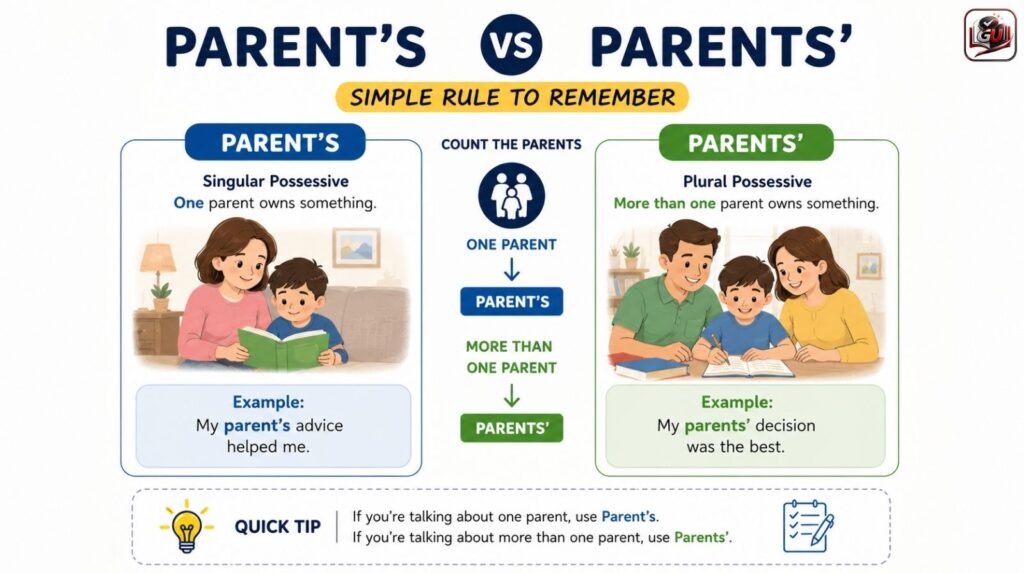
One of the easiest ways to remember the difference is to first identify how many parents you are talking about.
Step-by-Step Memory Trick
Step 1: Count the Parents
Ask yourself:
- One parent?
- More than one parent?
Step 2: Add the Apostrophe Correctly
- One parent → Parent’s
- Multiple parents → Parents’
Easy Formula
\text{One Parent} \rightarrow \text{Parent’s} \ \text{Multiple Parents} \rightarrow \text{Parents’}
Example Breakdown
Singular Possessive
The parent’s notebook was missing.
Meaning: One parent owns the notebook.
Plural Possessive
The parents’ notebook was missing.
Meaning: Multiple parents share the notebook.
A Helpful Shortcut
If the word already ends in s because it is plural, place the apostrophe after the s.
For example:
- Teachers’ lounge
- Students’ project
- Parents’ room
Common Mistakes People Make With Parents’ vs Parent’s
Many grammar mistakes happen because writers focus on pronunciation instead of sentence meaning.
Mistake #1: Using Parent’s for Multiple Parents
Incorrect:
My parent’s house is beautiful. (when referring to both mother and father)
Correct:
My parents’ house is beautiful.
Mistake #2: Forgetting the Apostrophe Completely
Incorrect:
The parents meeting begins soon.
Correct:
The parents’ meeting begins soon.
Without the apostrophe, the sentence sounds incomplete.
Mistake #3: Confusing “Parents” With Possessive Forms
Remember:
| Word | Type |
|---|---|
| Parent | Singular noun |
| Parents | Plural noun |
| Parent’s | Singular possessive |
| Parents’ | Plural possessive |
Why These Mistakes Are So Common
English punctuation rules can be tricky because apostrophes are used for both:
- Possession
- Contractions
As a result, many learners accidentally place apostrophes in the wrong location.
Real-Life Example: How Incorrect Apostrophes Changed a School Newsletter
A private school in Texas shared a printed newsletter inviting families to a yearly gathering. The headline said:
“Welcome to the Parent’s Dinner Night”
Several parents became confused because the sentence suggested the event belonged to only one parent instead of all families.
After receiving feedback, the school corrected the title to:
“Welcome to the Parents’ Dinner Night”
The updated version immediately sounded more professional and grammatically correct.
This small correction improved clarity and prevented misunderstanding among readers. It also highlighted how punctuation affects credibility in formal communication.
Interestingly, marketing experts and content editors often mention that grammar accuracy impacts audience trust. Readers are more likely to engage with content that looks polished and error-free.
For businesses, schools, bloggers, and website owners, proper grammar is not just about rules. It directly affects professionalism, readability, and user confidence.
Parents’ vs Parent’s in Everyday Writing
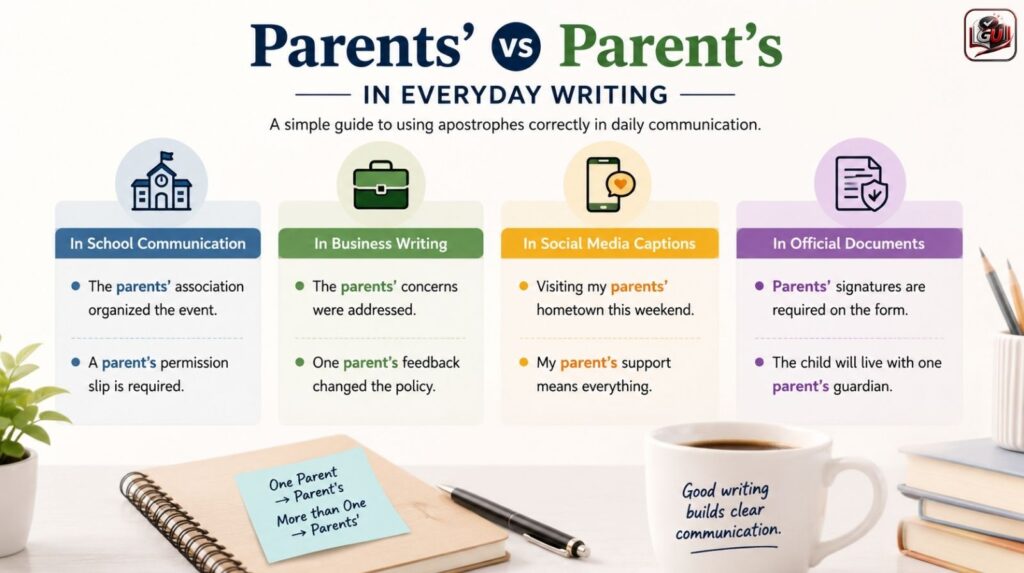
You will often see these words in daily communication. Understanding context makes choosing the correct form much easier.
In School Communication
Examples:
- The parents’ association organized the event.
- A parent’s permission slip is required.
In Business Writing
Examples:
- The parents’ concerns were addressed during the meeting.
- One parent’s feedback changed the policy.
In Social Media Captions
Examples:
- Visiting my parents’ hometown this weekend.
- My parent’s support means everything to me.
In Legal or Official Documents
Possessive grammar appears frequently in:
- Custody agreements
- School forms
- Family contracts
- Medical records
Therefore, grammar accuracy becomes extremely important in official writing.
2025–2026 Grammar and Writing Trends
Digital communication continues to grow rapidly. According to recent education and content marketing reports from 2025, grammar-focused searches have increased significantly because more people now create online content.
Recent Data About Writing Accuracy
Recent studies from educational publishing platforms show:
- Over 70% of readers notice grammar mistakes immediately.
- Content with strong readability often performs better in engagement metrics.
- Professional grammar improves audience trust and retention.
Additionally, AI-assisted writing tools and grammar checkers have become more popular in 2025–2026. However, human understanding of context remains essential because tools sometimes misinterpret possessive nouns.
For example, automated grammar systems occasionally fail to distinguish between:
- Parents
- Parent’s
- Parents’
Therefore, learning the rule yourself is still the best long-term solution.
Parent’s vs Parents’: Comparison Table
Here is a simple comparison table you can bookmark for quick reference.
| Feature | Parent’s | Parents’ |
|---|---|---|
| Type | Singular possessive | Plural possessive |
| Refers To | One parent | Multiple parents |
| Apostrophe Position | Before the s | After the s |
| Example | Parent’s car | Parents’ car |
| Ownership | Single owner | Shared ownership |
How to Always Remember the Correct Usage
Grammar becomes easier when you use practical memory methods instead of memorization alone.
Think About Ownership
Ask:
Who owns the thing?
If one parent owns it, use Parent’s.
If multiple parents own it, use Parents’.
Read the Sentence Out Loud
Sometimes reading aloud helps identify awkward grammar.
Replace the Word Mentally
Try replacing the phrase with:
- “one parent”
- “many parents”
This quickly reveals the correct form.
Practice With Simple Sentences
Examples:
- One parent → The parent’s office
- Many parents → The parents’ office
Consistent practice builds natural grammar habits over time.
FAQs
Q. Is “Parents” without an apostrophe ever correct?
A: Yes. “Parents” is simply the plural form of parent.
Example:
My parents are traveling.
No possession is shown here.
Q. Which is correct: Parents Day or Parents’ Day?
A: The correct version is usually:
Parents’ Day
This is because the day belongs to multiple parents collectively.
Q. What is the difference between Parent’s and Parents?
A:
- Parent’s = one parent owns something
- Parents = more than one parent, no ownership shown
Q. Can I use Parent’s for both mother and father?
A: No. If both parents own something together, use Parents’ instead.
Q. Why do people confuse Parents’ vs Parent’s?
A: The words sound similar when spoken, so writers often misplace the apostrophe during writing.
Q. Is apostrophe usage important in SEO writing?
A: Yes. Clear grammar improves readability, professionalism, and user trust, which supports better engagement.
Conclusion
Understanding Parents’ vs Parent’s becomes simple once you focus on ownership and the number of parents involved.
Remember:
- Parent’s = one parent owns something
- Parents’ = multiple parents own something
Although the apostrophe difference is small, it changes the entire meaning of a sentence. Therefore, using the correct form improves clarity, professionalism, and writing quality.
Whether you are writing blog posts, school documents, emails, or social media captions, mastering possessive grammar helps your content look polished and trustworthy.
Start practicing these rules in everyday writing, and soon the difference between Parents’ vs Parent’s will feel completely natural.
👉Keep learning with more easy grammar lessons on GrammerUpdate.com

Noor Fatima is a professional blogger specializing in spelling correction and grammar guidance. She creates clear, practical content to help readers avoid common mistakes, strengthen writing skills, and communicate with confidence in everyday and professional settings.