
The confusion between check-in vs check in is one of the most common grammar challenges in English writing. Many learners struggle to understand when to use the hyphenated form “check-in” and when to write it as two separate words “check in.”
The difference may look small, but it completely changes the grammatical function of the word one acts as a noun or adjective, while the other functions as a verb.
In this guide, you’ll learn the correct usage of check-in vs check in, supported with real examples, grammar rules, and expert-backed explanations so you never misuse them again.
Understanding Check-in vs Check In (Core Grammar Rule)
What Does “Check-in” Mean?
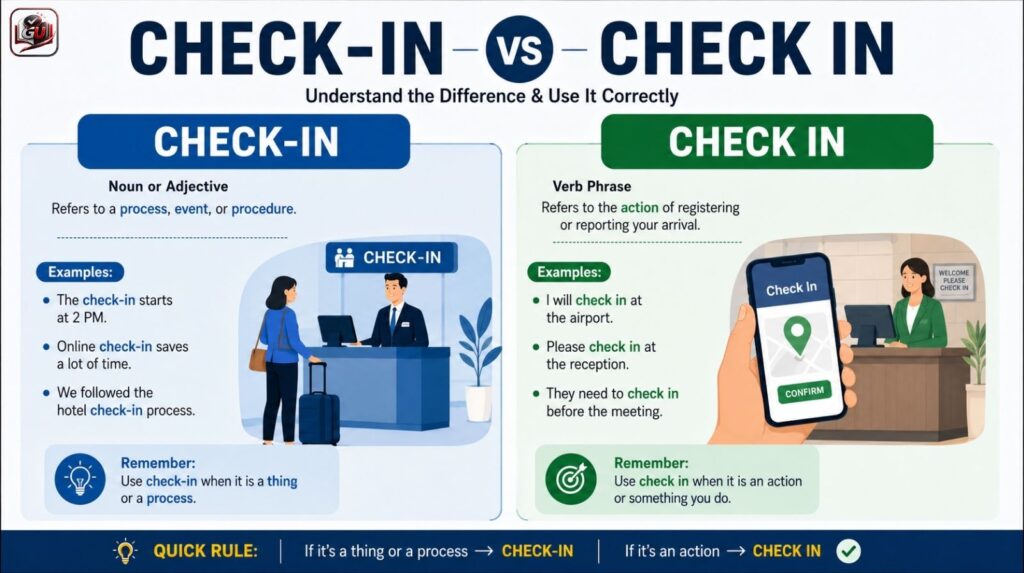
“Check-in” (with a hyphen) is used as a noun or adjective. It refers to a process or event.
For example:
- The check-in starts at 2 PM.
- We followed the hotel check-in procedure.
Here, it describes a thing or process, not an action.
What Does “Check In” Mean?
“Check in” (two words) is a verb phrase. It refers to the action of registering or reporting your arrival.
For example:
- I will check in at the airport.
- Please check in at the reception.
Quick Rule to Remember
- If it’s a thing/process → check-in
- If it’s an action → check in
Grammar Rules Behind Check-in vs Check In
Hyphenated Compound Words in English
English often uses hyphens to convert verbs into nouns.
For example:
- check in → check-in
- sign up → sign-up
- follow up → follow-up
This helps clarify meaning in sentences.
Why Context Matters
The same word can change function depending on usage:
- Verb: I need to check in early.
- Noun: Early check-in is allowed.
Understanding sentence structure is key.
Real-Life Examples of Check-in vs Check In
Travel & Airport Context
- Passengers must check in 3 hours before departure.
- The airport check-in counters open early in the morning.
Hotel Industry Usage
- Guests can check in after 2 PM.
- The hotel check-in process is fast and automated.
Digital & Workplace Usage
- Employees must check in using the app.
- Daily check-in reports are required by managers.
Case Study: Real-Life Usage in the Travel Industry
To understand the practical difference between check-in vs check in, let’s look at how a modern airline system uses both forms in real communication.
A major international airline redesigned its mobile app communication in 2025 to improve clarity for passengers. Initially, user confusion was high because notifications used inconsistent grammar such as “You can check-in now” and “Please check in your flight details.”
After linguistic optimization, the airline standardized usage:
- “Check in” was used in all action-based instructions (verb form).
- “Check-in” was used in menus, buttons, and labels (noun/adjective form).
For example:
- Button label: “Online Check-in”
- Instruction: “Check in now to save time at the airport.”
The result was a noticeable improvement in user understanding and reduced customer support queries about boarding procedures. This shows how small grammar differences can significantly impact real-world user experience, especially in travel and digital platforms.
Data & Trends (2025–2026 Language Usage Insights)
According to language usage research from leading writing platforms:
- Grammar-related searches like “check-in vs check in” have increased due to remote work and travel app usage.
- UX writing guidelines from platforms like Grammarly and Google Material Design emphasize consistent hyphenation rules for better readability.
- Modern digital interfaces increasingly prefer “check-in” as a noun label and “check in” for action buttons.
Sources:
- Merriam-Webster Dictionary
- Cambridge Dictionary
- Grammarly Writing Guide
These platforms confirm that hyphenated compound nouns like “check-in” are standard in formal and digital English writing.
Comparison Table: Check-in vs Check In
| Feature | Check-in | Check In |
|---|---|---|
| Grammar Type | Noun / Adjective | Verb phrase |
| Usage | Process or event | Action |
| Example | The check-in is fast | I will check in early |
| Context | Airport, hotel, app labels | Actions in sentences |
| Structure | Hyphenated | Two separate words |
Common Mistakes with Check-in vs Check In
Mistake 1 – Using Hyphen in Verb Form
Incorrect: I will check-in at the hotel.
Correct: I will check in at the hotel.
Mistake 2 – Missing Hyphen in Noun Form
Incorrect: The check in process is smooth.
Correct: The check-in process is smooth.
Mistake 3 – Mixing Both Forms in One Sentence
Incorrect: Please check-in after you check in.
Correct: Please check in after completing the check-in process.
Why This Difference Matters in Writing
Understanding check-in vs check in is not just grammar theory it directly affects clarity in:
- Professional emails
- Travel instructions
- App UI writing
- SEO content writing
Incorrect usage can make writing look unprofessional or confusing, especially in formal communication.
FAQs
q. What is the difference between check-in and check in?
A: “Check-in” is a noun/adjective, while “check in” is a verb phrase.
q. Is check-in always hyphenated?
A: Yes, when used as a noun or adjective, it is always hyphenated.
q. Can I use check in in formal writing?
A: Yes, but only when used as a verb.
q. Why does English use hyphens in words like check-in?
A: Hyphens clarify meaning and help distinguish between verb and noun forms.
q. Is airport check-in noun or verb?
A: It is a noun when referring to the process (check-in desk, check-in time).
q. Which is more commonly used in apps?
A: Most apps use “check-in” for labels and “check in” for actions.
Conclusion
The difference between check-in vs check in may seem minor, but it plays a major role in English grammar, clarity, and professional writing. Remember the simple rule:
- Use check-in when referring to a process or noun
- Use check in when describing an action
Mastering this distinction will instantly improve your writing accuracy, especially in travel content, business communication, and SEO writing.
If you want to improve your English grammar skills further, start paying attention to compound words like this in everyday writing you’ll notice patterns quickly and naturally.
👉 Keep learning, keep practicing, and refine your writing one rule at a time.
👉Keep learning with more easy grammar lessons on GrammerUpdate.com

Noor Fatima is a professional blogger specializing in spelling correction and grammar guidance. She creates clear, practical content to help readers avoid common mistakes, strengthen writing skills, and communicate with confidence in everyday and professional settings.