
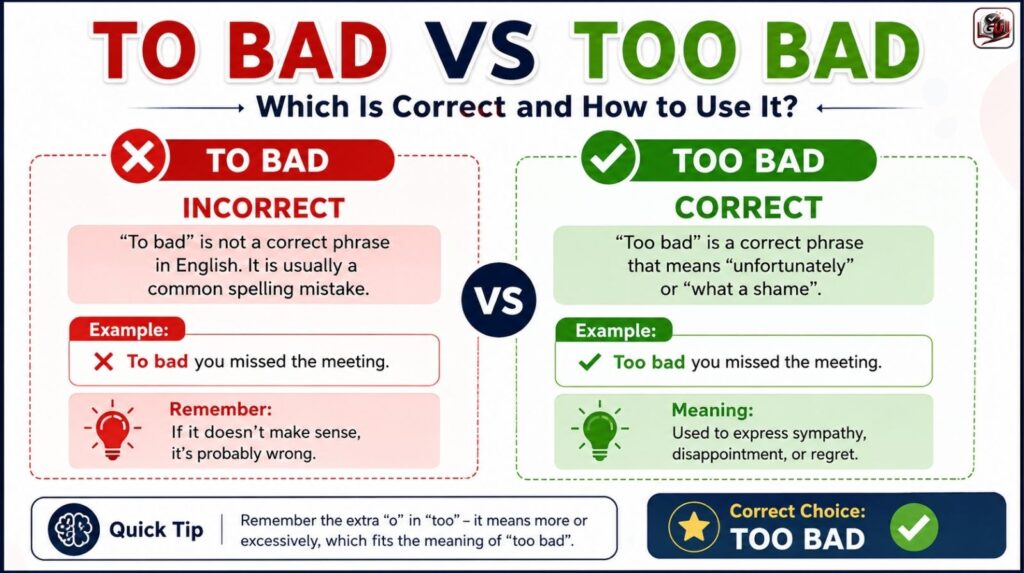
Have you ever typed “to bad” in a message and wondered whether it was correct? You’re not alone. Many English learners and even native speakers occasionally confuse “to bad” and “too bad.”
The confusion happens because the words to and too sound exactly alike when spoken. However, they have very different meanings and grammatical functions. Using the wrong one can make your writing appear less professional and may change the meaning of your sentence.
In this guide, you’ll learn the difference between to bad vs too bad, discover which phrase is correct, see real-world examples, avoid common mistakes, and gain practical tips for remembering the correct usage every time.
What Is the Difference Between To Bad and Too Bad?
The short answer is simple:
- Too bad is a correct and common English phrase.
- To bad is usually incorrect and considered a spelling or grammar mistake.
Understanding “Too Bad”
The phrase too bad means:
- Unfortunately
- Regrettably
- That’s a shame
- Unfortunate situation
Examples:
- It’s too bad that the concert was canceled.
- That’s too bad. I was looking forward to seeing her.
- It’s too bad we missed the train.
In these examples, too means “excessively” or serves as an intensifier expressing regret.
Understanding “To Bad”
The phrase to bad generally has no grammatical meaning in standard English.
Incorrect examples:
❌ To bad you couldn’t come.
❌ That’s to bad.
Correct versions:
✅ Too bad you couldn’t come.
✅ That’s too bad.
Therefore, when expressing sympathy or disappointment, too bad is always the correct choice.
Why Is “Too Bad” Correct?
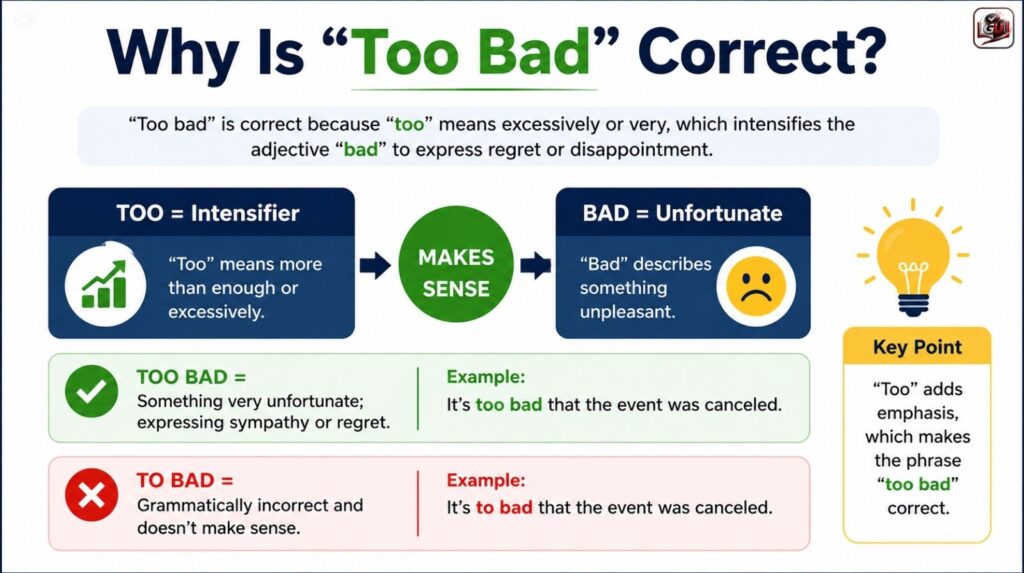
The confusion comes from the words to and too.
What Does “To” Mean?
The word to is a preposition or part of an infinitive verb.
Examples:
- I went to school.
- She wants to learn English.
- We traveled to London.
What Does “Too” Mean?
The word too usually means:
- Also
- As well
- More than enough
- Excessively
Examples:
- I want to come too.
- The coffee is too hot.
- It’s too bad that they left early.
Why “Too Bad” Works
In the phrase too bad, the word too intensifies the adjective bad.
Meaning:
- Extremely unfortunate
- Regrettably bad
- Sadly disappointing
Example:
“It’s too bad that the event was postponed.”
The phrase communicates disappointment or sympathy.
To Bad vs Too Bad: Side-by-Side Comparison
| Feature | To Bad | Too Bad |
|---|---|---|
| Grammatically Correct | ❌ No | ✅ Yes |
| Common Usage | Rarely used | Very common |
| Meaning | Usually none | Unfortunate, regrettable |
| Accepted in Formal Writing | ❌ No | ✅ Yes |
| Accepted in Casual Writing | ❌ No | ✅ Yes |
| Dictionary Recognition | ❌ No | ✅ Yes |
Quick Rule
If you mean:
- Unfortunately
- What a shame
- Regrettably
Use too bad, not to bad.
Common Situations Where You Use “Too Bad”
Understanding real-life usage makes the difference easier to remember.
Expressing Sympathy
Examples:
- That’s too bad about your injury.
- It’s too bad your vacation got canceled.
Showing Disappointment
Examples:
- It’s too bad we couldn’t attend the wedding.
- That’s too bad because the opportunity was excellent.
Responding to Bad News
Examples:
Person A: I failed my driving test.
Person B: That’s too bad. You’ll do better next time.
Informal Conversations
Examples:
- Too bad, we missed the movie.
- Too bad the weather changed.
The phrase is extremely common in everyday English conversations.
Common Mistakes People Make With To Bad and Too Bad
Many writers accidentally type to bad because English contains many homophones words that sound alike but have different spellings and meanings.
Mistake #1: Writing What You Hear
Since to and too sound identical, people often spell the phrase incorrectly.
Incorrect:
❌ That’s to bad.
Correct:
✅ That’s too bad.
Mistake #2: Relying on Autocorrect
Autocorrect does not always catch contextual mistakes.
Example:
- The sentence may be spelled correctly but still be grammatically wrong.
Mistake #3: Confusing “Too” With “To”
A useful memory trick:
- Too has an extra “o.”
- Think of the extra “o” as meaning “extra” or “more.”
Since too often means “more than enough” or acts as an intensifier, the extra letter helps you remember the correct spelling.
Mistake #4: Using It in Professional Writing
Business emails, academic papers, and professional documents require proper grammar.
Always proofread for:
- To/too confusion
- Their/there/they’re confusion
- Your/you’re confusion
These errors can reduce credibility.
Real-Life Case Study: How a Small Grammar Error Changed a Professional Email
A marketing coordinator was preparing a client communication regarding a delayed project launch. While expressing regret, she wrote:
“To bad the release has been delayed.”
The client noticed the error immediately.
Although the message’s meaning was still understandable, the mistake created an impression of rushed communication and lack of attention to detail. In professional environments, even minor grammar issues can influence how readers perceive competence and professionalism.
After receiving feedback from her manager, the coordinator began using a proofreading checklist and grammar-review tools before sending important emails.
A few months later, internal communication quality improved significantly. Team members reported fewer misunderstandings, and client-facing messages appeared more polished.
See Also: Nitch vs Niche Difference: Which Spelling Is Correct?
This example highlights an important lesson: small errors like confusing to bad and too bad may seem insignificant, but they can affect credibility in workplaces, schools, and business settings.
The correct phrase:
✅ “Too bad the release has been delayed.”
The lesson is simple mastering commonly confused words strengthens communication and creates a more professional impression.
To Bad vs Too Bad Usage Statistics (2025–2026)
Language trends continue to show overwhelming preference for too bad over to bad.
Recent Findings
According to grammar-learning platforms, educational websites, and language-analysis tools:
- Too bad appears millions of times across published English content.
- To bad is primarily identified as a spelling error.
- Search interest for grammar-related questions involving “too” vs “to” remains strong in 2025 and 2026.
- English learners frequently search for clarification on homophone confusion.
Why This Matters
Search behavior indicates that users want:
- Clear grammar explanations.
- Real examples.
- Easy memory tricks.
- Writing accuracy for school and work.
Understanding the correct usage helps improve:
- Academic writing
- Business communication
- Social media content
- Everyday conversations
How to Remember the Correct Spelling Every Time
Step 1: Look for the Meaning
Ask yourself:
“Am I expressing regret or disappointment?”
If yes, use too bad.
Step 2: Remember the Extra O
The extra “o” in too means:
- Extra
- More
- Intensified
Since you’re emphasizing that something is unfortunate, too is the correct choice.
Step 3: Test the Sentence
Example:
“It’s _____ bad we missed the flight.”
Which sounds correct?
✅ It’s too bad we missed the flight.
Step 4: Practice Common Phrases
Memorize these examples:
- That’s too bad.
- It’s too bad.
- Too bad we couldn’t go.
- Too bad the store closed.
Repeated exposure helps build correct habits.
Expert Tips for Using Too Bad Correctly
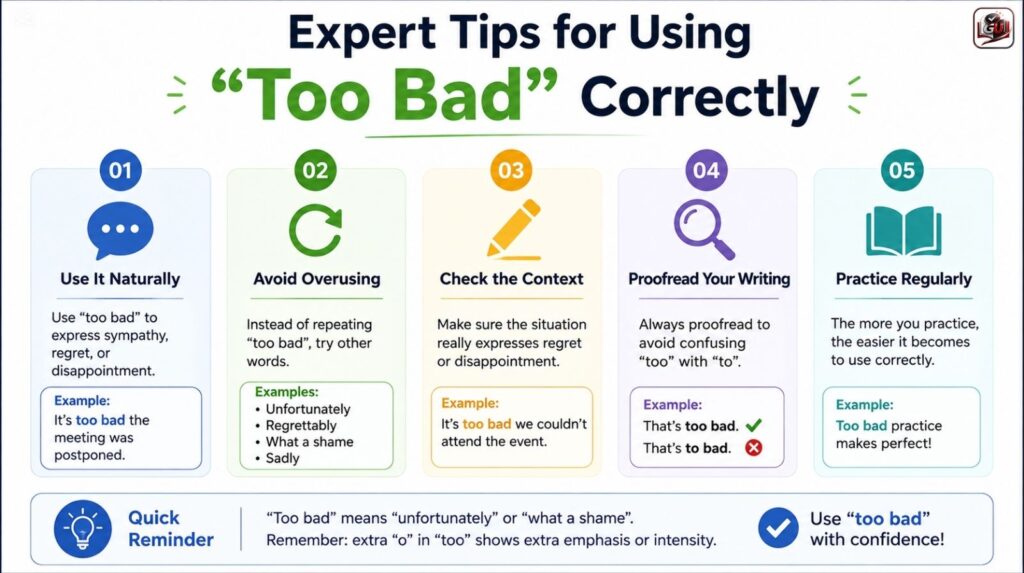
Use It Naturally
Good example:
- It’s too bad the meeting was postponed.
Avoid Overusing It
Instead of repeating “too bad,” consider:
- Unfortunately
- Regrettably
- What a shame
- Sadly
Proofread Important Writing
Before sending emails or publishing content:
- Check homophones.
- Review grammar.
- Read sentences aloud.
These habits significantly reduce errors.
FAQs
Q. Is “to bad” ever correct?
A: In standard English, to bad is almost always incorrect. The correct phrase for expressing regret is too bad.
Q. What does “too bad” mean?
A: Too bad means unfortunately, regrettably, or what a shame.
Q. Why do people write “to bad”?
A: People often confuse to and too because they sound identical when spoken.
Q. Is “too bad” formal or informal?
A: It can be used in both formal and informal situations, though it is more common in conversational English.
Q. How can I remember the difference?
A: Remember that too contains an extra “o,” which can represent “extra” emphasis or intensity.
Q. Is “that’s too bad” grammatically correct?
A: Yes. “That’s too bad” is a common and grammatically correct English expression.
Q. Can I use “too bad” in professional emails?
A: Yes, but use it carefully. For very formal communication, alternatives such as “unfortunately” or “regrettably” may sound more professional.
Authoritative References
For additional grammar guidance, consult:
These trusted language resources provide detailed explanations of English grammar and word usage.
See Also: Payed vs Paid: Difference And Which One Is Correct?
Conclusion
When comparing to bad vs too bad, the answer is straightforward: too bad is the correct phrase in standard English. It expresses disappointment, sympathy, or regret, while to bad is generally considered a spelling mistake.
Remember this simple rule: if you’re saying something is unfortunate or a shame, use too bad. The extra “o” in too can remind you that it adds extra emphasis.
By understanding this distinction, practicing common examples, and proofreading your writing, you’ll avoid one of the most common English grammar mistakes and communicate more confidently.
If you frequently struggle with confusing English words, save this guide and refer back to it whenever you need a quick reminder. Small improvements in grammar can make a big difference in the clarity and professionalism of your writing.
👉Keep learning with more easy grammar lessons on GrammerUpdate.com

Noor Fatima is a professional blogger specializing in spelling correction and grammar guidance. She creates clear, practical content to help readers avoid common mistakes, strengthen writing skills, and communicate with confidence in everyday and professional settings.