
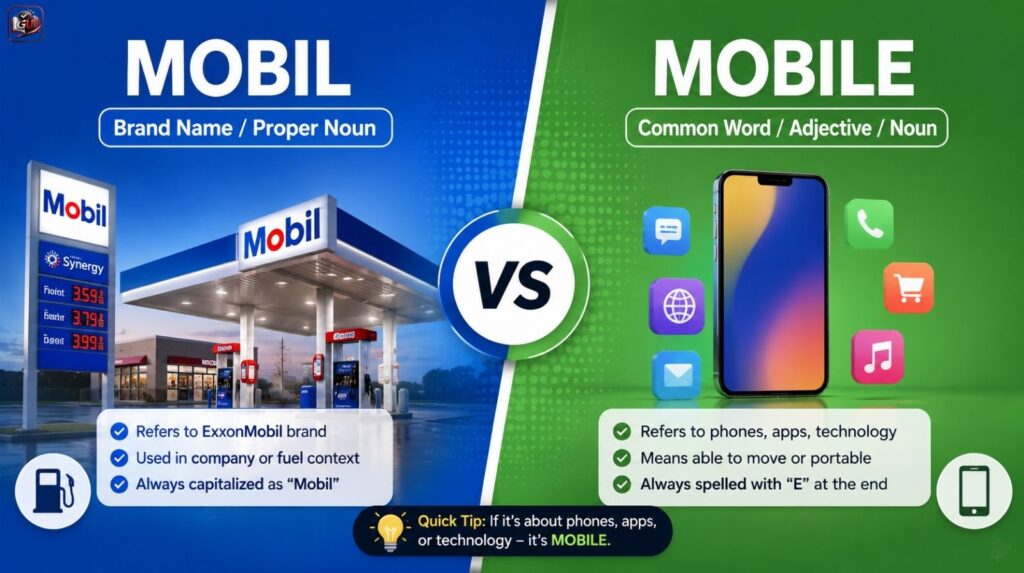
Have you ever typed “mobil” when you actually meant “mobile” and wondered whether both words are correct? You’re not alone. Many English learners, writers, bloggers, and even native speakers occasionally confuse these terms because they look nearly identical.
The difference becomes important when writing professionally, creating content, or communicating online. Using the wrong word can make your writing appear inaccurate and may confuse readers.
In this guide, you’ll learn the meaning of Mobil vs Mobile, when each term should be used, common mistakes to avoid, practical examples, and expert tips for remembering the difference. By the end, you’ll know exactly which word belongs in every situation.
What Is the Difference Between Mobil and Mobile?
The simplest answer is:
- Mobile is a common English word.
- Mobil is usually a proper noun, brand name, or spelling variation in specific languages.
For most English writing situations, mobile is the correct choice.
Quick Definition of Mobile
The word mobile generally means:
- Able to move freely
- Portable
- Related to smartphones or wireless devices
Examples:
- I bought a new mobile phone.
- The company launched a mobile app.
- Modern workers need mobile technology.
Quick Definition of Mobil
Mobil is best known as part of the energy company brand name ExxonMobil.
Examples:
- Mobil gas stations are found in many countries.
- ExxonMobil is one of the world’s largest energy companies.
Outside brand names or specific non-English contexts, mobil is generally not used in standard English writing.
Mobil vs Mobile at a Glance
| Feature | Mobil | Mobile |
|---|---|---|
| Common English Word | No | Yes |
| Brand Name Usage | Yes | No |
| Refers to Phones | No | Yes |
| Means Portable | No | Yes |
| Used in Everyday Writing | Rarely | Frequently |
What Does Mobile Mean?
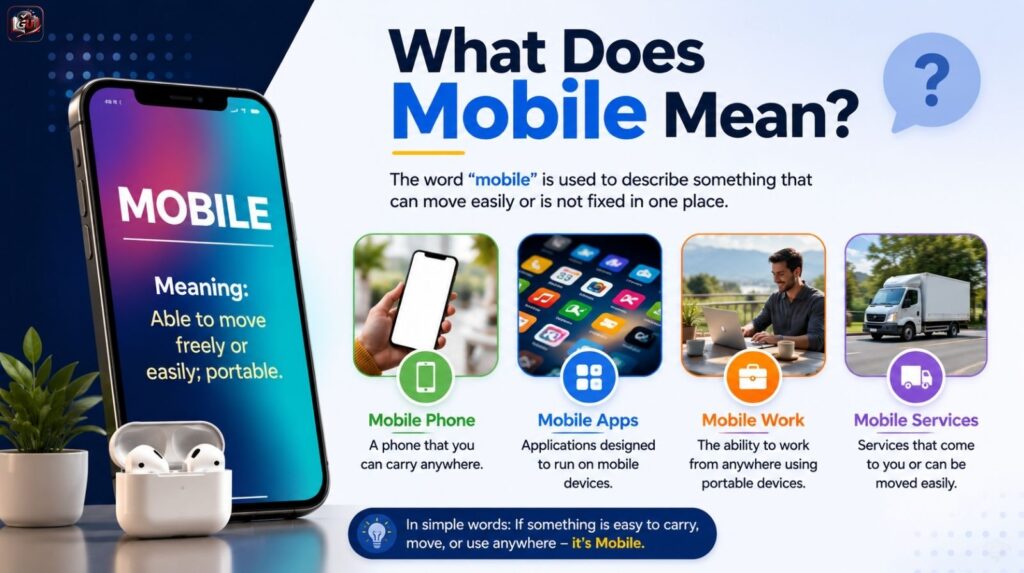
The word mobile comes from the Latin word mobilis, meaning movable or capable of movement.
Today, it has several common meanings in English.
Mobile as a Device
The most common use refers to a smartphone.
Examples:
- Please call me on my mobile.
- She upgraded her mobile phone last week.
Mobile as Portable
The word can also describe something that can be moved easily.
Examples:
- The hospital uses mobile medical units.
- The office invested in mobile workstations.
Mobile in Technology
Businesses frequently use the term in digital marketing and software development.
Examples:
- Mobile applications
- Mobile commerce
- Mobile optimization
- Mobile-first design
Because technology dominates modern communication, mobile has become one of the most widely used words in the digital world.
See Also: Propose vs Purpose: Which Is Correct?
When Should You Use Mobile?
Use mobile whenever you’re discussing movement, portability, smartphones, apps, or wireless technology.
Mobile Phones
Correct:
- My mobile phone battery is low.
Incorrect:
- My mobil phone battery is low.
Mobile Applications
Correct:
- The company released a new mobile application.
Incorrect:
- The company released a new mobil application.
See Also: Gray vs Grey: Which Spelling Is Correct And What’s The Difference?
Mobile Workforce
Correct:
- Many businesses now support a mobile workforce.
Incorrect:
- Many businesses now support a mobil workforce.
Mobile in Everyday Writing
Whether you’re writing:
- Blog posts
- Emails
- Academic papers
- Business documents
- Website content
The correct spelling is almost always mobile.
When Should You Use Mobil?
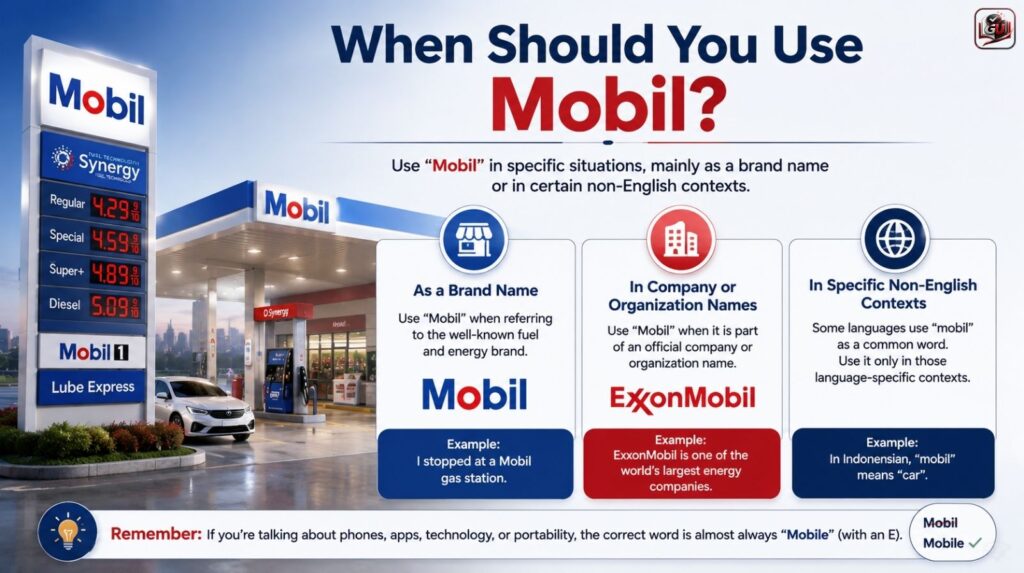
The situations where Mobil is correct are much more limited.
As a Brand Name
The most recognized use is within the ExxonMobil brand.
Examples:
- ExxonMobil announced a new energy initiative.
- The driver stopped at a Mobil station.
In Other Languages
Some languages use mobil as a regular word.
For example:
- Indonesian
- Malay
- Certain European language contexts
However, when writing standard English, these foreign-language uses generally do not apply.
Proper Nouns Require Exact Spelling
Brand names should always keep their official spelling.
Examples:
- Mobil
- ExxonMobil
Changing the spelling of a company name can create inaccuracies and appear unprofessional.
Common Mistakes People Make With Mobil vs Mobile
Many spelling errors happen because both words look similar.
Mistake #1: Dropping the Final “E”
Incorrect:
I forgot my mobil at home.
Correct:
I forgot my mobile at home.
Mistake #2: Autocorrect Confusion
Some devices may suggest unusual spellings based on search history, language settings, or brand references.
Always verify whether you’re referring to:
- A phone → Mobile
- A company name → Mobil
Mistake #3: Copying Non-English Spellings
Writers sometimes encounter mobil on international websites and assume it’s standard English.
In English content, mobile remains the correct choice unless discussing the brand name.
Real-Life Example: How One Missing Letter Changed a Marketing Campaign
A digital marketing agency was preparing advertisements for a technology startup launching a new mobile banking application. The campaign included website banners, social media graphics, blog posts, and email newsletters.
Everything looked polished until the launch day.
One of the main headlines read:
“Download Our New Mobil Banking App”
At first glance, the mistake seemed minor. However, users quickly noticed the spelling error. Several customers questioned whether the company was associated with the Mobil fuel brand. Others assumed the advertisement had been created without proper proofreading.
The marketing team tracked campaign performance and discovered that engagement on the incorrectly spelled advertisements was noticeably lower than expected. After correcting the spelling to mobile, user trust improved and click-through rates increased during the following weeks.
This example demonstrates how even a single missing letter can affect credibility, user perception, and marketing effectiveness. Accurate spelling helps build trust, especially in professional communication.
Mobile Technology Statistics in 2025–2026

The importance of understanding the word mobile becomes even clearer when looking at modern technology trends.
Global Smartphone Usage
Recent industry reports show that smartphone adoption continues to rise worldwide, with billions of active users relying on mobile devices daily.
Mobile Internet Dominance
Research from Google and industry analytics platforms indicates that mobile traffic now accounts for more than half of global web usage.
Mobile Commerce Growth
E-commerce studies project continued growth in mobile shopping throughout 2025 and 2026 as consumers increasingly purchase products directly from smartphones.
Why This Matters
Because the mobile industry plays such a major role in modern life, the word mobile appears constantly in:
- SEO content
- Digital marketing
- Technology articles
- Business communications
- Software documentation
Using the correct spelling is essential for clarity and professionalism.
Credible References
- Google Search Central
- Statista
- GSMA Mobile Economy Reports
How to Remember the Difference Between Mobil and Mobile
A simple memory trick can prevent future mistakes.
The “E for Electronics” Rule
Think of it this way:
Mobil + E = Mobile
The letter E can remind you of:
- Electronics
- E-commerce
- Everyday English
Since smartphones and technology are electronic devices, mobile is usually the correct spelling.
Visual Memory Technique
Remember:
📱 Mobile = Phone
⛽ Mobil = Fuel Brand
This quick association makes the distinction much easier.
Proofreading Tip
Before publishing any content, ask:
Am I talking about a phone, app, technology, or portability?
If yes, choose mobile.
Mobil vs Mobile: Quick Checklist
Use this checklist whenever you’re unsure.
Choose “Mobile” If:
✔ You’re talking about a smartphone
✔ You’re discussing apps
✔ You’re writing about technology
✔ You’re describing something portable
✔ You’re creating English content
Choose “Mobil” If:
✔ You’re referring to the Mobil fuel brand
✔ You’re using a specific non-English term
✔ It’s part of a proper company name
FAQs
Q. Is Mobil a real English word?
A: Not as a commonly used English vocabulary word. It is primarily recognized as a brand name, especially in ExxonMobil.
Q. Which spelling is correct: Mobil or Mobile?
A: For most English writing situations, mobile is the correct spelling.
Q. Why do people confuse Mobil and Mobile?
A: The words differ by only one letter, making typographical mistakes common.
Q. Is Mobil short for Mobile?
A: No. Mobil and Mobile are separate terms with different meanings and usage.
Q. Can I use Mobil when talking about smartphones?
A: No. The correct word is mobile when referring to phones or mobile technology.
Q. Is Mobile British or American English?
A: Both British and American English use mobile, although Americans often say “cell phone” more frequently.
Q. Does spelling Mobile incorrectly affect SEO?
A: Yes. Consistent spelling helps search engines understand content and improves professionalism, readability, and user trust.
Conclusion
Understanding Mobil vs Mobile is simpler than it first appears. In standard English, mobile is the correct word for smartphones, portable technology, apps, and anything related to movement or wireless communication. Meanwhile, Mobil is generally reserved for brand names such as ExxonMobil or certain non-English usages.
Whenever you’re writing about technology, phones, or digital experiences, choose mobile. Doing so improves clarity, professionalism, and credibility while helping readers understand your message instantly.
Before publishing your next article, email, or social media post, take a moment to check your spelling. That single letter “E” can make all the difference.
👉Keep learning with more easy grammar lessons on GrammerUpdate.com

Noor Fatima is a professional blogger specializing in spelling correction and grammar guidance. She creates clear, practical content to help readers avoid common mistakes, strengthen writing skills, and communicate with confidence in everyday and professional settings.