
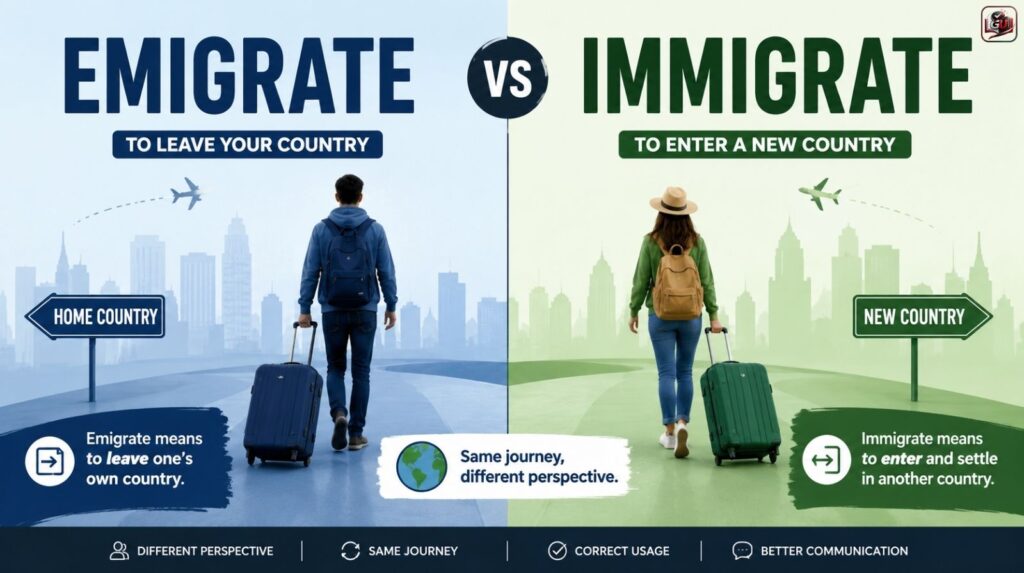
Have you ever read a sentence about someone moving abroad and wondered whether the correct word is emigrate or immigrate? You’re not alone. These two words confuse many English learners because they describe the same move but from different points of view.
For example, if someone leaves India and settles in Canada, did they emigrate or immigrate? The answer depends on which country you’re focusing on. While the difference is actually quite simple, using the wrong word can easily change the meaning of your sentence.
In this guide, you’ll learn the difference between emigrate vs immigrate, when to use each term, common mistakes to avoid, and easy memory tricks that will help you use both words correctly with confidence.
What Is the Difference Between Emigrate and Immigrate?
Quick Definition
The difference between emigrate and immigrate depends on the point of view.
- Emigrate means to leave your country to live somewhere else.
- Immigrate means to enter a new country to live permanently.
Simple Rule to Remember
Think of it this way:
- Emigrate = Exit
- Immigrate = Into
Both words describe the same move, but from different perspectives.
Example
If Maria moves from Spain to Canada:
- Maria emigrated from Spain.
- Maria immigrated to Canada.
The action is the same, but the focus changes.
Understanding the Meaning of Emigrate
What Does Emigrate Mean?
The verb emigrate refers to leaving one’s home country to settle in another country permanently.
The emphasis is on the country being left behind.
Common Sentence Examples
- My grandparents emigrated from Italy in the 1960s.
- Thousands of workers emigrate from developing countries every year.
- She decided to emigrate from Pakistan for better career opportunities.
When to Use Emigrate
Use emigrate when discussing:
- Leaving a country
- Moving abroad permanently
- Departing from a homeland
Keyword Tip
The preposition commonly used with emigrate is:
Emigrate from + country
Correct:
✅ He emigrated from Germany.
Incorrect:
❌ He emigrated to Germany.
Understanding the Meaning of Immigrate
What Does Immigrate Mean?
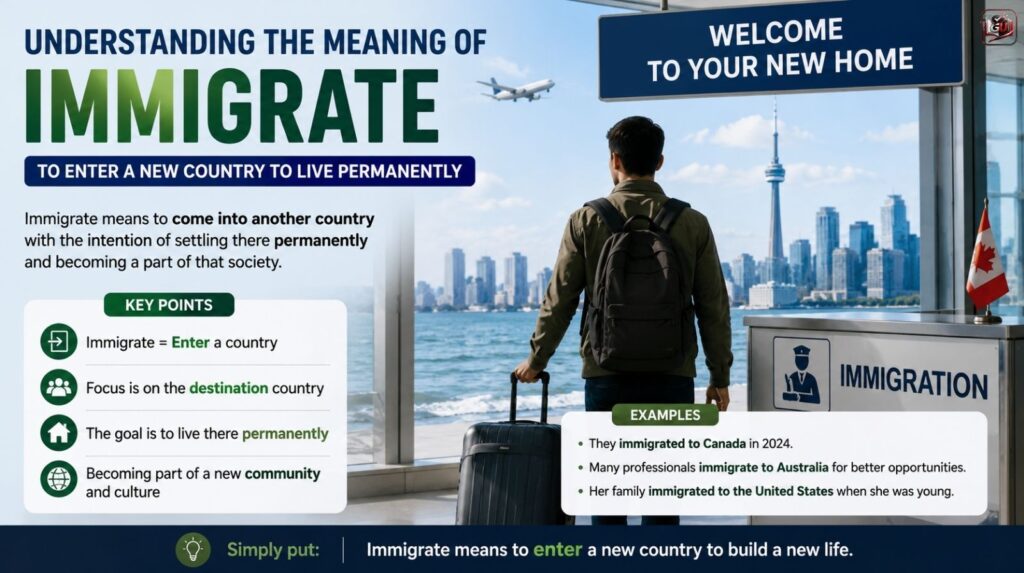
The verb immigrate means entering a foreign country to live there permanently.
The focus is on the destination country.
Common Sentence Examples
- They immigrated to Australia in 2024.
- Many professionals immigrate to Canada for better opportunities.
- Her family immigrated to the United States when she was young.
When to Use Immigrate
Use immigrate when discussing:
- Arriving in a new country
- Establishing permanent residence
- Becoming part of another nation
Keyword Tip
The preposition commonly used with immigrate is:
Immigrate to + country
Correct:
✅ She immigrated to New Zealand.
Incorrect:
❌ She immigrated from New Zealand.
Emigrate vs Immigrate: Side-by-Side Comparison
Comparison Table
| Feature | Emigrate | Immigrate |
|---|---|---|
| Meaning | Leave a country | Enter a country |
| Focus | Country of origin | Destination country |
| Common Preposition | From | To |
| Perspective | Departure | Arrival |
| Example | Emigrated from India | Immigrated to Canada |
| Related Noun | Emigration | Immigration |
Easy Memory Trick
Remember:
- Emigrate = Exit a country
- Immigrate = Move Into a country
This simple trick helps many English learners avoid confusion.
Real-Life Example: A Family Moving from India to Canada
Case Study
Consider the Sharma family, who decided to relocate from India to Canada in search of better educational opportunities and career growth.
In 2025, Mr. Sharma received a skilled worker invitation through Canada’s immigration system. After completing the necessary paperwork, obtaining visas, and preparing financial documents, the family moved to Toronto.
From India’s perspective, the family emigrated from India because they left their home country permanently.
From Canada’s perspective, the family immigrated to Canada because they entered the country with the intention of settling there long-term.
See Also: Muscle vs Mussel: Which Is The Difference And How To Use Them Correctly?
Many news reports covering international migration use both terms depending on the context. An article in India might state that the Sharma family emigrated, while a Canadian publication could report that they immigrated.
Understanding this distinction helps readers interpret news stories, government reports, and migration statistics accurately. It also prevents confusion when discussing global mobility, immigration policies, and international workforce trends.
This example demonstrates that emigrate and immigrate often describe the same movement but from opposite viewpoints.
Migration Trends and Statistics (2025–2026)
Global Migration Growth
International migration continues to shape economies worldwide.
According to recent reports from the United Nations, there are more than 300 million international migrants globally, representing a significant increase compared to previous decades.
Popular Immigration Destinations
Countries attracting large numbers of immigrants include:
- Canada
- Australia
- Germany
- United States
- United Kingdom
Why People Emigrate
Common reasons people emigrate include:
- Better employment opportunities
- Higher education
- Family reunification
- Improved quality of life
- Political stability
- Economic advancement
Why Migration Matters
Migration contributes to:
- Workforce development
- Cultural diversity
- Economic growth
- Global knowledge exchange
Understanding terms like emigrate and immigrate becomes increasingly important as international mobility continues to rise.
Sources:
- United Nations Migration Reports
- International Organization for Migration (IOM)
- OECD Migration Outlook Reports
Common Mistakes When Using Emigrate and Immigrate
Mistake 1: Using the Wrong Perspective
Incorrect:
❌ She emigrated to Australia.
Correct:
✅ She immigrated to Australia.
Or:
✅ She emigrated from England.
Mistake 2: Mixing Up Prepositions
Incorrect:
❌ They immigrated from Canada.
Correct:
✅ They immigrated to Canada.
See Also: Instalments vs Installments Which Is Correct And Use It?
Mistake 3: Assuming the Words Mean Different Actions
Many learners think emigrate and immigrate describe separate events.
In reality, they usually describe the same move viewed from different angles.
Practice Example
Sentence:
“John moved from Brazil to Germany.”
Correct versions:
- John emigrated from Brazil.
- John immigrated to Germany.
How to Remember Emigrate vs Immigrate Forever
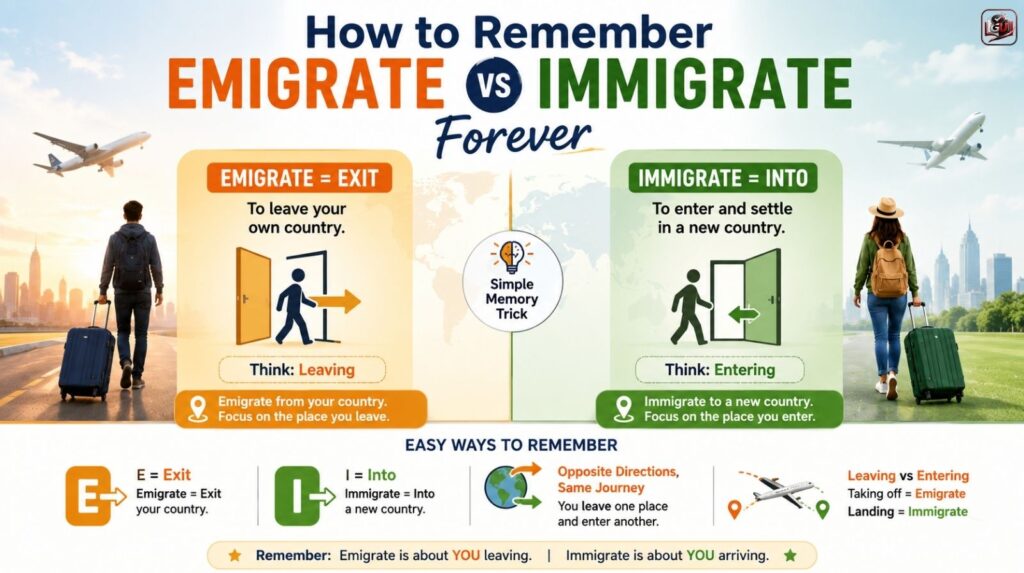
Method 1: Exit vs Into
- Emigrate = Exit
- Immigrate = Into
Method 2: Think About the Direction
Ask yourself:
Are you focusing on the place someone left or the place they entered?
If left:
➡ Use emigrate
If entered:
➡ Use immigrate
Method 3: Visual Memory
Imagine an airplane.
- Taking off from a country = Emigrate
- Landing in a new country = Immigrate
This mental image makes the distinction easy to remember.
Related Words You Should Know
Emigration
The process of leaving a country.
Example:
- Emigration from rural areas has increased.
Immigration
The process of entering a new country.
Example:
- Immigration contributes to cultural diversity.
Migrant
A person who moves from one place to another.
Migration
The overall movement of people from one region or country to another.
These terms frequently appear in discussions about global migration and international relocation.
FAQs
Q. Is emigrate the same as immigrate?
A: No. They describe the same move from different perspectives. Emigrate focuses on leaving a country, while immigrate focuses on entering a new country.
Q. Do you emigrate from or to a country?
A: You emigrate from a country.
Example:
- She emigrated from France.
Q. Do you immigrate from or to a country?
A: You immigrate to a country.
Example:
- He immigrated to Canada.
Q. What is the easiest way to remember emigrate vs immigrate?
A: Remember:
- Emigrate = Exit
- Immigrate = Into
Q. Can one person be both an emigrant and an immigrant?
A: Yes. A person who leaves one country and settles in another is both an emigrant and an immigrant depending on the perspective.
Q. What is the noun form of emigrate?
A: The noun form is emigration.
Q. What is the noun form of immigrate?
A: The noun form is immigration.
Conclusion
Understanding the difference between emigrate vs immigrate is simpler than it first appears. The key is remembering the perspective being used. When someone leaves a country, they emigrate. When they arrive and settle in a new country, they immigrate.
By using the simple memory trick “Emigrate = Exit” and “Immigrate = Into,” you can avoid common mistakes and communicate more confidently. Whether you’re reading migration reports, discussing international relocation, or improving your English vocabulary, knowing when to use these terms correctly will make your writing clearer and more accurate.
Continue practicing with real-world examples, and soon the distinction between emigrate vs immigrate will become second nature.
👉Keep learning with more easy grammar lessons on GrammerUpdate.com

Noor Fatima is a professional blogger specializing in spelling correction and grammar guidance. She creates clear, practical content to help readers avoid common mistakes, strengthen writing skills, and communicate with confidence in everyday and professional settings.