
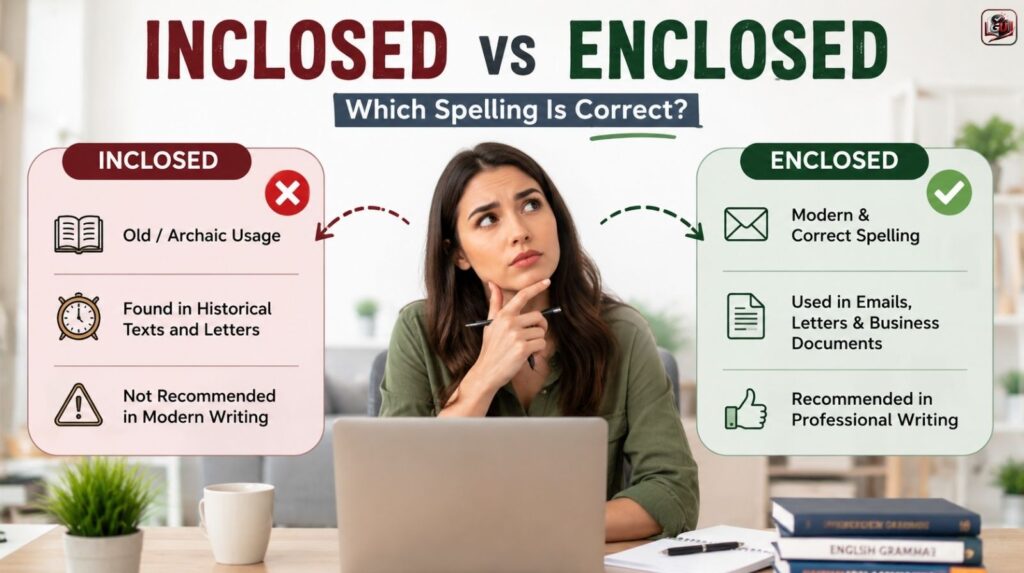
Have you ever come across the words inclosed and enclosed and wondered if they mean the same thing? At first glance, the two spellings look very similar, which makes it easy to assume that both are correct. However, when writing an email, letter, or professional document, choosing the wrong spelling can make your writing look outdated or inaccurate.
The confusion exists because inclosed was once used in older English, while enclosed has become the standard spelling in modern usage. As a result, many writers are unsure which form they should use today.
In this guide, we’ll break down the difference between inclosed vs enclosed, explain their history, show real-world examples, and help you understand which spelling is correct in modern English.
What Is the Difference Between Inclosed and Enclosed?
The short answer is simple:
| Word | Status | Modern Usage |
|---|---|---|
| Inclosed | Archaic/Old-fashioned | Rarely used today |
| Enclosed | Standard English | Correct and widely accepted |
Today, enclosed is the preferred spelling in business communication, academic writing, emails, legal documents, and everyday English.
Why Are People Confused?
The confusion comes from historical spelling variations.
Centuries ago, English writers sometimes used prefixes interchangeably. Words beginning with en- occasionally appeared as in-. Therefore, “inclosed” was once an accepted alternative spelling.
However, language evolves. Over time, enclosed became the standard form, while inclosed gradually disappeared from modern usage.
Quick Answer
If you’re writing today, always choose enclosed unless you’re quoting a historical document.
Is “Enclosed” the Correct Spelling?
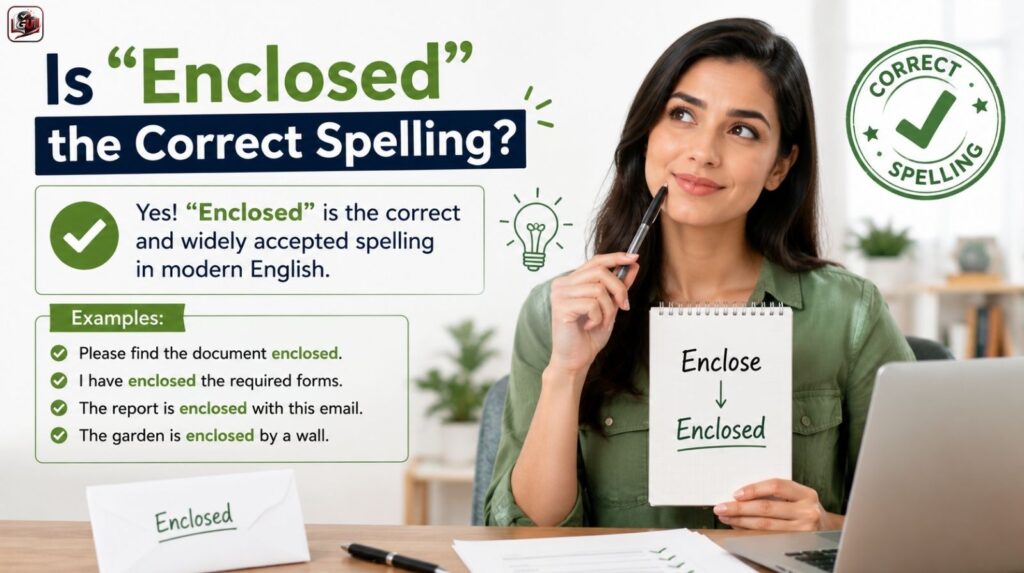
Yes, enclosed is the correct spelling in modern English.
The word “enclosed” means:
- Included inside something
- Surrounded by something
- Attached to a document or letter
Examples of Correct Usage
- Please find the contract enclosed.
- The garden is enclosed by a wooden fence.
- I have enclosed the required documents.
- An enclosed package arrived this morning.
These examples reflect how the word is commonly used in both formal and informal contexts.
Why Dictionaries Prefer Enclosed
Major dictionaries and language authorities list enclosed as the standard spelling used in contemporary English.
Professional editors, publishers, businesses, and educational institutions also recommend using enclosed exclusively in modern writing.
What Does “Inclosed” Mean?
The word inclosed has the same basic meaning as enclosed. It refers to something that is contained, surrounded, or included.
However, the key difference is that inclosed is now considered outdated.
Historical Usage of Inclosed
You may encounter “inclosed” in:
- Historical books
- Old newspapers
- Legal records from previous centuries
- Classic literature
- Archived letters
Example from Older English
You might see sentences such as:
The papers are herein inclosed.
While this was acceptable centuries ago, modern readers would write:
The papers are herein enclosed.
Should You Use Inclosed Today?
In nearly all situations, no.
Using inclosed in modern writing can make your content appear outdated or incorrect.
Inclosed vs Enclosed: A Detailed Comparison
Meaning Comparison
| Feature | Inclosed | Enclosed |
|---|---|---|
| Meaning | Included or surrounded | Included or surrounded |
| Modern Acceptance | Rare | Standard |
| Business Writing | Not recommended | Recommended |
| Academic Writing | Not recommended | Recommended |
| Email Communication | Not recommended | Recommended |
| Historical Documents | Common | Also found |
Pronunciation
Both words are pronounced almost identically:
enclosed = /ɪnˈkloʊzd/
Because they sound similar, many writers assume both spellings are equally acceptable. However, spelling standards not pronunciation determine modern correctness.
Which One Should You Choose?
For modern English:
✅ Enclosed
❌ Inclosed
Why Did English Change from Inclosed to Enclosed?
English spelling has never been completely fixed throughout history.
Many words evolved over centuries as dictionaries, publishers, and educators worked toward standardization.
The Influence of Standard Dictionaries
During the 18th and 19th centuries, dictionaries began promoting consistent spellings.
As a result:
- Enclose became standard.
- Enclosed became standard.
- Inclose became rare.
- Inclosed gradually disappeared.
Language Simplification
Modern English tends to favor forms that are:
- Widely recognized
- Consistently taught
- Commonly published
Therefore, enclosed became the dominant spelling across English-speaking countries.
Similar Examples
Other words have experienced similar changes:
| Older Form | Modern Form |
|---|---|
| Inquire | Enquire (UK variant exists) |
| Inclose | Enclose |
| Inclosed | Enclosed |
Language naturally eliminates less common spellings over time.
Real-Life Example: A Job Application Mistake
A job seeker submitted applications to multiple companies. In their cover letter, they repeatedly wrote:
Please find my resume inclosed.
Although recruiters understood the intended meaning, some hiring managers viewed the spelling as outdated and potentially incorrect.
The applicant later revised the phrase to:
Please find my resume enclosed.
After updating their application materials, their documents looked more professional and aligned with modern business standards.
This example highlights an important lesson. Even when a word has historical legitimacy, modern readers expect contemporary spelling conventions. Using standard forms improves clarity, professionalism, and credibility.
In professional environments, small language choices can influence first impressions. Recruiters, editors, professors, and clients often notice spelling details. Therefore, choosing enclosed instead of inclosed helps ensure your writing meets current expectations.
The goal of communication is clarity. Since modern audiences recognize enclosed immediately, it remains the safest and most effective choice.
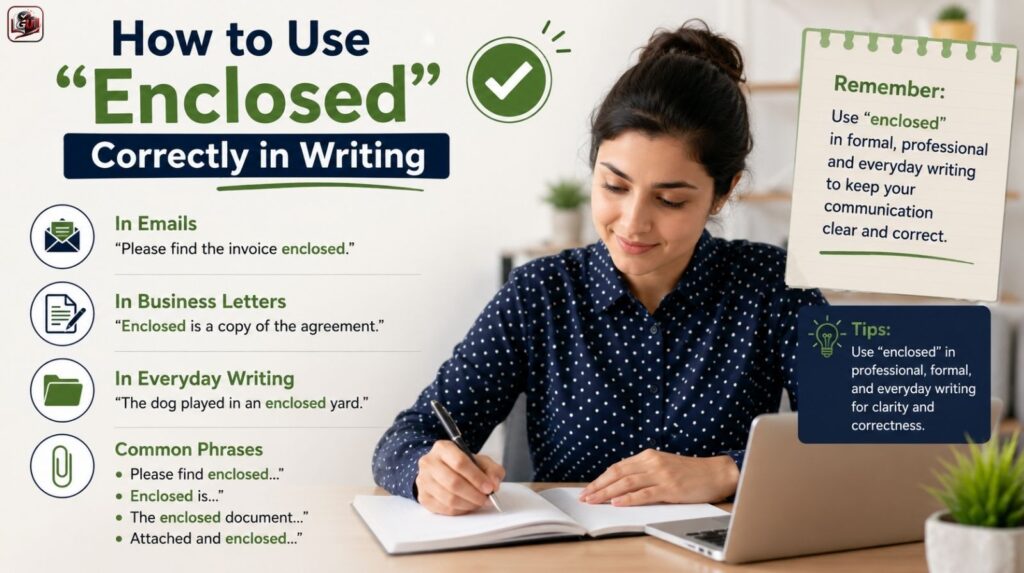
How to Use “Enclosed” Correctly in Writing
In Emails
Examples:
- I have enclosed the invoice for your review.
- Please see the enclosed attachment.
- The enclosed file contains the requested information.
In Business Letters
Examples:
- Enclosed is a copy of the agreement.
- Please review the enclosed documents.
- The enclosed report summarizes our findings.
In Everyday Writing
Examples:
- The dog played in an enclosed yard.
- We purchased an enclosed trailer.
- The enclosed area is reserved for guests.
Common Professional Phrases
- Please find enclosed…
- Enclosed is…
- The enclosed document…
- Attached and enclosed…
These phrases are widely accepted in formal communication.
Usage Statistics and Language Trends (2025–2026)
Language databases and digital publishing trends continue to show overwhelming preference for enclosed over inclosed.
Key Findings
- Modern dictionaries list enclosed as the standard form.
- Most business style guides recommend only enclosed.
- Online publications overwhelmingly use enclosed.
- Searches for inclosed are typically related to historical texts or spelling questions.
According to language usage patterns documented by major dictionary publishers and corpus databases, enclosed remains the dominant spelling across modern English writing, while inclosed appears primarily in archived or historical materials.
This trend demonstrates how language standardization has effectively replaced the older form in everyday communication.
What This Means for Writers
If your goal is clarity, professionalism, and SEO-friendly content, always use enclosed.
Common Mistakes Writers Make
Mistake #1: Assuming Both Are Equally Correct
Many writers believe both spellings are interchangeable.
While historically true, modern English strongly favors enclosed.
Mistake #2: Copying Historical Text
Older books may use inclosed, but modern readers expect current spelling standards.
Mistake #3: Using Inclosed in Professional Documents
Business communication should prioritize clarity and modern conventions.
Mistake #4: Trusting Spellcheck Alone
Some systems may not flag archaic words. Always verify usage with trusted dictionaries and style guides.
How to Remember the Correct Spelling
Simple Memory Trick
Think of the base word:
Enclose → Enclosed
Since modern dictionaries use enclose, the past participle naturally becomes enclosed.
Easy Formula
- Enclose = correct verb
- Enclosed = correct adjective/past participle
- Inclose = outdated
- Inclosed = outdated
Quick Reminder
If you’re writing an email, letter, report, article, or assignment, choose:
✅ Enclosed
Never:
❌ Inclosed
FAQs
Q. Is inclosed a real word?
A: Yes. It is a historical spelling that was once accepted in English. However, it is rarely used in modern writing.
Q. Which is correct: inclosed or enclosed?
A: Enclosed is the correct and preferred spelling in contemporary English.
Q. Can I use inclosed in professional writing?
A: No. Modern business and academic writing should use enclosed.
Q. Why do old books use inclosed?
A: Older English spelling conventions sometimes used “inclosed” before spelling became standardized.
Q. Is enclosed correct in emails?
A: Yes. Phrases like “Please find enclosed” and “The enclosed file” are common in professional emails.
Q. Do dictionaries recognize inclosed?
A: Some dictionaries may list it as an archaic or historical variant, but they recommend enclosed for current usage.
References
- Merriam-Webster Dictionary
- Cambridge Dictionary
- Oxford English Dictionary
Conclusion
When comparing Inclosed vs Enclosed, the answer is clear: enclosed is the correct spelling for modern English.
Although inclosed appeared in historical texts and older forms of English, it is now considered archaic and rarely used. Whether you’re writing an email, business letter, academic paper, or blog post, enclosed is the spelling that readers, employers, editors, and style guides expect.
Remember this simple rule: If you’re writing for a modern audience, always choose “enclosed.”
By using the standard spelling, you’ll improve clarity, professionalism, and credibility in every piece of writing.
Have questions about other commonly confused English words? Explore more grammar and spelling guides to strengthen your writing skills and communicate with confidence.
👉Keep learning with more easy grammar lessons on GrammerUpdate.com

Noor Fatima is a professional blogger specializing in spelling correction and grammar guidance. She creates clear, practical content to help readers avoid common mistakes, strengthen writing skills, and communicate with confidence in everyday and professional settings.