
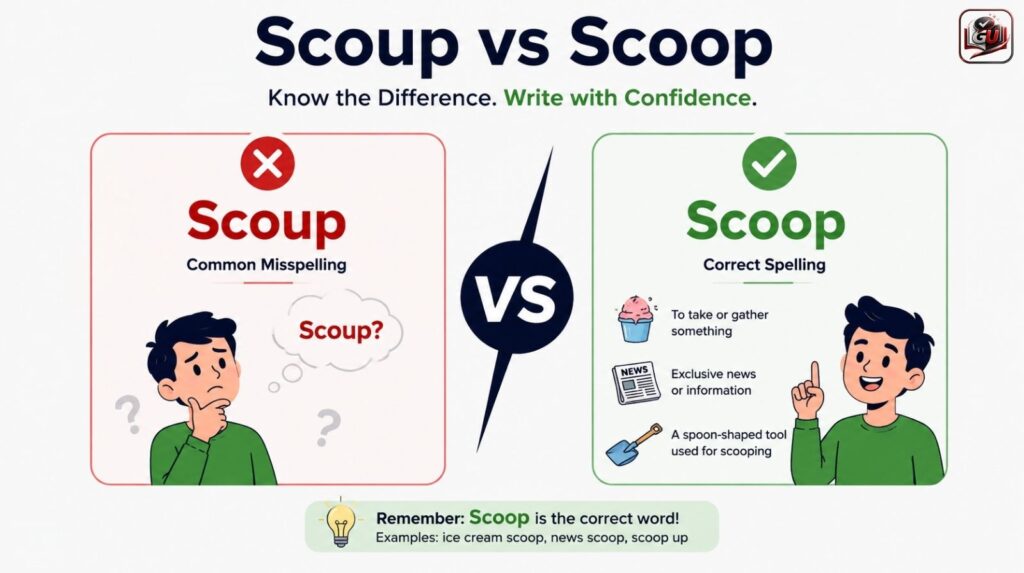
Have you ever written “scoup” and then paused to wonder if it was actually correct? It’s a common mistake that many students, writers, bloggers, and English learners make. Since “scoup” and “scoop” look similar at first glance, it’s easy to assume they are interchangeable. However, only one of them is considered correct in standard English.
Understanding the difference between Scoup vs Scoop can help you avoid spelling errors, improve your writing, and communicate more clearly. Whether you’re writing an email, a school assignment, a blog post, or social media content, using the right word makes a difference.
In this guide, you’ll learn the correct spelling, the meaning of scoop, whether scoup is a real word, common examples, and simple tips to remember the difference with confidence.
What Is the Difference Between Scoup and Scoop?
The short answer is simple:
| Word | Correct? | Meaning |
|---|---|---|
| Scoup | Usually No | Common misspelling of “scoop” |
| Scoop | Yes | To pick up, gather, or obtain information |
In modern English, scoop is the standard and accepted spelling. Most people who write scoup are making a spelling error rather than using a separate word.
Why Do People Confuse Scoup and Scoop?
Several factors contribute to the confusion:
- Similar pronunciation patterns
- Fast typing mistakes
- Autocorrect issues
- Influence from other English words ending in “oup”
Because English spelling can be unpredictable, many writers assume both forms are acceptable when they are not.
Is Scoup a Real Word?
In standard English dictionaries, scoup is generally not recognized as a valid alternative spelling of scoop.
If you are writing:
- Blog posts
- Academic papers
- Business emails
- Marketing content
- Social media captions
You should use scoop, not scoup.
Quick Answer
If you’re unsure which spelling to choose, use scoop.
What Does Scoop Mean?
The word scoop has several meanings depending on context.
Scoop as a Verb
As a verb, scoop means to pick up or gather something.
Examples:
- She used a spoon to scoop ice cream.
- He scooped sand into the bucket.
- The worker scooped snow from the sidewalk.
Scoop as a Noun
As a noun, it refers to a quantity collected with a scoop-shaped tool.
Examples:
- Add one scoop of protein powder.
- I would like two scoops of chocolate ice cream.
Scoop in Journalism
In media and journalism, a scoop means exclusive information.
Examples:
- The newspaper got a major scoop.
- The reporter broke the story before competitors.
This usage is particularly common in news publishing and digital media.
Common Uses of Scoop in Everyday Writing
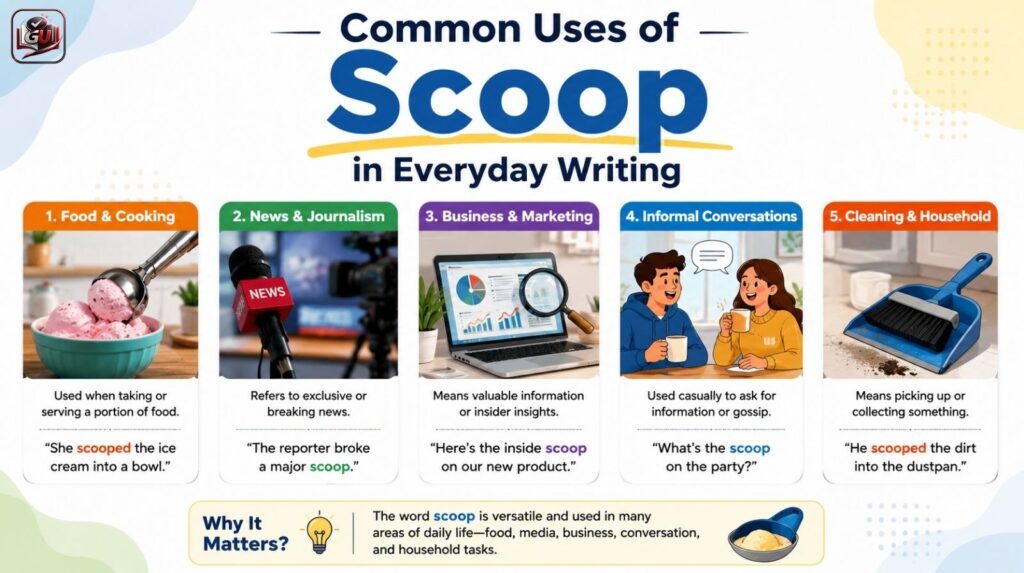
The word scoop appears frequently in daily communication.
Food and Cooking
Many recipes use the term scoop.
Examples:
- Scoop the batter into muffin trays.
- Scoop mashed potatoes onto the plate.
News and Media
Journalists often seek exclusive stories.
Examples:
- The magazine landed an exclusive scoop.
- Reporters compete for the latest scoop.
Business and Marketing
Companies use scoop metaphorically to describe valuable information.
Examples:
- Here is the inside scoop on our new product.
- Customers received a scoop about upcoming discounts.
Informal Conversations
People often use scoop casually.
Examples:
- What’s the scoop?
- Give me the scoop on the event.
Why Correct Spelling Matters in Digital Content
Spelling errors may seem small, but they can significantly impact online communication.
Reader Trust and Credibility
When readers notice obvious spelling mistakes, they may question the accuracy of the entire content.
For example, if a blog repeatedly uses scoup instead of scoop, visitors might perceive the content as unprofessional.
SEO Performance
Search engines have become smarter, but content quality still matters.
According to guidance from Google Search Central, helpful and people-first content should demonstrate accuracy and trustworthiness.
While a single typo may not hurt rankings, repeated spelling mistakes can negatively affect user experience.
Better User Engagement
Correct spelling helps readers:
- Understand content faster
- Stay on the page longer
- Share content confidently
- Trust the author
Therefore, proofreading remains an important part of content creation.
Real-Life Example: How a Small Spelling Error Hurt Content Performance
Consider a freelance blogger writing an article about celebrity news. The writer repeatedly used the word scoup instead of scoop throughout the article.
Initially, the mistake seemed harmless because the article was published quickly to cover a trending topic. However, several readers commented on the spelling error. Some even questioned the reliability of the information presented in the article.
The editor later reviewed the content and discovered the typo appeared more than twenty times. After correcting every instance of scoup to scoop, the article looked significantly more professional.
More importantly, user engagement improved. Readers spent more time on the page, and fewer complaints appeared in the comments section.
This example highlights an important lesson: even small spelling mistakes can affect audience perception. In competitive industries such as blogging, journalism, and content marketing, professionalism matters. A simple proofreading session can prevent avoidable errors and improve the overall quality of published content.
The takeaway is clear: when referring to gathering information, ice cream servings, or exclusive news, always use scoop.
Scoup vs Scoop: Side-by-Side Comparison
Meaning
| Feature | Scoup | Scoop |
|---|---|---|
| Standard English Word | No | Yes |
| Found in Major Dictionaries | Rarely | Yes |
| Suitable for Professional Writing | No | Yes |
| Commonly Used | No | Yes |
| Accepted by Editors | No | Yes |
Usage Examples
❌ Incorrect:
- I got the latest scoup on the story.
- Please scoup the ice cream into bowls.
- The reporter found an exclusive scoup.
✅ Correct:
- I got the latest scoop on the story.
- Please scoop the ice cream into bowls.
- The reporter found an exclusive scoop.
Data and Writing Trends (2025–2026)
Recent language trends continue to show growing dependence on digital writing tools.
According to research and industry reports from sources such as Grammarly Blog and HubSpot Blog, spelling accuracy remains one of the most important factors influencing reader trust and content quality in 2025–2026.
Key observations include:
- Millions of spelling corrections are made daily through writing assistants.
- Content quality remains a major ranking and engagement factor.
- Readers are more likely to trust professionally edited content.
- Businesses increasingly invest in proofreading and content review processes.
These trends reinforce the importance of using correct spellings such as scoop instead of scoup.
How to Remember the Correct Spelling
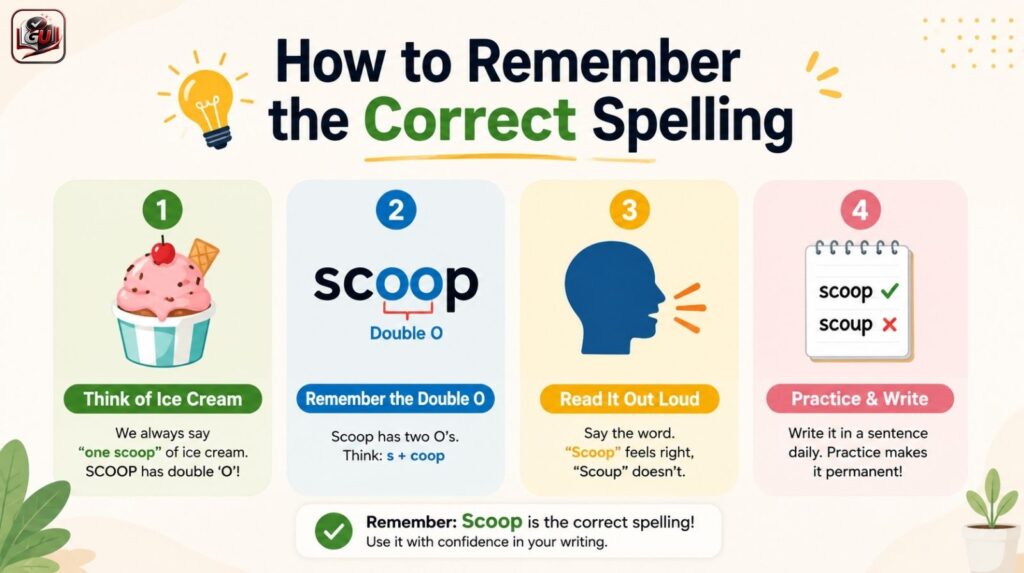
Many writers struggle with similar-looking words. Fortunately, remembering scoop is easy.
Memory Trick #1
Think about ice cream.
People commonly order:
“One scoop of ice cream.”
This phrase is used worldwide and can help reinforce the correct spelling.
Memory Trick #2
Remember the Double O
The word scoop contains two O’s.
Visualize:
s + coop
The word coop is already familiar to many English speakers.
Memory Trick #3
Read Aloud
If a spelling looks unusual, read it aloud.
Most people instantly recognize that scoop looks more natural than scoup.
FAQs
Q. Is scoup a correct English word?
A: In standard English, scoup is generally considered a misspelling of scoop.
Q. Which spelling should I use, scoup or scoop?
A: Use scoop in all professional, academic, business, and casual writing.
Q. What does scoop mean in journalism?
A: A scoop is exclusive information or a news story obtained before competitors.
Q. Why do people write scoup?
A: Most cases occur because of typing errors, spelling confusion, or unfamiliarity with the correct word.
Q. Can spelling mistakes affect SEO?
A: Minor mistakes are usually not critical, but excessive spelling errors can reduce user trust and negatively affect content quality signals.
Q. Is scoop a noun or a verb?
A: It can be both. As a noun, it refers to a quantity or exclusive piece of information. As a verb, it means to gather or pick up something.
Q. What is the easiest way to remember scoop?
A: Associate it with the phrase “a scoop of ice cream.” This makes the correct spelling easier to recall.
Conclusion
When comparing Scoup vs Scoop, the answer is straightforward: scoop is the correct spelling and the only form appropriate for standard English writing. The word can refer to gathering something, a serving size, or exclusive information in journalism. Meanwhile, scoup is typically a spelling mistake that should be avoided.
Whether you are writing blog posts, emails, academic assignments, or marketing content, using the correct spelling improves clarity, professionalism, and reader trust. Before publishing any content, take a few moments to proofread and verify commonly confused words.
The next time you encounter Scoup vs Scoop, remember: scoop is the correct choice every time.
👉Keep learning with more easy grammar lessons on GrammerUpdate.com

Noor Fatima is a professional blogger specializing in spelling correction and grammar guidance. She creates clear, practical content to help readers avoid common mistakes, strengthen writing skills, and communicate with confidence in everyday and professional settings.