
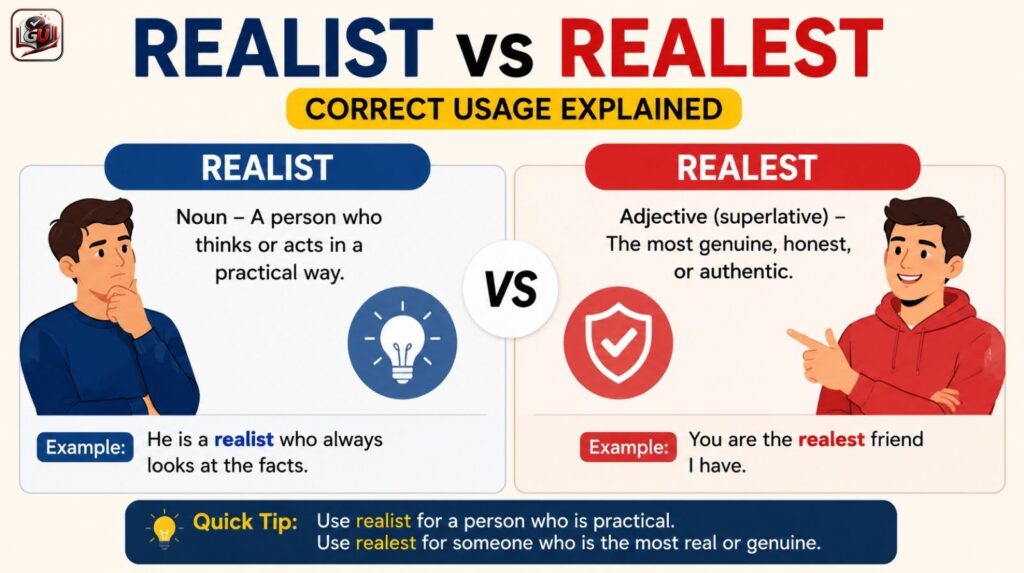
Many people get confused between realist and realest because both words come from the word “real” and sound very similar. Because of this, it’s easy to mix them up while writing or speaking. However, these two words have completely different meanings, and using the wrong one can make a sentence sound strange or unclear.
A realist is someone who thinks in a practical and sensible way, while realest is usually used to describe someone as the most genuine or authentic person. Even though the difference is small, understanding it can improve your English and help you avoid common grammar mistakes.
If you’ve ever stopped while writing and wondered which word is correct, you’re not alone. In this guide, you’ll learn the exact difference between realist vs realest, when to use each one, simple examples, and easy tips to remember the correct usage in everyday English.
Understanding Realist vs Realest
The confusion between these words usually happens because they share the same root word: real. However, their meanings and sentence structures are very different.
| Word | Part of Speech | Meaning | Example |
|---|---|---|---|
| Realist | Noun | A person who sees things practically | She is a realist about money. |
| Realest | Adjective (superlative slang/formal variation) | The most genuine or authentic | He is the realest friend I have. |
A realist is someone practical and grounded in reality. On the other hand, realest describes someone or something considered the most authentic, honest, or genuine.
Therefore, these words should never be used interchangeably.
What Does “Realist” Mean?
A realist is a person who accepts situations as they truly are instead of imagining how they should be.
Realist Definition
A realist focuses on facts, logic, and practical outcomes. This word is commonly used in psychology, politics, philosophy, and everyday conversations.
Examples of Realist in Sentences
- My brother is a realist who always plans carefully.
- She remained a realist despite the difficult situation.
- Investors need to be realists during economic uncertainty.
- A realist understands both opportunities and risks.
When to Use “Realist”
Use realist when talking about:
- Practical thinkers
- Logical decision-makers
- People focused on reality
- Someone who avoids unrealistic expectations
For example:
“He wanted to become rich overnight, but his sister was a realist.”
In this sentence, realist describes a person with a practical mindset.
What Does “Realest” Mean?
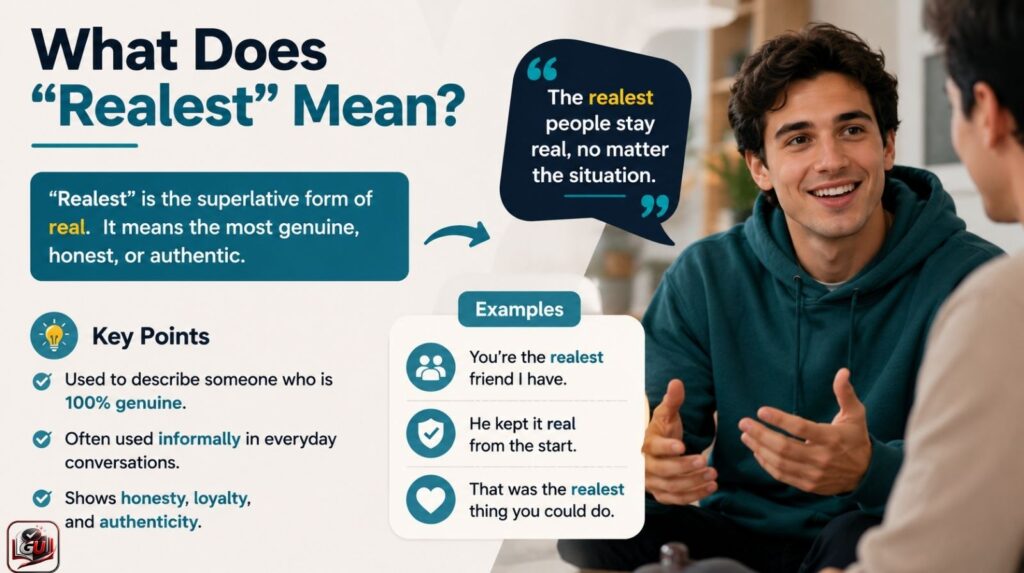
The word realest is the superlative form of “real.” It usually means most genuine, most honest, or most authentic.
Realest Definition
Although “realest” appears in dictionaries, it is more common in informal English, pop culture, music, and social media.
People often use it to praise someone’s honesty or loyalty.
Examples of Realest in Sentences
- She is the realest person I know.
- Thanks for always being the realest friend.
- His interview gave the realest explanation of the issue.
- That was the realest conversation we ever had.
Is “Realest” Grammatically Correct?
Yes, realest is grammatically correct in modern English. However, it is considered more informal compared to phrases like:
- most real
- most genuine
- most authentic
Still, “realest” is widely accepted in casual communication.
According to the Merriam-Webster Dictionary, the word exists as a valid superlative form of “real.”
Realist vs Realest: Key Differences
Understanding the grammatical role of each word makes the distinction easier.
Grammar Difference
- Realist = noun
- Realest = adjective
A noun names a person, while an adjective describes someone or something.
Meaning Difference
| Realist | Realest |
|---|---|
| Practical person | Most genuine person |
| Focuses on reality | Focuses on authenticity |
| Formal and academic | Casual and conversational |
| Used in philosophy and psychology | Used in slang and modern speech |
Sentence Structure Difference
Correct:
- She is a realist.
- He is the realest guy here.
Incorrect:
- She is a realest.
- He is realist friend.
This distinction is important because mixing them changes the meaning entirely.
Why People Confuse Realist and Realest
Many English learners confuse these words because they:
- Share the same root word
- Sound somewhat similar
- Are both connected to “real”
- Often appear in informal conversations online
Social media platforms like TikTok, Instagram, and music lyrics have increased the popularity of “realest,” especially among younger audiences.
However, “realist” has existed for centuries in formal English writing and philosophy.
Common Mistake Examples
Incorrect:
- My dad is the realest about finances.
Correct:
- My dad is a realist about finances.
Incorrect:
- Sarah is a realist friend.
Correct:
- Sarah is the realest friend.
The easiest way to avoid confusion is to ask:
Am I describing a practical person or the most genuine person?
If it is about practicality, use realist.
If it is about authenticity, use realest.
Real-Life Example: How Correct Word Choice Changes Meaning
A university student once wrote this sentence in a scholarship essay:
“I became the realist version of myself after facing challenges.”
The sentence sounded strange because realist was incorrectly used as an adjective. The intended meaning was likely “most authentic” or “most genuine.”
After editing, the sentence became:
“I became the realest version of myself after facing challenges.”
This completely changed the tone and clarity of the sentence.
Another example comes from workplace communication. A manager described an employee as:
“She is a realist during company crises.”
Here, the word works perfectly because it highlights practical thinking under pressure.
These examples show how choosing between realist vs realest can significantly affect meaning, professionalism, and readability.
In professional writing, grammar precision matters because unclear wording may confuse readers or weaken credibility.
According to Grammarly, word confusion remains one of the most common grammar issues in digital communication.
Realist vs Realest in Modern English Usage
Language evolves constantly, especially online. In recent years, “realest” has become more common due to social media culture and music trends.
Popularity of “Realest” in Pop Culture
Artists, influencers, and creators frequently use “realest” to describe honesty and loyalty.
Examples include:
- “Stay with the realest people.”
- “She kept it real from day one.”
- “He’s the realest one here.”
This style is highly conversational and emotionally expressive.
Academic Usage of “Realist”
Meanwhile, “realist” appears more often in:
- Academic essays
- Psychology discussions
- Political theory
- Literature analysis
For example:
- political realist
- social realist
- economic realist
The term also appears in art and philosophy movements.
According to Cambridge Dictionary, a realist is “someone who accepts and deals with situations as they really are.”
2025–2026 Language Trends and Data
Recent language trends show increasing use of informal English online.
Statistics About Informal English Usage
A 2025 digital communication study by HubSpot reported that:
- Over 72% of Gen Z users prefer conversational language online.
- Informal superlative words like “realest,” “coolest,” and “truest” are growing rapidly on social media.
- Authenticity-related terms perform better in engagement-focused content.
Meanwhile, educational and professional platforms still prefer standard grammar structures.
This means:
- “Realest” works well in casual settings.
- “Realist” remains stronger in formal writing.
Therefore, understanding context is essential for choosing the correct word.
Simple Trick to Remember the Difference
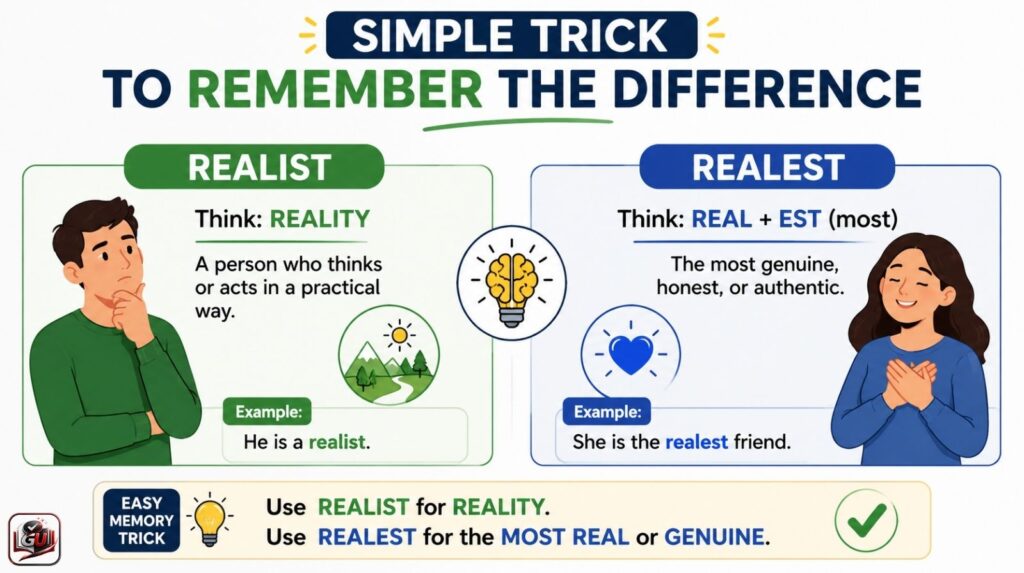
A quick memory technique can help you avoid mistakes forever.
Memory Shortcut
Use “Realist” for Reality
Both words begin with:
- Realist
- Reality
This helps you remember that a realist focuses on practical reality.
Use “Realest” for Real Emotion
“Realest” is commonly used to describe emotional honesty, authenticity, and loyalty.
For example:
- the realest friend
- the realest conversation
- the realest version of yourself
This shortcut works especially well for English learners.
FAQs
Q. Is “realest” a real word?
A: Yes, “realest” is recognized in modern English and commonly used in casual speech and online communication.
Q. What is the difference between realist and realistic?
A: A realist is a person, while realistic is an adjective describing something practical or achievable.
Example:
- She is a realist.
- Her goals are realistic.
Q. Can I use “realest” in professional writing?
A: You can, but formal alternatives like “most authentic” or “most genuine” are usually better for academic or business contexts.
Q. Is realist positive or negative?
A: It depends on context. Usually, it is neutral or positive because it describes someone practical and sensible.
Q. Why is “realest” popular online?
A: Social media culture values authenticity and emotional honesty, which makes words like “realest” popular in conversations and captions.
Q. Which word is more formal?
A: “Realist” is generally more formal than “realest.”
Conclusion:
Understanding the difference between realist vs realest is easier once you focus on their roles in a sentence.
- A realist is a practical person who sees reality clearly.
- The realest person is the most genuine or authentic.
Although these words come from the same root, they serve completely different purposes in English grammar. Therefore, using the correct one improves clarity, professionalism, and confidence in writing.
The next time you write a sentence, ask yourself:
Am I talking about practicality or authenticity?
That simple question will help you choose the right word every time.
If you found this guide helpful, bookmark it and share it with anyone struggling with confusing English word pairs.
👉Keep learning with more easy grammar lessons on GrammerUpdate.com

Noor Fatima is a professional blogger specializing in spelling correction and grammar guidance. She creates clear, practical content to help readers avoid common mistakes, strengthen writing skills, and communicate with confidence in everyday and professional settings.