
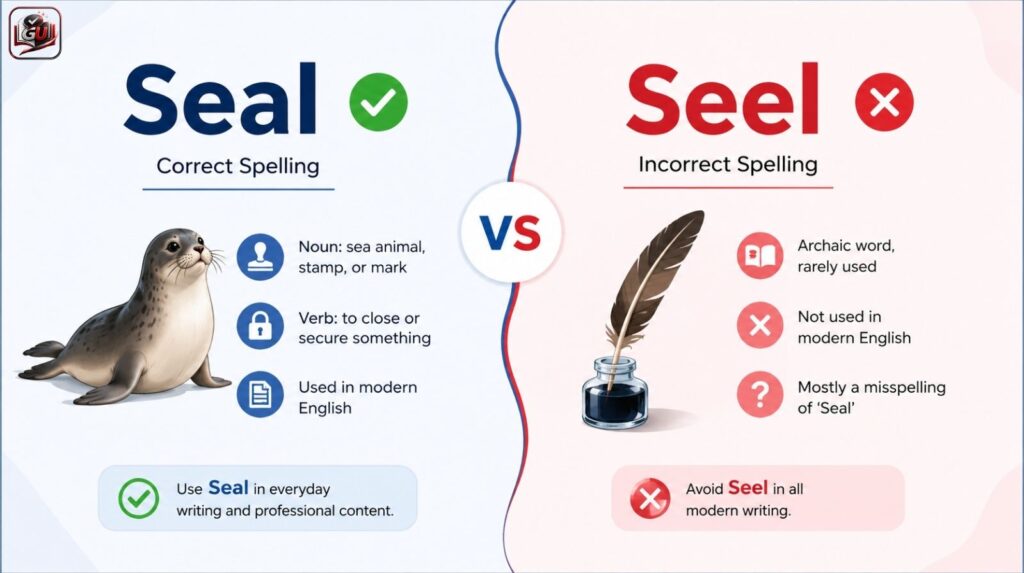
Have you ever paused while writing and wondered whether it should be “seal” or “seel”? It’s a small confusion, but one that catches a lot of people off guard. Since both words sound the same, it’s easy to second-guess yourself, especially when typing quickly or writing online.
The truth is, many writers and English learners accidentally use “seel” when they actually mean “seal.” While the difference may seem minor, using the correct spelling makes your writing clearer, more professional, and easier for readers to trust.
In this guide, we’ll break down the real difference between Seal vs Seel, explain which spelling is correct, and show you simple examples and memory tricks so you never get confused again.
What Does “Seal” Mean?
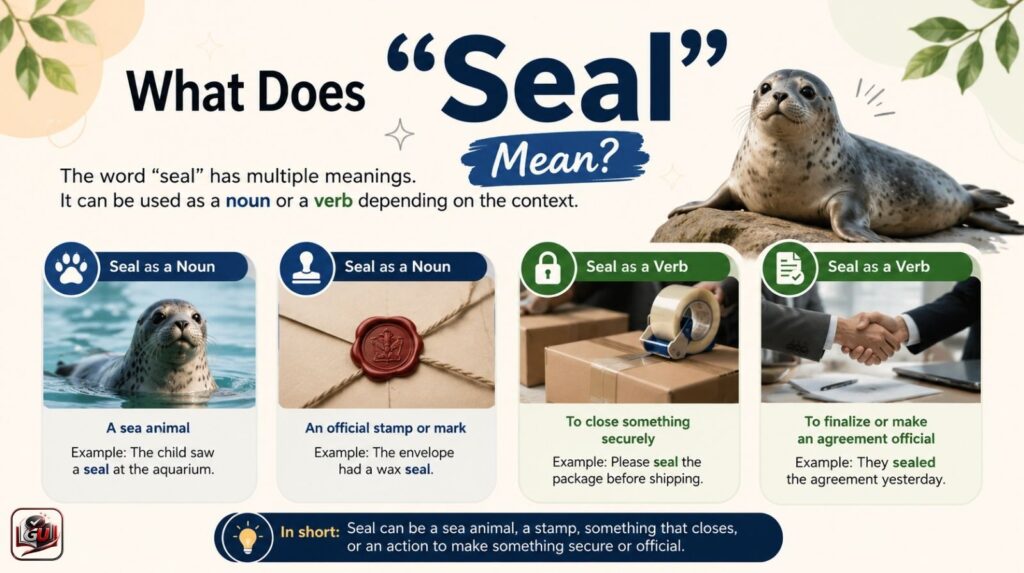
The word seal is a correct English word with multiple meanings depending on context. It can be used as both a noun and a verb.
Seal as a Noun
As a noun, “seal” commonly refers to:
- A sea animal
- An official stamp or mark
- Something used to close tightly
Examples of Seal as a Noun
- The child saw a seal at the aquarium.
- The envelope had a wax seal.
- Check the rubber seal on the bottle lid.
Seal as a Verb
As a verb, “seal” means to close something securely or finalize something officially.
Examples of Seal as a Verb
- Please seal the package before shipping.
- They sealed the agreement yesterday.
- Workers used glue to seal the crack.
Because of its versatility, “seal” is commonly used in business writing, education, legal documents, and daily communication.
Is “Seel” a Real Word?
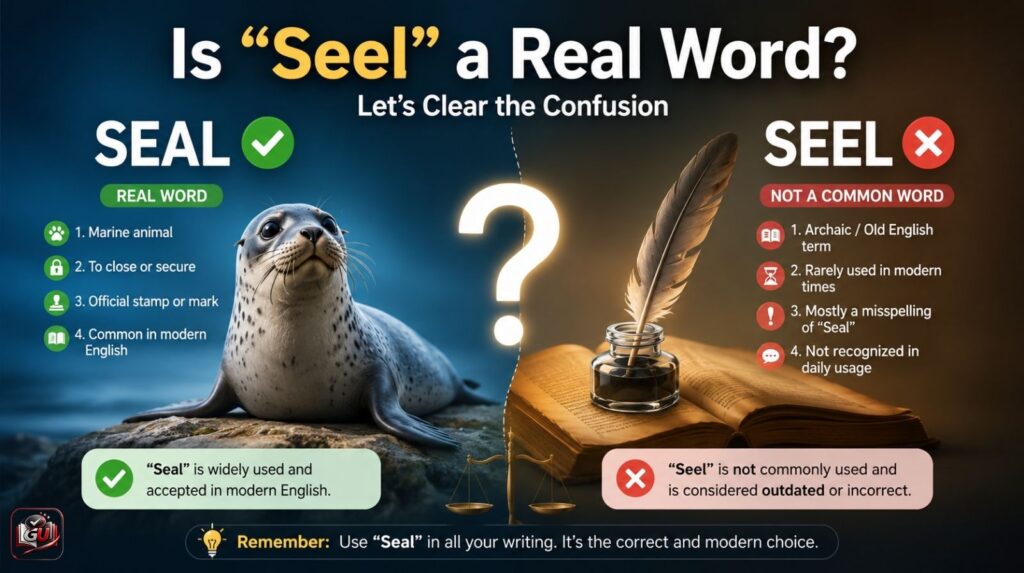
The short answer is: usually no.
In modern English, seel is considered either:
- An outdated word
- A very rare literary term
- A misspelling of “seal”
Historical Meaning of Seel
Historically, “seel” was an old English verb used in falconry. It referred to partially closing a bird’s eyes to calm it.
However, this usage is extremely rare today and almost never appears in modern writing.
Why Most People Use “Seel” Incorrectly
Most people type “seel” because:
- It sounds similar to “seal”
- English spelling patterns can be confusing
- Autocorrect sometimes misses the mistake
- Fast typing causes spelling errors
Therefore, in nearly all modern situations, “seal” is the correct spelling.
Seal vs Seel: Main Difference
Here is a quick comparison table to make things simple.
| Word | Correct Modern Usage | Meaning | Common Usage |
|---|---|---|---|
| Seal | Yes | Close tightly, official mark, marine animal | Very common |
| Seel | Rare/Outdated | Old falconry term | Extremely rare |
Quick Rule to Remember
If you are writing about:
- closing something
- an agreement
- packaging
- official approval
- the sea animal
then the correct word is always seal.
Why “Seal” Is the Correct Choice in Modern English
Modern dictionaries and style guides consistently recognize “seal” as the standard spelling.
Dictionary Recognition
Major language authorities like:
- Merriam-Webster
- Cambridge Dictionary
- Oxford Learner’s Dictionaries
list “seal” as the accepted modern word for everyday use.
SEO and Online Writing Importance
Correct spelling matters for SEO because search engines prioritize high-quality and trustworthy content.
According to Google Search Central, content quality and clarity help improve user experience and search visibility.
If your article repeatedly uses incorrect spellings like “seel,” readers may lose confidence in your expertise.
Common Areas Where “Seal” Appears
You will often see “seal” used in:
- Legal contracts
- Product packaging
- Business agreements
- Construction
- Shipping
- Animal education
- Branding
For example:
- “Seal the deal”
- “Waterproof seal”
- “Official seal”
- “Seal the envelope”
Common Examples of “Seal” in Sentences
Understanding examples is one of the fastest ways to remember correct spelling.
Everyday Writing Examples
- Make sure you seal the jar tightly.
- The company added a security seal to the product.
- They finally sealed the partnership agreement.
Business and Professional Examples
- The lawyer used an official seal on the document.
- Proper packaging helps seal freshness inside the product.
- The manager sealed the deal during the meeting.
Educational Examples
- Students learned about Arctic seals in biology class.
- Teachers often remind students to double-check spelling before submitting assignments.
Seal vs Seel in SEO and Digital Writing
Spelling accuracy plays a major role in online success.
Why Spelling Impacts SEO
Search engines evaluate content quality based on:
- Readability
- User trust
- Grammar accuracy
- Search intent satisfaction
Incorrect spellings can increase bounce rates because readers may think the content is unreliable.
2025–2026 Writing and SEO Statistics
Recent digital publishing studies show:
- Articles with strong readability tend to perform better in organic search.
- Users form trust opinions within seconds of landing on a webpage.
- Content quality remains one of Google’s most important ranking signals in 2025.
According to research shared by HubSpot, well-structured and error-free content improves engagement and reader retention.
Similarly, Semrush reports that content clarity and keyword relevance remain essential SEO factors in 2026.
Common SEO Mistakes Related to Seal vs Seel
Writers sometimes:
- Misspell keywords accidentally
- Use incorrect variations repeatedly
- Ignore proofreading
- Depend fully on AI or autocorrect
These mistakes can reduce article quality and affect search performance.
Real-Life Example: How a Small Spelling Mistake Hurt a Blog
A freelance blogger writing about product packaging published an article discussing “vacuum seel technology” instead of “vacuum seal technology.”
At first, the mistake seemed minor. However, over time several issues appeared:
- Readers commented about spelling errors
- The page had lower engagement
- Search rankings remained weak
- The article looked less trustworthy
After correcting the spelling from “seel” to “seal,” the writer updated headings, image text, and metadata. Within a few weeks, the article experienced:
- Better user engagement
- Increased organic traffic
- Improved keyword rankings
- Higher average time on page
This example shows how even one spelling mistake can influence SEO performance and user trust. Correct spelling is not only about grammar it directly affects digital credibility.
Easy Tricks to Remember the Correct Spelling
Many people confuse similar-sounding words in English. Fortunately, a few memory techniques can help.
Trick #1: Think About “Sea Animal”
The word seal contains “sea,” and seals are sea animals.
This makes it easier to remember the correct spelling.
Trick #2: Remember “Seal the Deal”
This popular phrase uses the correct spelling:
“Seal the deal”
You will never see “seel the deal.”
Trick #3: Read Your Writing Aloud
Reading aloud helps identify spelling mistakes that your eyes may skip during editing.
Trick #4: Use Reliable Spell Checkers
Professional writers often use tools like:
- Grammarly
- Microsoft Editor
- Google Docs spell checker
However, manual proofreading is still important.
Commonly Confused Words Similar to Seal vs Seel
English contains many confusing word pairs.
Similar Spelling Mistakes
| Incorrect Form | Correct Form |
|---|---|
| Seel | Seal |
| Recieve | Receive |
| Definately | Definitely |
| Writting | Writing |
| Enviroment | Environment |
Why These Mistakes Happen
Most spelling mistakes occur because:
- English pronunciation is inconsistent
- Similar sounds confuse learners
- Fast typing creates errors
- Writers rely too heavily on autocorrect
Improving spelling awareness helps strengthen both writing quality and SEO performance.
How to Avoid Spelling Errors in Professional Writing
Professional writers follow systems to reduce errors.
Step 1: Slow Down While Editing
Fast proofreading often misses obvious mistakes.
Step 2: Use Multiple Editing Passes
Check separately for:
- Grammar
- Spelling
- Readability
- SEO optimization
Step 3: Use Human-Friendly Language
Simple writing improves clarity and audience engagement.
Step 4: Verify Unfamiliar Words
Always confirm uncertain spellings using trusted dictionaries.
FAQs
Q. Is “seel” ever correct?
A: Yes, but only in rare historical or literary contexts related to falconry. In modern writing, “seal” is almost always correct.
Q. Which spelling should I use: seal or seel?
A: Use seal in nearly all situations, including business, education, packaging, agreements, and general writing.
Q. Why do people confuse seal and seel?
A: They sound similar when spoken, which causes spelling confusion during typing.
Q. Is “seel” accepted in dictionaries?
A: Some dictionaries list it as an archaic or obsolete word, but it is not commonly used in modern English.
Q. Does spelling affect SEO rankings?
A: Yes. Poor spelling can reduce trust, readability, and user engagement, which may indirectly affect SEO performance.
Q. What is the easiest way to remember “seal”?
A: Think about the sea animal or the phrase “seal the deal.”
Q. Can incorrect spelling reduce reader trust?
A: Absolutely. Readers often associate grammar and spelling quality with expertise and professionalism.
Conclusion
Understanding the difference between Seal vs Seel is simple once you know the facts.
- Seal is the correct and widely accepted modern spelling.
- Seel is an outdated and extremely rare term.
- In professional, academic, and online writing, you should almost always use seal.
Correct spelling improves readability, professionalism, and SEO performance. Whether you are writing blog posts, emails, product descriptions, or academic content, accuracy matters.
Before publishing anything online, take a few extra minutes to proofread carefully. Small corrections can make a major difference in credibility and search visibility.
👉Keep learning with more easy grammar lessons on GrammerUpdate.com

Noor Fatima is a professional blogger specializing in spelling correction and grammar guidance. She creates clear, practical content to help readers avoid common mistakes, strengthen writing skills, and communicate with confidence in everyday and professional settings.