
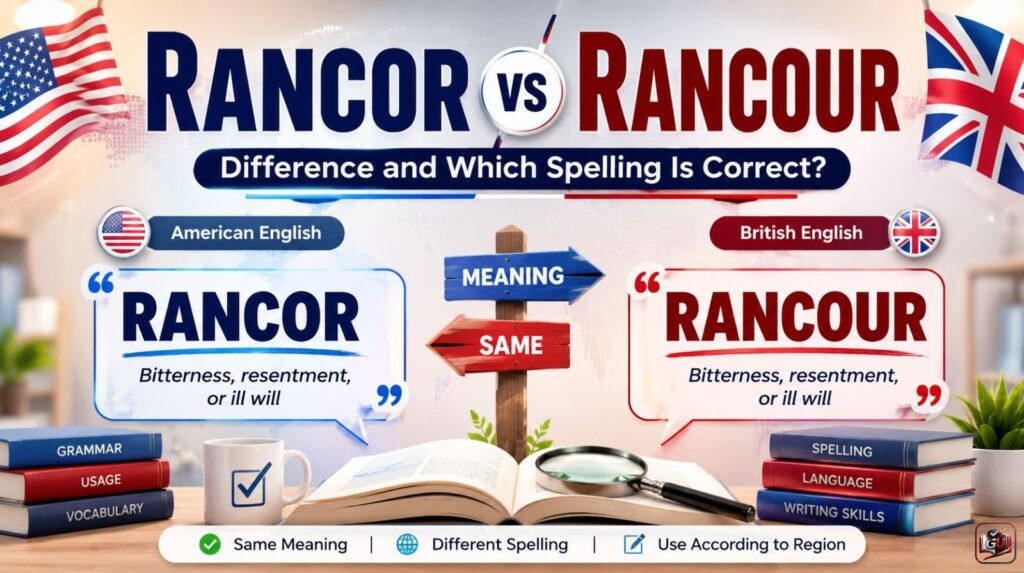
Have you ever come across the words rancor and rancour and wondered whether one of them is wrong? Many writers, students, and professionals encounter this spelling dilemma when reading books, articles, or international publications.
The confusion exists because both words appear frequently in English, yet they are spelled differently. This often leads people to question which version should be used in formal writing.
The good news is that both spellings are correct. However, the choice depends largely on the type of English you are using. In this guide, you’ll learn the difference between Rancor vs Rancour, discover where each spelling is preferred, see real-world examples, and understand how to choose the correct version every time.
What Does Rancor or Rancour Mean?

The words rancor and rancour share the exact same meaning. They refer to deep bitterness, resentment, or long-lasting ill will toward someone.
Definition of Rancor
In American English, rancor is the standard spelling. It describes strong feelings of hostility that continue over time.
Examples:
- Years after the argument, he still felt rancor toward his former business partner.
- The debate ended without rancor despite the disagreement.
- She spoke calmly, showing no rancor toward her critics.
Definition of Rancour
In British English, rancour is the preferred spelling. The meaning remains identical.
Examples:
- The politician expressed his views without rancour.
- Their rivalry ended with surprisingly little rancour.
- She carried no rancour after the dispute was resolved.
Pronunciation
Both words are pronounced exactly the same:
RAN-kər
Because the pronunciation does not change, the distinction exists only in spelling.
Rancor vs Rancour: What Is the Difference?
The primary difference between rancor vs rancour is regional spelling preference.
| Feature | Rancor | Rancour |
|---|---|---|
| Meaning | Bitterness or resentment | Bitterness or resentment |
| Pronunciation | Same | Same |
| American English | Preferred | Rare |
| British English | Less common | Preferred |
| Canadian English | Often Rancour | Common |
| Australian English | Less common | Preferred |
Why Do Two Spellings Exist?
The variation comes from historical differences between American and British English spelling systems.
Many British English words retain the “-our” ending:
- Colour
- Honour
- Labour
- Favour
- Rancour
American English often simplifies these endings to “-or”:
- Color
- Honor
- Labor
- Favor
- Rancor
This spelling pattern was popularized in the United States during language standardization efforts in the 19th century.
Quick Answer
If you’re writing for an American audience, use rancor.
If you’re writing for a British, Australian, or many Commonwealth audiences, use rancour.
When Should You Use Rancor?
Using Rancor in American English
The spelling rancor is considered standard in the United States.
Most American newspapers, universities, publishers, and businesses use this version.
Common Situations
Academic Writing
American institutions generally expect American spelling conventions.
Example:
“The negotiations proceeded without rancor despite significant disagreements.”
Business Communication
Professional documents written for U.S. audiences typically use rancor.
Online Content
Many U.S.-based websites and blogs favor the American spelling because it aligns with audience expectations.
Example Sentences
- The meeting ended without rancor.
- Public discussions often become filled with rancor during election seasons.
- The former colleagues resolved their differences and moved forward without rancor.
When Should You Use Rancour?
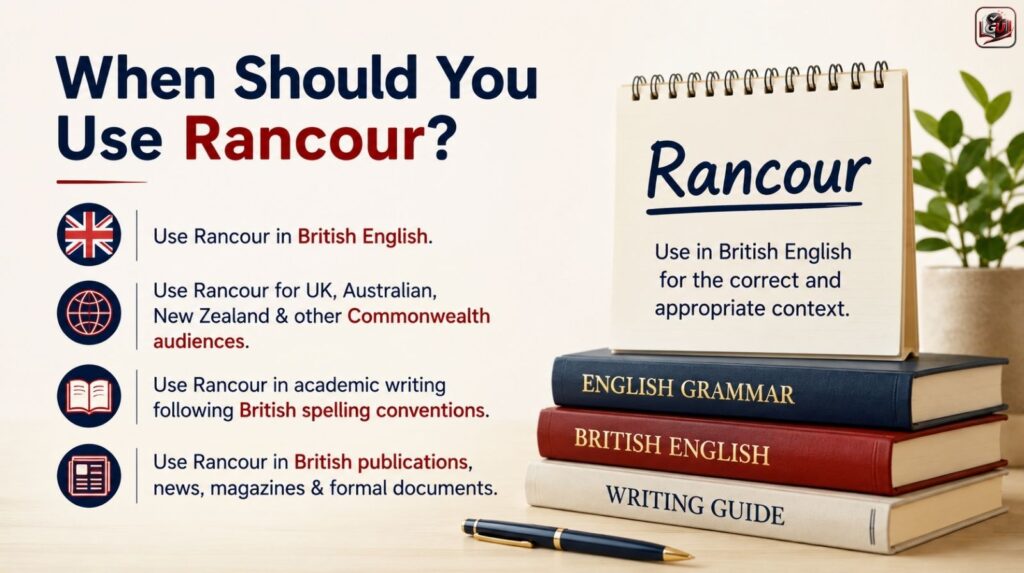
Using Rancour in British English
The spelling rancour follows traditional British English conventions.
It appears frequently in publications from the United Kingdom, Australia, New Zealand, and other Commonwealth countries.
Common Situations
British Publications
Newspapers and magazines in the UK generally prefer rancour.
Educational Institutions
British schools and universities often require British spelling standards.
International Audiences
Some global organizations choose British English as their primary style guide, making rancour the preferred form.
Example Sentences
- The discussion remained respectful and free of rancour.
- They parted ways without rancour after the disagreement.
- Political opponents often attempt to debate without personal rancour.
Real-Life Example: How One International Brand Maintained Consistency
A multinational consulting company expanded its content marketing efforts across North America, Europe, and Australia. Initially, different regional teams produced articles independently.
The U.S. team consistently used American spellings such as “color,” “honor,” and “rancor.” Meanwhile, the UK and Australian teams naturally wrote “colour,” “honour,” and “rancour.”
At first, the inconsistency seemed harmless. However, the company soon noticed issues. Readers pointed out spelling differences across pages, creating confusion about editorial standards. Search engine optimization teams also discovered that some regional keyword targets differed depending on the audience’s spelling preferences.
See Also: Envolved vs Involved: Which Is Correct In English?
To solve the problem, the company created separate style guidelines for each regional website. The U.S. website adopted American English exclusively, while the UK and Australian websites followed British English standards.
The result was improved brand consistency, better user experience, and stronger audience trust. This example highlights an important lesson: neither spelling is wrong, but consistency matters. Choosing the appropriate version for your target audience helps maintain professionalism and clarity.
Rancor vs Rancour in Modern Writing Statistics (2025–2026)

Language trends continue to show significant regional differences in spelling preferences.
Key Language Trends
American English Dominates Global Web Content
Research from major web indexing and publishing platforms indicates that American English remains the most widely used variety of English online due to the large volume of U.S.-based websites.
British English Remains Strong Internationally
British English continues to be widely used throughout:
- United Kingdom
- Australia
- New Zealand
- Ireland
- South Africa
- Various international organizations
Search Behavior Reflects Geography
Users typically search using spellings familiar to their region.
For example:
- Americans are more likely to search for “rancor meaning.”
- British users are more likely to search for “rancour meaning.”
Why This Matters for SEO
Content creators should consider audience location when selecting spellings.
A website targeting U.S. readers may perform better with American spellings, while UK-focused content should maintain British conventions.
According to guidance from Google Search Central, content should be written naturally for its intended audience rather than forcing keyword variations.
Similarly, style resources from Merriam-Webster and Cambridge Dictionary recognize regional spelling differences while preserving meaning.
How to Choose the Correct Spelling Every Time
Step 1: Identify Your Audience
Ask yourself:
- Is my audience primarily American?
- Is my audience primarily British or international?
Step 2: Follow a Style Guide
Many organizations have established editorial standards.
Examples include:
- AP Style
- Chicago Manual of Style
- Oxford Style Guide
See Also: Mobil vs Mobile: Which Is Correct And How To Use Them?
Step 3: Stay Consistent
Do not mix spellings within the same document.
Avoid:
- The debate ended without rancor, although some participants expressed rancour afterward.
Better:
- The debate ended without rancor, although some participants expressed resentment afterward.
Step 4: Match Regional English
Use:
- Rancor → American English
- Rancour → British English
Simple Checklist
✅ Writing for U.S. readers → Use Rancor
✅ Writing for UK readers → Use Rancour
✅ Academic paper → Follow institution guidelines
✅ Company content → Follow brand style guide
✅ Blog article → Match target audience location
Common Mistakes People Make With Rancor and Rancour
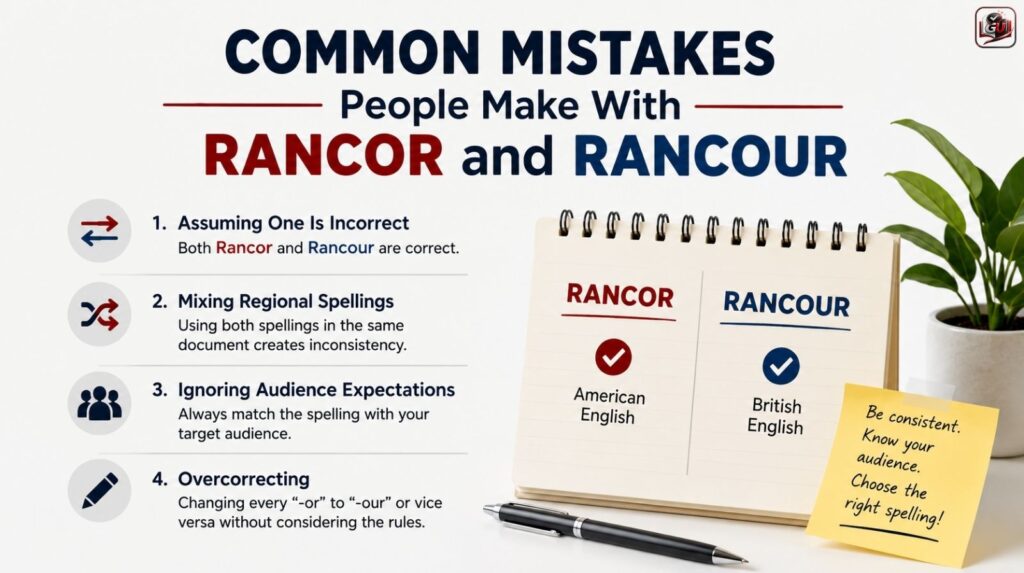
Assuming One Is Incorrect
Many writers mistakenly believe one spelling is wrong.
In reality, both are accepted forms.
Mixing Regional Spellings
Switching between American and British spellings creates inconsistency.
Ignoring Audience Expectations
Readers often expect familiar spelling conventions.
Overcorrecting
Some writers change every “-or” word to “-our” or vice versa without considering regional standards.
FAQs
Q. Is rancor a real word?
A: Yes. Rancor is the standard American English spelling for bitterness or long-term resentment.
Q. Is rancour a real word?
A: Yes. Rancour is the standard British English spelling of the same word.
Q. Do rancor and rancour mean different things?
A: No. Both words have exactly the same meaning and pronunciation.
Q. Which spelling is more common?
A: Globally, rancor often appears more frequently online because American English dominates much web content. However, rancour remains standard throughout many English-speaking countries.
Q. Should I use rancor or rancour for SEO?
A: Use the version your audience is most likely to search for. U.S. audiences generally prefer rancor, while UK audiences typically use rancour.
Q. Is rancour considered incorrect in America?
A: Not incorrect, but uncommon. American readers usually expect rancor.
Q. Can I use both spellings in one article?
A: It is best to choose one spelling style and remain consistent throughout the content.
Conclusion
Understanding the difference between Rancor vs Rancour is actually quite simple. Both words mean bitterness, resentment, or long-lasting ill will. The only distinction is regional spelling preference.
Use rancor when writing in American English and rancour when following British English conventions. Neither spelling is more correct than the other; the key is choosing the version that matches your audience and staying consistent throughout your writing.
Whether you’re creating academic content, business documents, blog posts, or website copy, using the appropriate spelling helps improve readability, professionalism, and audience trust. Before publishing, check your target market and style guide to ensure you’re using the right form every time.
👉Keep learning with more easy grammar lessons on GrammerUpdate.com

Noor Fatima is a professional blogger specializing in spelling correction and grammar guidance. She creates clear, practical content to help readers avoid common mistakes, strengthen writing skills, and communicate with confidence in everyday and professional settings.