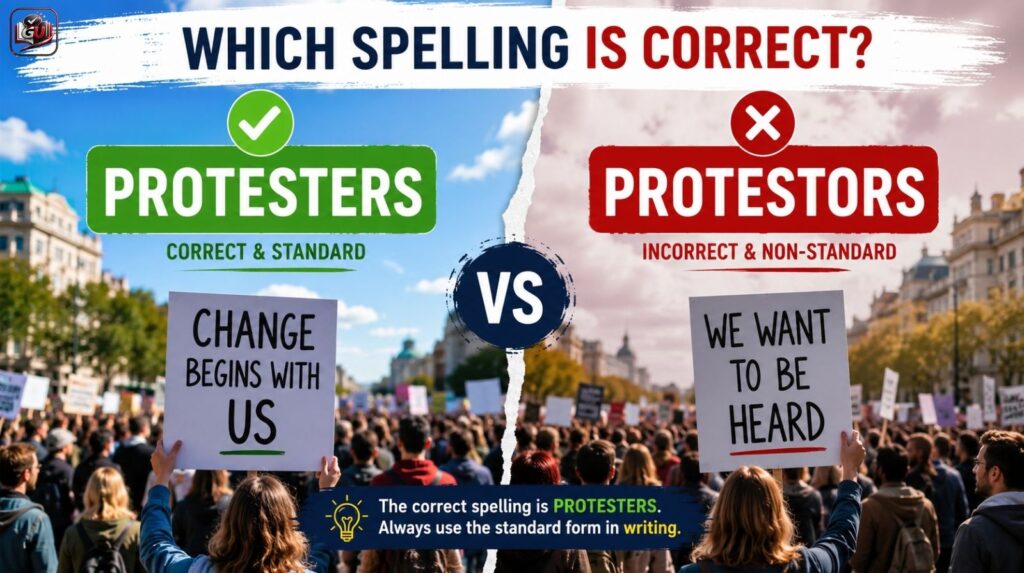
If you’ve ever typed protestors and then wondered whether it should actually be protesters, you’re not alone. This is one of those spelling questions that catches even experienced writers off guard. Since both words look correct and sound exactly the same, it’s easy to see why people get confused.
The challenge comes from the way English forms nouns. Some words end in -or, while others take -er, and there isn’t always an obvious rule to follow. As a result, many students, bloggers, journalists, and professionals find themselves stopping to check which spelling is the accepted one.
So, is it protestors or protesters? In this guide, we’ll clear up the confusion, explain which spelling is considered correct in modern English, explore why the mix-up happens, and share examples that will help you use the right word with confidence every time.
What Is the Difference Between Protestors and Protesters?
The short answer is simple:
| Word | Status | Recommendation |
|---|---|---|
| Protesters | Standard English | ✅ Use this spelling |
| Protestors | Less common variant | ⚠ Generally avoid |
The word protesters is the preferred spelling in modern English. It refers to people who publicly express opposition to an idea, policy, law, or action.
Example
✅ Thousands of protesters gathered outside the city hall.
⚠ Thousands of protestors gathered outside the city hall.
While the second sentence is understandable, most editors, style guides, and dictionaries recommend protesters.
Why Does Confusion Exist?
Many English nouns ending in -or describe a person performing an action:
- actor
- creator
- inventor
- operator
Because of this pattern, some people naturally assume that someone who protests should be called a protestor. However, English developed the noun from the verb protest using the more common -er ending.
Why “Protesters” Is the Preferred Spelling
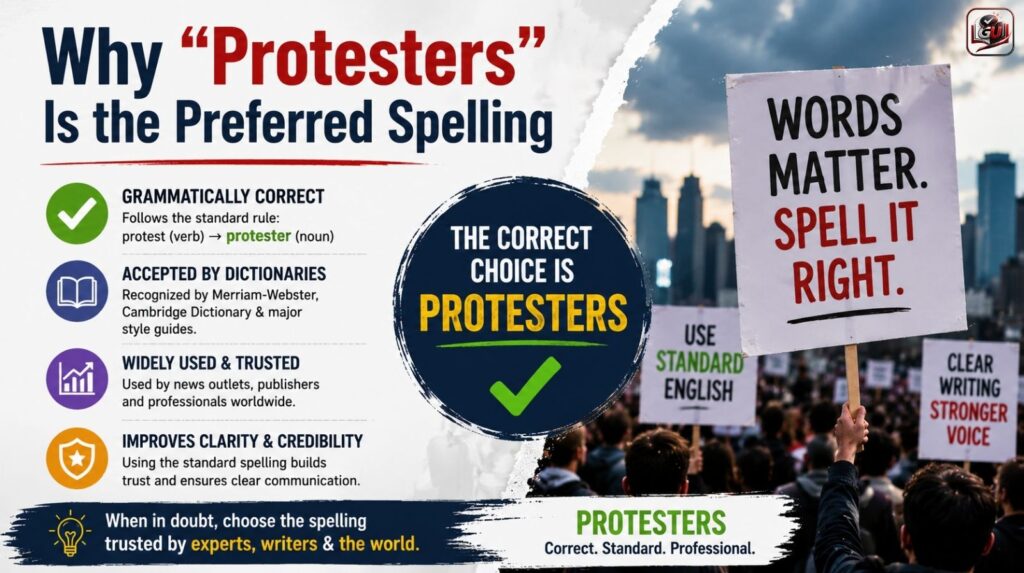
When major dictionaries and language authorities are consulted, the overwhelming preference is protesters.
Dictionary Usage
Leading dictionaries such as:
- Merriam-Webster
- Cambridge Dictionary
- Oxford Learner’s Dictionaries
list protester as the primary noun form.
Grammar Pattern
Many English action nouns follow this structure:
| Verb | Noun |
|---|---|
| Teach | Teacher |
| Work | Worker |
| Travel | Traveler |
| Protest | Protester |
The -er ending is the standard way to create a noun describing someone who performs an action.
Modern Publishing Standards
Most newspapers, academic publications, government reports, and professional websites consistently use protesters.
As a result, using protesters helps your writing appear more professional and aligned with current English standards.
Protesters Meaning and Usage in Modern English
A protester is a person who publicly objects to or opposes something.
Common Situations
People may become protesters when responding to:
- Political decisions
- Social issues
- Environmental concerns
- Economic policies
- Human rights matters
Examples in Sentences
- Protesters marched through downtown streets.
- Environmental protesters demanded stronger climate policies.
- Student protesters organized a peaceful demonstration.
- The protesters carried signs supporting education reform.
Formal Writing Example
The protesters assembled peacefully and delivered their concerns to local officials.
Informal Writing Example
Protesters filled the park throughout the afternoon.
In both formal and informal contexts, protesters remains the preferred spelling.
Protestors vs Protesters: A Side-by-Side Comparison
The easiest way to understand the difference is through direct comparison.
| Feature | Protesters | Protestors |
|---|---|---|
| Widely accepted | ✅ Yes | ⚠ Limited |
| Found in major dictionaries | ✅ Yes | Sometimes listed as variant |
| Common in journalism | ✅ Yes | Rare |
| Recommended for SEO writing | ✅ Yes | No |
| Preferred by editors | ✅ Yes | Rarely |
| Modern English standard | ✅ Yes | No |
Which Should You Use?
For nearly every situation:
✅ Use protesters
This includes:
- Blog posts
- Academic papers
- News articles
- Business writing
- Website content
- Social media captions
Real-World Example: How Major News Organizations Use the Word
Language usage often becomes clear when we examine real publishing practices.
During major public demonstrations across the world between 2024 and 2026, leading news organizations consistently used the spelling protesters.
Consider headlines commonly seen in international media:
- “Protesters Gather Outside Parliament”
- “Student Protesters Demand Change”
- “Thousands of Protesters Attend Rally”
- “Environmental Protesters March Through Capital”
You rarely see the spelling protestors in professional journalism today.
Why This Matters
Editors prioritize consistency and readability. Since readers are more familiar with protesters, news organizations choose that version to maintain clarity.
For writers, this provides an important lesson:
When a standard spelling clearly dominates professional publications, using that version improves credibility and trust.
A content writer creating a blog post about social movements, for example, might accidentally use protestors. While readers would likely understand the meaning, experienced editors would often revise the word to protesters before publication.
This small correction helps maintain alignment with modern language standards and ensures the content matches reader expectations.
As a result, professional writers, journalists, and SEO specialists almost always choose protesters.
Language Trends and Usage Statistics (2025–2026)
Modern language databases reveal a significant preference for protesters over protestors.
Key Observations
Recent publishing trends show:
- Protesters appears far more frequently in news articles.
- Search engines return substantially more results for protesters.
- Academic publications overwhelmingly prefer protesters.
- Style guides generally recommend protesters.
Why Search Trends Matter
Search behavior influences content visibility.
When people search for:
- protesters meaning
- protesters definition
- peaceful protesters
- protesters spelling
they typically use the standard spelling.
For SEO purposes, using the version most readers search for helps content align with user intent and language expectations.
Featured Snippet Answer
Is protesters or protestors correct?
Protesters is the standard and widely accepted spelling in modern English. While protestors occasionally appears as a variant, most dictionaries, editors, and publications recommend using protesters.
How to Remember the Correct Spelling
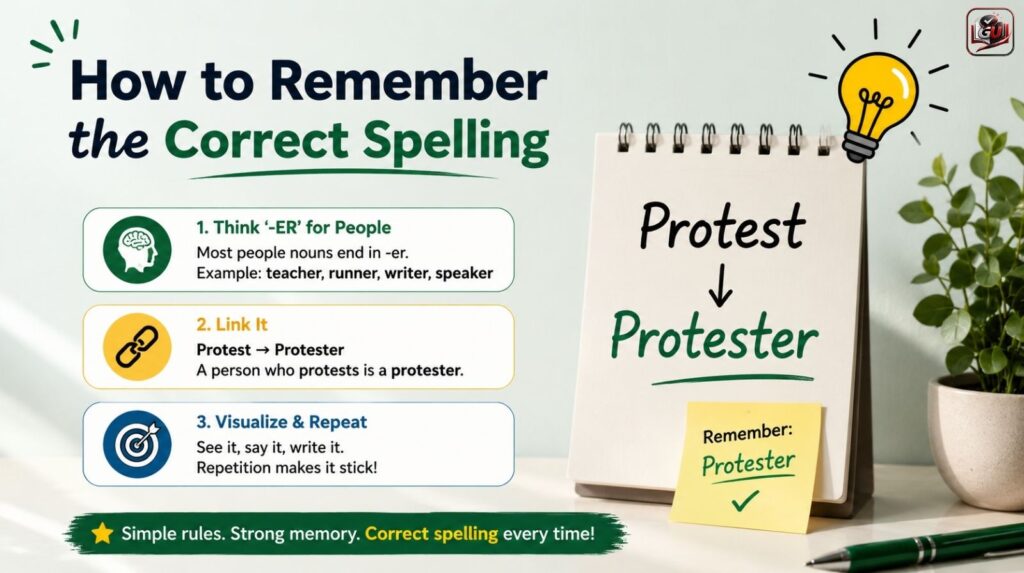
If you often mix up the two words, use this simple method.
The “Action Person” Rule
Most people who perform an action take the -er ending.
Examples:
- Runner
- Writer
- Reader
- Teacher
- Protester
Because a person protests, they become a protester.
Check Professional Sources
When unsure:
- Look at major dictionaries.
- Check reputable news sites.
- Review academic writing.
You’ll almost always find protesters.
Think About Audience Expectations
Readers are accustomed to seeing protesters.
Using the familiar spelling improves readability and avoids distractions.
Common Writing Mistakes Related to Protesters
Writers sometimes make mistakes beyond the spelling itself.
Mistake #1: Using Protestors in Formal Writing
❌ The protestors gathered downtown.
✅ The protesters gathered downtown.
Mistake #2: Inconsistent Spelling
❌ Protesters arrived early, while protestors joined later.
✅ Protesters arrived early, while other protesters joined later.
Mistake #3: Assuming “-or” Is Always Correct
Not every action noun ends in -or.
English often uses -er, making protester the natural choice.
FAQs
Q. Is protestors a real word?
A: Yes. Some dictionaries recognize it as a variant spelling. However, it is far less common than protesters.
Q. Which spelling is correct in American English?
A: Protesters is the preferred spelling in American English.
Q. Which spelling is correct in British English?
A: British English also overwhelmingly favors protesters.
Q. Why do some people write protestors?
A: People often assume the noun should follow patterns like actor, creator, or inventor, leading them to use the -or ending.
Q. Should I use protestors in academic writing?
A: No. Academic writing generally prefers protesters.
Q. Is protesters better for SEO?
A: Yes. Since it is the dominant spelling, it better matches search behavior and reader expectations.
Q. Do newspapers use protesters or protestors?
A: Most professional newspapers and media organizations use protesters.
Conclusion
When comparing protestors or protesters, the answer is straightforward: protesters is the correct and preferred spelling in modern English.
Although protestors occasionally appears as a variant, it is far less common and generally avoided in professional writing. Dictionaries, journalists, educators, and editors overwhelmingly favor protesters, making it the safest choice for blogs, academic work, business communication, and SEO content.
Whenever you’re unsure, remember this simple rule: a person who protests is a protester, just as a person who teaches is a teacher or a person who writes is a writer.
Using the standard spelling improves clarity, professionalism, and reader trust. If you’re aiming for polished, search-friendly content, always choose protesters.
👉Keep learning with more easy grammar lessons on GrammerUpdate.com

Noor Fatima is a professional blogger specializing in spelling correction and grammar guidance. She creates clear, practical content to help readers avoid common mistakes, strengthen writing skills, and communicate with confidence in everyday and professional settings.