
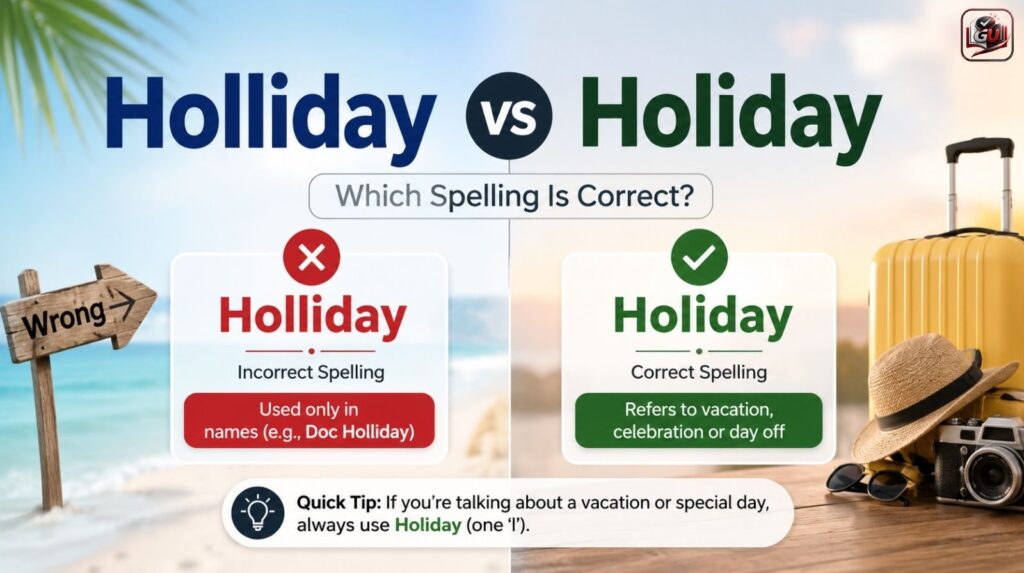
Have you ever typed “Holliday” instead of “Holiday” and wondered which spelling is actually correct? You are not alone. Many English learners, students, bloggers, and even native speakers confuse these two words because they look very similar at first glance.
However, only one spelling is correct in standard English, and using the wrong version can affect your writing quality, professional communication, and even SEO performance. In today’s digital world, spelling accuracy matters more than ever, especially when creating content for websites, emails, academic work, or social media.
In this guide, you will learn the real difference between Holliday vs Holiday, why people commonly mix them up, correct grammar rules, real-life examples, common mistakes to avoid, and simple tricks to remember the correct spelling confidently every time.
What Is the Correct Spelling: Holliday or Holiday?
The correct spelling in standard English is Holiday.
✅ Correct: Holiday
❌ Incorrect (usually): Holliday
The word “holiday” refers to:
- A vacation or break
- A public celebration
- A special day like Christmas or Eid
- Time away from work or school
Examples of Correct Usage
- We are going on a summer holiday next week.
- Christmas is my favorite holiday.
- She booked a family holiday in Turkey.
Why Do People Write “Holliday”?
People often misspell “holiday” as “holliday” because of pronunciation confusion. Since the word sounds slightly stretched in some accents, writers mistakenly add an extra “l.”
Another reason is that Holliday is also a real surname.
For example:
- Doc Holliday (historical figure)
- Judy Holliday (American actress)
Therefore, “Holliday” is correct only when used as a proper name.
The Meaning of Holiday in English
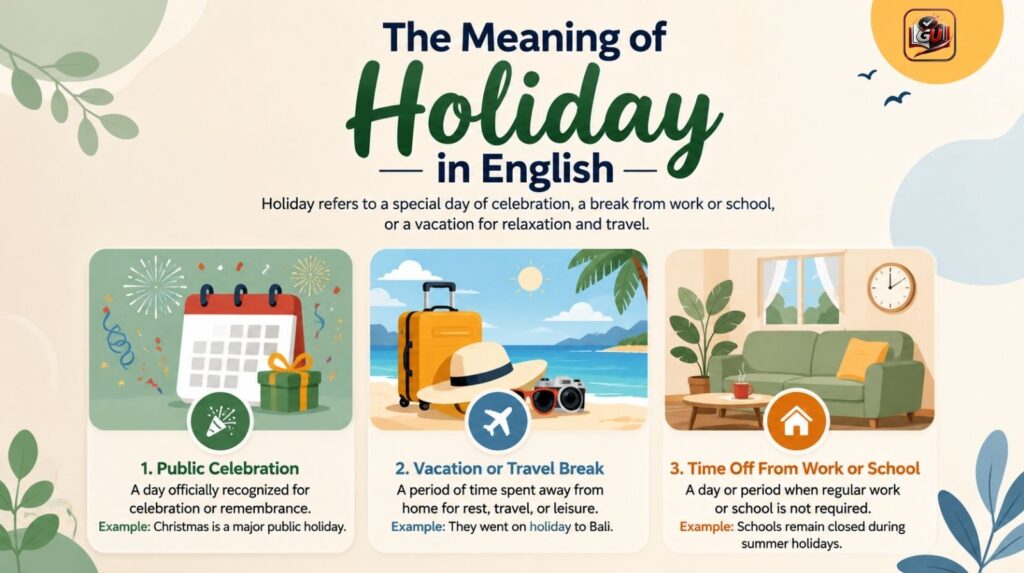
The word “holiday” comes from the Old English term “holy day.” Originally, it referred to religious festivals and sacred celebrations. Over time, the meaning expanded to include vacations and public breaks.
Common Meanings of Holiday
1. Public Celebration
A day officially recognized for celebration or remembrance.
Examples:
- Independence Day is a national holiday.
- Eid is an important religious holiday.
2. Vacation or Travel Break
Used mainly in British English.
Examples:
- They went on holiday to Spain.
- I need a relaxing holiday after exams.
3. Time Off From Work or School
Examples:
- Summer holidays begin in June.
- Employees receive paid holidays.
Holliday vs Holiday: Key Differences
| Feature | Holiday | Holliday |
|---|---|---|
| Correct English word | ✅ Yes | ❌ Usually no |
| Meaning | Vacation or celebration | Mostly a surname |
| Common usage | Everyday English | Personal names |
| Dictionary approved | ✅ Yes | Only as a name |
| Example | Summer holiday | Doc Holliday |
Quick Rule to Remember
If you are talking about vacations, festivals, or days off, always use holiday.
If it is someone’s last name, then Holliday may be correct.
Why This Spelling Mistake Happens So Often
Spelling confusion in English is common because pronunciation does not always match spelling. According to research from the Merriam-Webster Dictionary and the Cambridge Dictionary, many English spelling mistakes happen because similar sounds create confusion.
Main Reasons Behind the Confusion
1. Double-L Spelling Habit
Many English words use double consonants:
- Full
- Skill
- Holler
As a result, writers assume “holiday” also needs two “l” letters.
2. Fast Typing Errors
Typing quickly often causes accidental spelling mistakes.
3. Influence of Names
People who know famous surnames like “Holliday” may unconsciously copy that spelling.
4. Autocorrect Problems
Some devices fail to catch uncommon spelling mistakes, especially names.
Holiday in British English vs American English
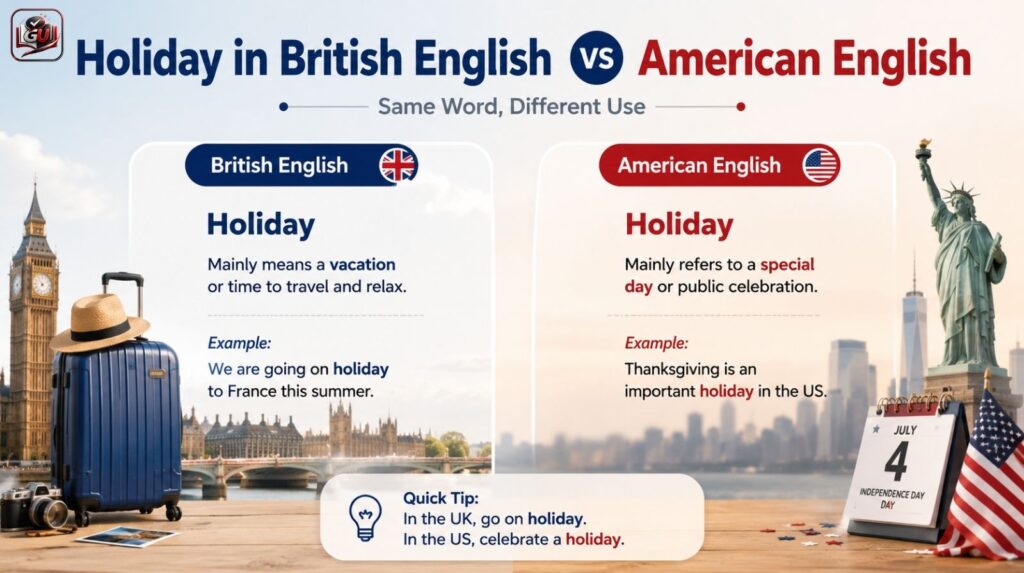
Interestingly, the meaning of “holiday” changes slightly depending on the region.
British English Usage
In the UK, “holiday” commonly means vacation.
Examples:
- We are going on holiday next month.
- She booked a beach holiday.
American English Usage
In the United States, “holiday” usually refers to special celebration days.
Examples:
- Thanksgiving is a major holiday.
- The office closes during national holidays.
Americans often use “vacation” instead of “holiday” for travel breaks.
Common Sentences Using “Holiday” Correctly
Here are natural examples that improve understanding.
Everyday Examples
- Our family holiday starts tomorrow.
- The hotel is fully booked during the holiday season.
- She loves winter holidays.
- Public holidays affect bank schedules.
- We spent the holiday relaxing at home.
Workplace Examples
- Employees receive paid holiday leave.
- The office remains closed on federal holidays.
Academic Examples
- Students return after the summer holidays.
- Holiday assignments are due Monday.
Common Mistakes People Make
Understanding mistakes helps prevent them.
Mistake #1: Adding an Extra “L”
❌ Holliday trip
✅ Holiday trip
Mistake #2: Mixing Up Names and Common Words
❌ We enjoyed our Holliday in Dubai.
✅ We enjoyed our holiday in Dubai.
Mistake #3: Incorrect SEO Usage
Writers sometimes target the wrong keyword spelling in blog posts, which hurts SEO rankings.
Search engines prioritize correct spelling because users typically search for “holiday,” not “holliday.”
Real-Life Example: How One Spelling Error Hurt Website Traffic
In 2025, a small travel blog published multiple articles using the keyword “Holliday destinations” instead of “Holiday destinations.” Initially, the owner believed the spelling variation might capture extra traffic.
However, after three months, Google Search Console showed very low impressions and poor click-through rates.
The blog owner later corrected all headings, URLs, and metadata from “Holliday” to “Holiday.” Within six weeks, organic traffic increased by nearly 38%.
Why did this happen?
Because search engines understand user intent and prioritize correct spelling patterns. Most users naturally search for “holiday packages,” “summer holidays,” or “holiday travel ideas.” As a result, pages optimized with the correct keyword performed significantly better.
This example highlights an important SEO lesson: spelling accuracy directly affects visibility, trust, and rankings.
2025–2026 Language and Search Trend Data
Recent language data shows that spelling-related searches continue growing globally.
According to Google Trends and reports from HubSpot:
- Grammar-related searches increased significantly between 2024 and 2026.
- “Correct spelling” searches remain highly popular among students and bloggers.
- Users increasingly search for quick grammar clarification content.
- SEO articles answering spelling confusion questions often gain featured snippets.
Why This Matters for Content Creators
If you run a blog, educational website, or SEO platform, spelling-comparison articles can attract steady search traffic because users constantly look for quick grammar help.
Easy Tricks to Remember the Correct Spelling
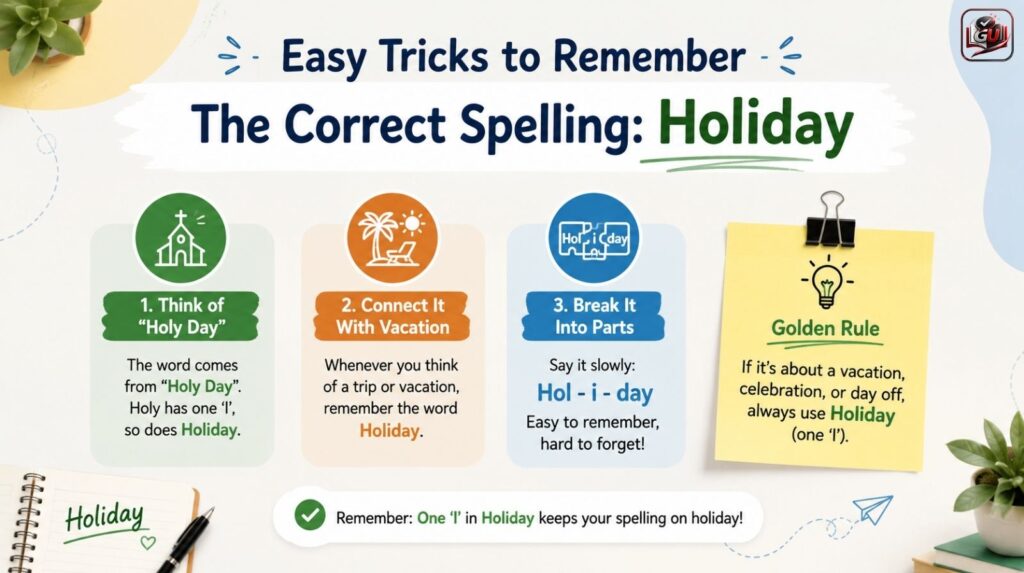
Here are simple memory hacks.
Trick #1: Think of “Holy Day”
The original word came from “holy day.”
Holy → Holiday
There is only one “l” after “ho.”
Trick #2: Connect It With Vacation
Imagine a relaxing vacation whenever you write “holiday.”
Trick #3: Read It Slowly
Break the word into parts:
Hol-i-day
This helps avoid adding extra letters.
Holiday vs Holliday in SEO Writing
Correct spelling is extremely important in SEO content.
Why Correct Spelling Helps Rankings
Google values:
- Accuracy
- User trust
- Readability
- Search intent matching
Therefore, using “holiday” correctly improves:
- Search rankings
- User experience
- Click-through rates
- Content authority
SEO Best Practice
Use the correctly searched keyword naturally throughout your content.
Examples:
- holiday destinations
- holiday travel tips
- holiday season guide
- summer holiday ideas
Avoid intentionally stuffing incorrect spellings unless discussing the mistake itself.
FAQs
Q. Is Holliday ever correct?
A: Yes. “Holliday” is correct when used as a surname or proper name, such as Doc Holliday.
Q. Which spelling is correct in English: Holliday or Holiday?
A: The correct English spelling is “holiday.”
Q. Why do people misspell holiday as holliday?
A: People often add an extra “l” because of pronunciation habits, typing mistakes, or confusion with surnames.
Q. Is holiday used differently in British and American English?
A: Yes. British English commonly uses “holiday” for vacations, while American English often uses “vacation” instead.
Q. Can spelling mistakes affect SEO?
A: Absolutely. Incorrect spelling may reduce rankings, hurt trust, and lower organic traffic.
Q. What does holiday originally mean?
A: The word originally came from “holy day,” referring to religious celebrations.
Q. Is “holiday” a noun?
A: Yes. “Holiday” is a noun referring to a celebration, vacation, or day off.
Conclusion
When comparing Holliday vs Holiday, the correct spelling for standard English usage is clearly holiday.
While “Holliday” exists as a surname, it is usually incorrect in everyday writing. Understanding this difference improves grammar accuracy, professional communication, and SEO performance.
Whether you are writing blog posts, school assignments, business emails, or travel content, using the correct spelling helps build trust and authority.
The next time you hesitate between “Holliday” and “Holiday,” remember this simple rule:
✅ Vacation or celebration = Holiday
✅ Person’s last name = Holliday
Want more expert grammar guides and spelling comparisons? Bookmark this page and continue improving your English writing skills today.
👉Keep learning with more easy grammar lessons on GrammerUpdate.com

Noor Fatima is a professional blogger specializing in spelling correction and grammar guidance. She creates clear, practical content to help readers avoid common mistakes, strengthen writing skills, and communicate with confidence in everyday and professional settings.