
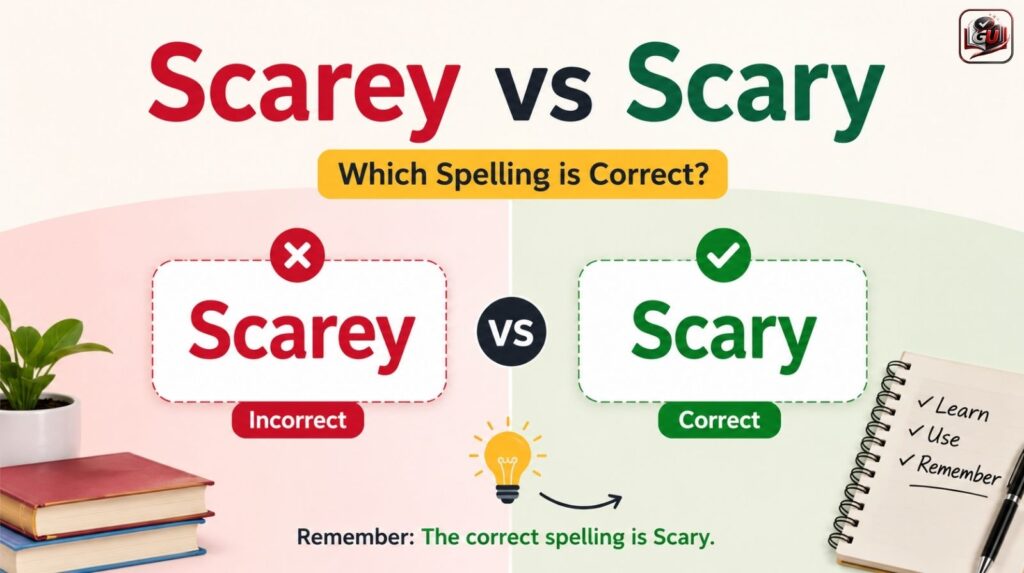
Have you ever written “scarey” and then stopped to wonder if it was actually correct? You’re not the only one. Many people get confused between scarey vs scary because both spellings seem reasonable when you hear the word out loud.
The confusion often comes from the word “scare,” which makes it easy to assume that “scarey” should be correct. However, English spelling doesn’t always follow the patterns we expect. In this case, only one version is accepted in standard English, while the other is considered a common misspelling.
In this guide, you’ll learn the correct spelling, understand why the confusion happens, see real examples of proper usage, and discover a few simple tricks to remember the right form. By the end, you’ll know exactly when to use “scary” and avoid making this mistake in your writing.
What Is the Correct Spelling: Scarey or Scary?
The correct spelling is scary.
❌ Scarey – Incorrect spelling
✅ Scary – Correct spelling
Scary is an adjective that describes something that causes fear, fright, or anxiety.
Quick Answer
| Word | Correct? | Meaning |
|---|---|---|
| Scary | ✅ Yes | Causing fear or fright |
| Scarey | ❌ No | Misspelling of scary |
Examples of Correct Usage
- That horror movie was scary.
- The thunderstorm looked scary from a distance.
- Some people find public speaking scary.
In standard English dictionaries, scarey is not recognized as the preferred spelling.
Why Do People Write “Scarey” Instead of “Scary”?
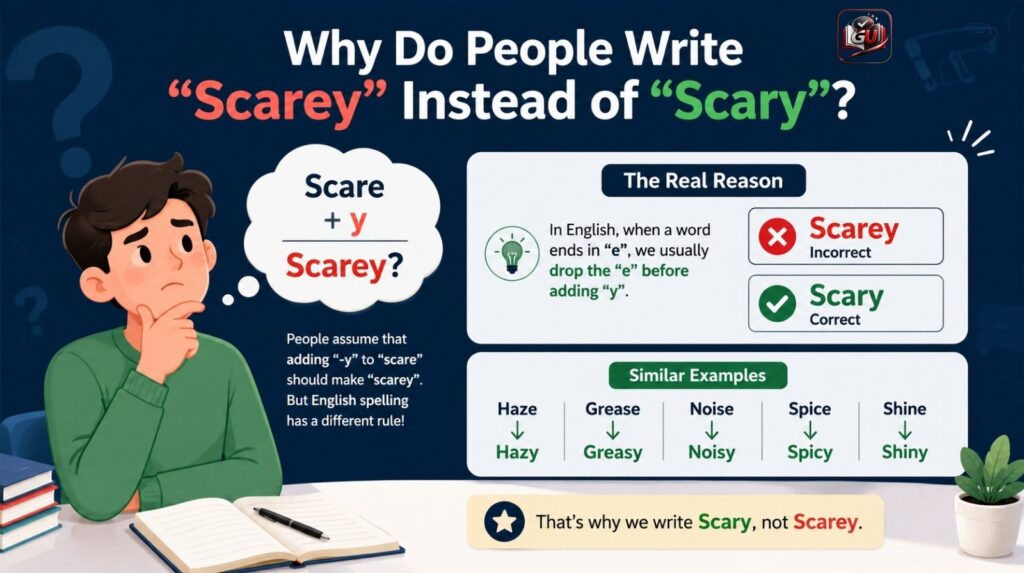
The confusion usually comes from the base word scare.
People often assume that since the noun and verb are spelled scare, the adjective should naturally become scarey.
However, English doesn’t always work that way.
Understanding the Word Formation
The adjective scary comes from the word scare, but the spelling changes during word formation.
Examples:
| Base Word | Adjective |
|---|---|
| scare | scary |
| haze | hazy |
| grease | greasy |
| shine | shiny |
Notice that the final e is dropped before adding y.
Common Pattern in English
Many English adjectives follow this pattern:
- Noise → Noisy
- Ice → Icy
- Spice → Spicy
- Grease → Greasy
Similarly:
- Scare → Scary
This spelling rule explains why scary is correct and scarey is not.
Why the Mistake Looks Reasonable
Because English contains words like:
- Care → Careful
- Rare → Rarely
- Share → Shared
Many writers instinctively keep the “e” and produce scarey, even though dictionaries reject that spelling.
What Does Scary Mean?
The word scary describes something that causes fear, nervousness, or uneasiness.
Dictionary Definition
According to major dictionaries, scary means:
Causing fear, alarm, or fright.
Examples in Daily Life
Scary Situations
- Walking alone in a dark alley.
- Hearing strange noises at night.
- Watching a horror movie.
Scary Events
- Earthquakes
- Severe storms
- Unexpected accidents
Scary Experiences
- First skydiving jump
- Getting lost in a forest
- Facing a difficult exam
Synonyms of Scary
- Frightening
- Terrifying
- Alarming
- Chilling
- Creepy
- Fearsome
- Intimidating
Using synonyms can improve your writing while avoiding repetition.
Scarey vs Scary: Side-by-Side Comparison
Many users search specifically for the difference between scarey vs scary. The table below provides a quick comparison.
| Feature | Scary | Scarey |
|---|---|---|
| Correct English spelling | ✅ Yes | ❌ No |
| Found in major dictionaries | ✅ Yes | ❌ No |
| Accepted in academic writing | ✅ Yes | ❌ No |
| Used by professional writers | ✅ Yes | ❌ No |
| Recommended for SEO content | ✅ Yes | ❌ No |
| Causes spelling errors | ❌ No | ✅ Yes |
Key Takeaway
If you’re writing emails, articles, essays, blog posts, or social media content, always use scary.
Real-Life Example: How a Simple Spelling Mistake Affected Content Performance
A freelance blogger who wrote entertainment content noticed that one of their Halloween-themed articles received significantly less search traffic than expected.
The article title contained the phrase:
“Top 20 Scarey Movies to Watch This Halloween”
At first, the mistake seemed minor. After all, readers could still understand the meaning.
However, keyword research later revealed that people overwhelmingly searched for “scary movies” rather than “scarey movies.”
The writer updated the title and several headings to use the correct spelling:
“Top 20 Scary Movies to Watch This Halloween”
Within the following months, the page began attracting more organic traffic because it matched the spelling users actually searched for.
This example highlights an important lesson:
Spelling errors don’t just affect grammar. They can also reduce credibility, hurt search visibility, and create confusion for readers.
Whether you’re writing a school assignment, business email, or SEO article, using the correct spelling helps readers trust your content and makes it easier for search engines to understand your topic.
English Spelling Trends and Language Data (2025–2026)
Language databases and search trend tools continue to show overwhelming preference for the spelling scary.
What Recent Language Trends Show
- Major dictionaries list scary as the standard spelling.
- Educational websites teach scary as the correct form.
- Publishing style guides recommend scary exclusively.
- Search engine results overwhelmingly favor scary over scarey.
Why This Matters
Search engines analyze language patterns and user behavior. Using standard spellings helps content align with reader expectations and improves clarity.
For writers, students, and businesses, choosing the correct spelling contributes to:
- Better readability
- Higher credibility
- Improved user experience
- Stronger SEO performance
How to Remember the Correct Spelling of Scary
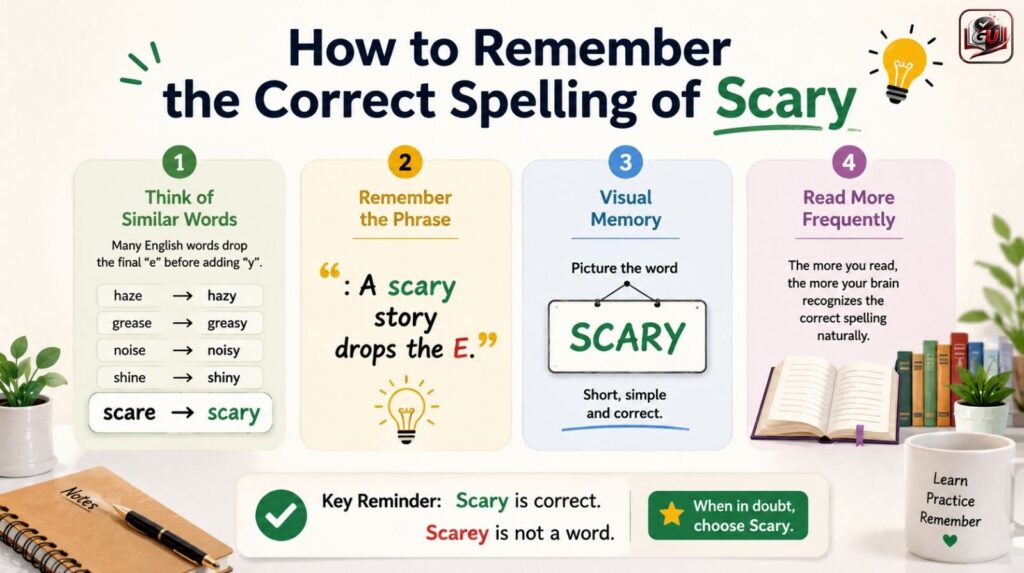
If you frequently mix up scarey vs scary, these memory tricks can help.
Trick #1: Think of Similar Words
Compare:
- Haze → Hazy
- Grease → Greasy
- Noise → Noisy
- Scare → Scary
The final e disappears.
Trick #2: Remember the Phrase
“A scary story drops the E.”
This simple phrase helps reinforce the spelling rule.
Trick #3: Visual Memory
Picture the word:
SCARY
The shorter version is the standard spelling used everywhere.
Trick #4: Read More Frequently
Reading books, articles, and news content regularly helps your brain recognize correct spellings naturally.
Common Mistakes People Make
Many spelling errors are similar to scarey.
Mistake 1: Adding Extra Letters
❌ Scarey
✅ Scary
Mistake 2: Assuming Every Word Keeps Its Base Form
People often think:
Scare + Y = Scarey
But English spelling rules modify many words during word formation.
Mistake 3: Trusting Autocorrect Blindly
Some devices may not immediately flag uncommon misspellings. Always double-check important writing.
Mistake 4: Copying Incorrect Usage Online
Not every website follows proper grammar standards. Reliable sources should always be consulted.
How Writers, Students, and Professionals Should Use Scary
For Students
Use scary in essays, assignments, and exams.
Example:
The haunted house was scary.
For Bloggers
Use the correct spelling in titles and headings to match search intent.
Example:
10 Scary Stories That Will Keep You Awake
For Professionals
Maintain credibility in reports, presentations, and communications.
Example:
The security risks described in the report are quite scary.
For Social Media Users
Even casual content appears more polished with correct spelling.
Example:
That movie was so scary!
FAQs
Q. Is scarey a real word?
A: No. Scarey is generally considered a misspelling of scary in modern English.
Q. Which spelling is correct: scarey or scary?
A: Scary is the correct and widely accepted spelling.
Q. Why is scary spelled without the letter E?
A: The final e in scare is dropped before adding the y ending, following a common English spelling pattern.
Q. Can I use scarey in formal writing?
A: No. Formal writing should always use scary.
Q. Do dictionaries recognize scarey?
A: Major dictionaries list scary as the standard spelling. Scarey is not accepted as the preferred form.
Q. Is scary an adjective?
A: Yes. Scary is an adjective that describes something frightening or fear-inducing.
Q. What are synonyms for scary?
A: Common synonyms include frightening, terrifying, creepy, alarming, chilling, and fearsome.
Credible References
For further reading, consult these trusted language resources:
- Merriam-Webster Dictionary
- Cambridge Dictionary
- Oxford Learner’s Dictionaries
Conclusion
When comparing Scarey vs Scary, the answer is simple: scary is the correct spelling, while scarey is a common misspelling.
Understanding why the word is spelled this way helps you avoid future mistakes and write with greater confidence. Whether you’re a student, blogger, professional writer, or English learner, using scary correctly improves clarity, credibility, and overall communication.
The next time you’re unsure, remember this simple rule:
“A scary word drops the E.”
Keep practicing correct spelling, and you’ll strengthen your English writing skills with every sentence you write.
👉Keep learning with more easy grammar lessons on GrammerUpdate.com

Noor Fatima is a professional blogger specializing in spelling correction and grammar guidance. She creates clear, practical content to help readers avoid common mistakes, strengthen writing skills, and communicate with confidence in everyday and professional settings.