
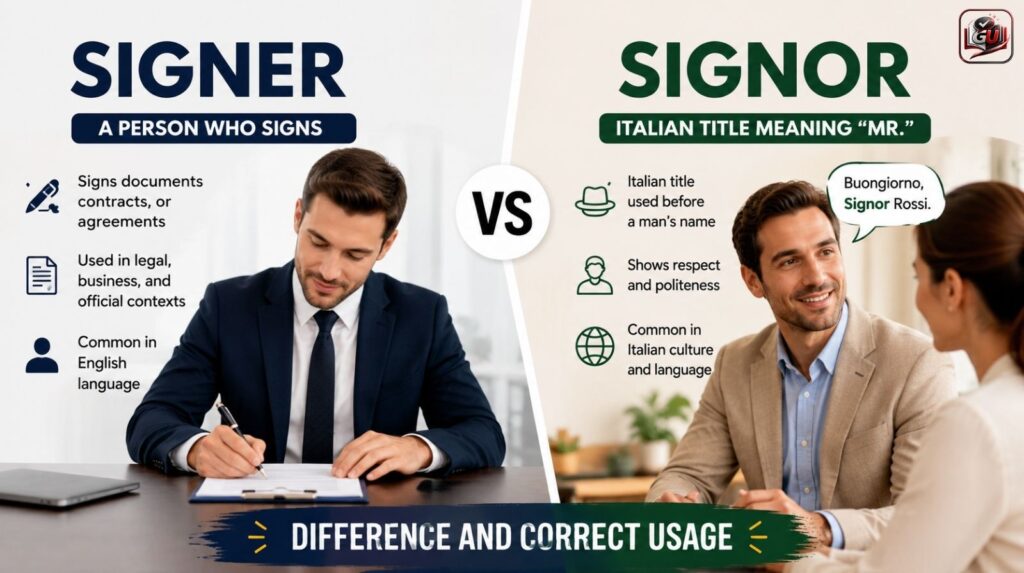
Have you ever come across the words Signer and Signor and wondered whether they mean the same thing? At first glance, they look almost identical, which is why many people confuse them. However, these two words have completely different meanings and are used in very different contexts.
A Signer is someone who signs a document, contract, or agreement, while Signor is an Italian title used to address a man, similar to “Mr.” in English. Using the wrong word may seem like a small mistake, but it can create confusion, especially in professional, legal, or formal writing.
In this guide, we’ll break down the difference between Signer vs Signor, explain when to use each term, share practical examples, and highlight common mistakes so you can use both words with confidence in your writing.
What Is the Difference Between Signer and Signor?
Quick Answer
A Signer is a person who signs a document, contract, agreement, or form.
A Signor is an Italian title of respect equivalent to “Mr.” in English.
Although the words differ by only one letter, they belong to completely different categories of language.
| Word | Meaning | Usage |
|---|---|---|
| Signer | A person who signs something | Legal, business, contracts |
| Signor | Italian title meaning Mr. | Names, greetings, Italian language |
Featured Snippet Answer
Signer refers to a person who signs a document or agreement, while Signor is an Italian title used before a man’s name, similar to “Mr.” in English.
What Does Signer Mean?
The word Signer comes from the verb “sign.” It refers to an individual who places their signature on a document.
Common Contexts for Signer
- Legal contracts
- Employment agreements
- Financial documents
- Government forms
- Real estate paperwork
Examples of Signer in Sentences
- The signer reviewed the contract before signing it.
- Every signer must provide identification.
- The bank verified the signer’s signature.
- The signer agreed to all terms and conditions.
Why the Word Signer Matters
In legal and business environments, identifying the signer is critical because signatures often establish responsibility, consent, and authorization.
For example, when you sign a mortgage agreement, you become the official signer and are legally bound by the document’s terms.
What Does Signor Mean?
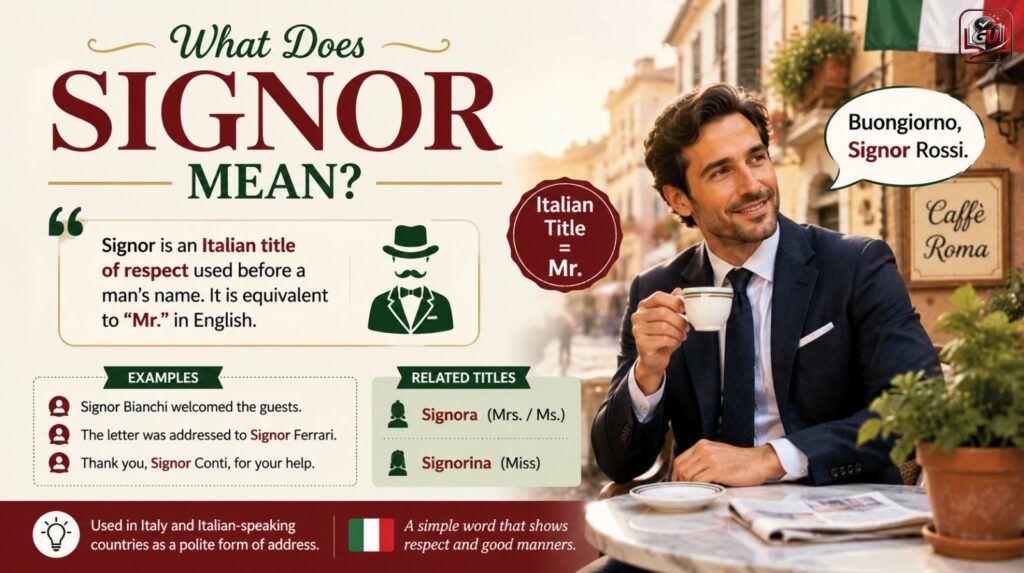
Signor is an Italian honorific title used before a man’s surname or full name. It functions similarly to the English title “Mr.”
Origins of Signor
The word originates from the Italian language and is widely used throughout Italy.
Examples of Signor in Sentences
- Signor Rossi welcomed the guests.
- The reservation was made under Signor Bianchi.
- Good evening, Signor Ferrari.
- The letter was addressed to Signor Marco Conti.
Related Italian Titles
Signora
Used for married or adult women.
Example:
- Signora Rossi attended the meeting.
Signorina
Traditionally used for younger unmarried women.
Example:
- Signorina Lucia greeted the visitors.
When You Should Use Signor
Use Signor only when:
- Referring to Italian names.
- Writing Italian dialogue.
- Using Italian cultural or formal titles.
- Addressing an Italian gentleman respectfully.
Signer vs Signor: Side-by-Side Comparison
Understanding the distinction becomes easier when viewed side by side.
| Feature | Signer | Signor |
|---|---|---|
| Part of Speech | Noun | Title/Honorific |
| Language Origin | English | Italian |
| Meaning | Person who signs | Equivalent of Mr. |
| Common Usage | Legal and business documents | Italian names and greetings |
| Related Terms | Signature, signing | Signora, Signorina |
| Example | The signer approved the contract. | Signor Rossi approved the proposal. |
Easy Memory Trick
Think of it this way:
- Signer = Signature
- Signor = Sir-like Italian title
If a signature is involved, choose Signer.
If an Italian gentleman is involved, choose Signor.
Common Mistakes People Make
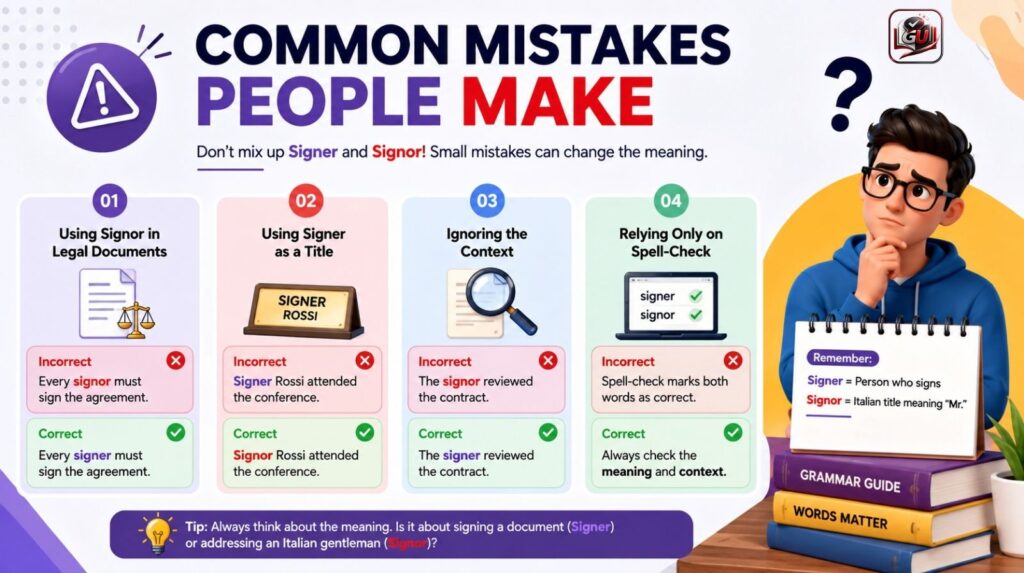
Because both words share similar spelling, writers often mix them up.
Mistake 1: Using Signor in Legal Documents
Incorrect:
- Every signor must sign the agreement.
Correct:
- Every signer must sign the agreement.
Mistake 2: Using Signer as a Title
Incorrect:
- Signer Rossi attended the conference.
Correct:
- Signor Rossi attended the conference.
Mistake 3: Spell-Check Reliance
Many spelling tools verify both words as correctly spelled because both exist in dictionaries. However, the software may not recognize whether the word fits the context.
Always review the meaning rather than relying solely on spell-check tools.
Real-Life Example: How a Small Mistake Created Confusion
A translation agency working with international clients prepared documents for an Italian business conference. One employee was tasked with translating participant information from Italian into English.
The original Italian document included several attendees listed as “Signor Rossi,” “Signor Bianchi,” and “Signor Conti.” During translation, the employee misunderstood the title and assumed it referred to people who had signed registration forms.
As a result, the English version referred to the attendees as “signers” instead of preserving their names and titles correctly.
When conference materials were distributed, several Italian guests noticed the mistake immediately. While the error was not offensive, it created confusion and required the company to reprint materials.
The incident highlights an important lesson: understanding vocabulary context is just as important as knowing spelling. Similar-looking words can carry completely different meanings depending on language and usage. For businesses operating internationally, accuracy in titles and terminology helps maintain professionalism and credibility.
Language and Writing Trends in 2025–2026
Recent language-learning and writing trends show that global communication continues to increase rapidly.
Key Statistics
- More than 1.5 billion people use English worldwide as either a first or second language.
- Language-learning platforms continue to report strong growth in Italian language study due to tourism, business, and cultural interest.
- Cross-border business communication has increased demand for accurate translation and localization services.
- Professional writing tools now emphasize context-based grammar checking rather than simple spell-checking.
These trends make understanding words like Signer and Signor increasingly valuable for writers, translators, students, and professionals.
How to Choose the Correct Word Every Time
Step 1: Check the Context
Ask yourself:
Is the sentence about a signature or document?
If yes, use Signer.
Step 2: Look for an Italian Name
If the word appears before an Italian surname, use Signor.
Example:
- Signor Romano
- Signor De Luca
Step 3: Consider the Purpose
Business contract?
→ Signer
Italian greeting?
→ Signor
Step 4: Read the Sentence Aloud
Often the context becomes obvious when spoken naturally.
Examples of Signer and Signor in Everyday Writing
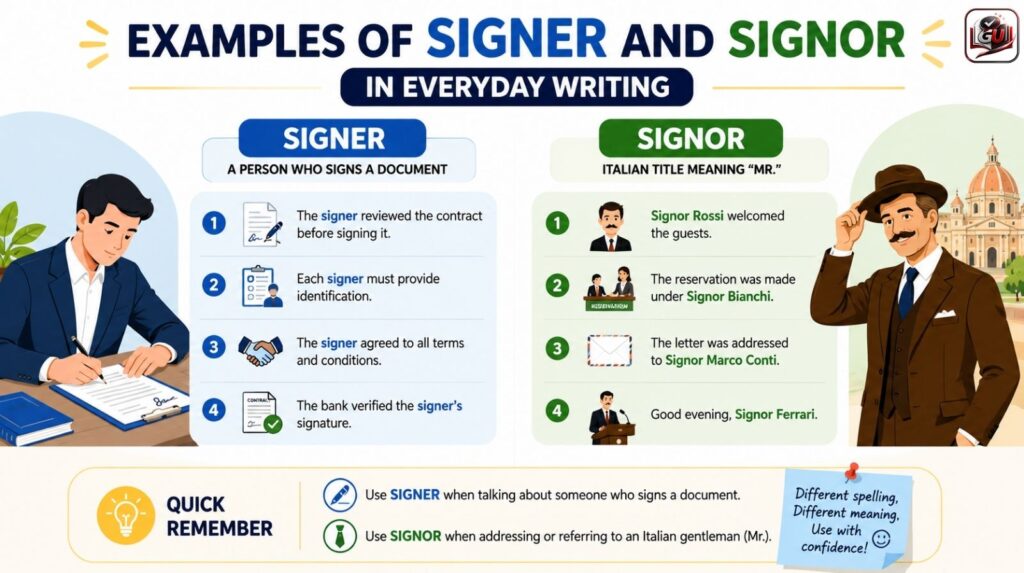
Examples Using Signer
- The signer accepted the terms of service.
- Each signer must complete the application.
- The signer provided proof of identity.
- A witness confirmed the signer’s signature.
Examples Using Signor
- Signor Ricci welcomed visitors to the museum.
- We spoke with Signor Bellini yesterday.
- The invitation was addressed to Signor Romano.
- Signor Ferrari delivered the opening remarks.
Examples Showing the Difference
- The signer completed the contract.
- Signor Romano reviewed the contract.
The first sentence refers to a role.
The second refers to a person’s title.
FAQs
Q. Is Signer a real English word?
A: Yes. A signer is a person who signs a document, agreement, petition, or contract.
Q. Is Signor an English word?
A: Signor originates from Italian but is commonly recognized and used in English when referring to Italian men.
Q. Can Signor mean someone who signs?
A: No. Signor is an Italian title and has nothing to do with signatures.
Q. What is the female version of Signor?
A: The most common female equivalent is Signora.
Q. Which word is used in contracts?
A: Signer is the correct word for legal and business documents.
Q. Why do people confuse Signer and Signor?
A: They look and sound somewhat similar, but their meanings and origins are completely different.
Q. Is Signor still used today?
A: Yes. It remains a standard and respectful form of address in Italy.
Conclusion
Understanding the difference between Signer vs Signor is simple once you focus on context. A Signer is someone who signs a document, contract, or agreement, while Signor is an Italian title equivalent to “Mr.”
Remember the easy rule: if signatures and paperwork are involved, use Signer. If you’re referring to an Italian gentleman respectfully, use Signor.
Using the correct word improves clarity, professionalism, and accuracy in your writing. The next time you encounter these similar-looking terms, you’ll know exactly which one belongs in the sentence.
If you found this guide helpful, bookmark it and share it with anyone who wants to improve their English writing and avoid common word confusion.
👉Keep learning with more easy grammar lessons on GrammerUpdate.com

Noor Fatima is a professional blogger specializing in spelling correction and grammar guidance. She creates clear, practical content to help readers avoid common mistakes, strengthen writing skills, and communicate with confidence in everyday and professional settings.