
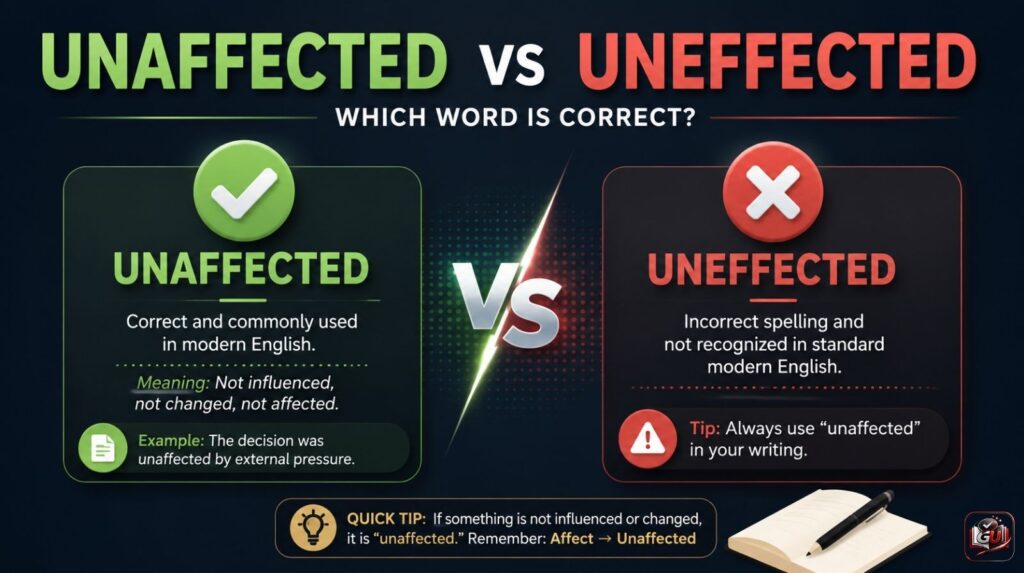
Sometimes, a single spelling mistake can completely change how your writing looks to readers. One common confusion many people face is choosing between “unaffected” and “uneffected.” Since both words look almost the same, it is easy to think they are interchangeable. However, only one of them is actually correct in modern English.
If you have ever felt unsure about which word to use, you are definitely not alone. Students, bloggers, content writers, and even fluent English speakers often make this mistake while writing emails, articles, or social media posts.
In this guide, you will learn the real difference between unaffected vs uneffected, understand why this confusion happens so often, and discover simple examples and memory tricks that will help you use the correct spelling confidently every time.
What Does “Unaffected” Mean?
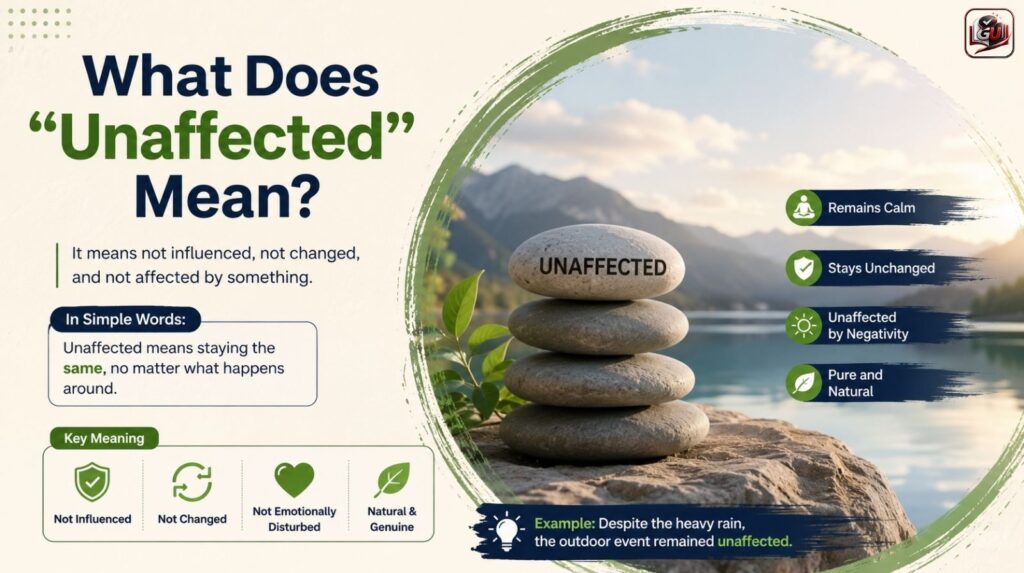
The word unaffected is a correct English word. It is commonly used to describe something or someone that has not been changed, influenced, harmed, or emotionally impacted by something else.
Simple Definition of Unaffected
“Unaffected” means:
- Not influenced
- Not changed
- Not emotionally disturbed
- Natural or genuine
Examples of Unaffected in Sentences
- Despite the heavy rain, the indoor event remained unaffected.
- She stayed calm and unaffected by the criticism.
- The village was completely unaffected by the power outage.
- His simple lifestyle shows his unaffected personality.
In all these examples, the word describes something that remained unchanged or untouched.
Why “Unaffected” Is the Correct Word
The word comes from the base word affect, which means “to influence or change something.”
When we add the prefix un-, it becomes:
- affected → changed or influenced
- unaffected → not changed or influenced
This follows normal English grammar rules.
Is “Uneffected” a Real Word?
The short answer is no.
Uneffected is considered an incorrect spelling in modern English writing. Most dictionaries, grammar experts, and style guides do not recognize it as a standard word.
Why People Write “Uneffected”
Many people mistakenly think the opposite of “effected” should be “uneffected.” This confusion usually happens because of the well-known grammar issue involving affect vs effect.
However, English does not commonly use “uneffected” in standard writing.
Grammar Explanation
The verb affect means:
- to influence
The noun effect means:
- result or outcome
Because “unaffected” comes from “affected,” it is the grammatically correct form.
Incorrect Example
❌ The project remained uneffected by the delay.
Correct Example
✅ The project remained unaffected by the delay.
Therefore, if you want to sound professional and grammatically correct, always use unaffected.
Unaffected vs Uneffected: Key Differences
Here is a simple comparison table to make everything easier to understand.
| Feature | Unaffected | Uneffected |
|---|---|---|
| Correct English Word | Yes | No |
| Recognized in Dictionaries | Yes | Rare/Incorrect |
| Meaning | Not influenced or changed | Nonstandard spelling |
| Common Usage | Very common | Considered a mistake |
| Recommended for Writing | Yes | No |
Quick Summary
If you are choosing between unaffected vs uneffected, always pick unaffected.
Why This Spelling Mistake Happens So Often
English spelling can sometimes feel confusing because many words sound similar but follow different grammar patterns.
Confusion Between Affect and Effect
One major reason for the mistake is the famous grammar pair:
- Affect = verb
- Effect = noun
For example:
- The weather can affect your mood.
- The medicine had a positive effect.
Because of this pair, some writers incorrectly assume “uneffected” should exist too.
Pronunciation Similarities
Another reason is pronunciation. When spoken quickly, “unaffected” may sound similar to “uneffected,” especially for non-native speakers.
Typing and Autocorrect Errors
Sometimes typing mistakes or weak autocorrect systems can also create the wrong spelling. However, professional grammar tools usually flag “uneffected” as incorrect.
How to Remember the Correct Spelling Easily
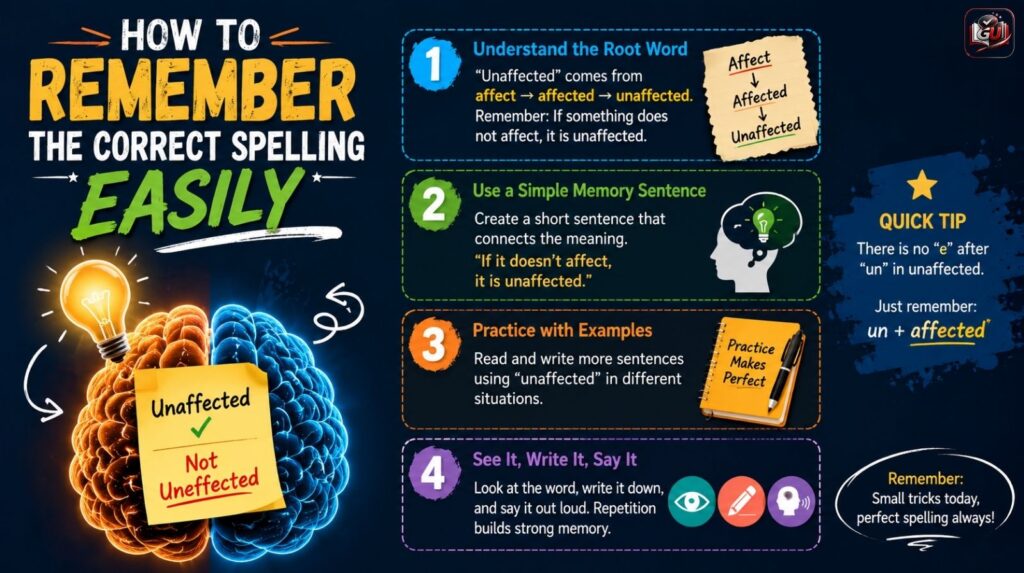
If you often forget which word is correct, these simple memory tricks can help.
Remember the Root Word
“Unaffected” comes from:
- affect → affected → unaffected
Since “affect” is the original word, the spelling keeps the letter “A.”
Use This Simple Memory Trick
Think of this sentence:
“An event can affect you, but if it does not, you are unaffected.”
This small trick helps connect the words naturally.
Practice with Real Sentences
Reading and writing example sentences regularly can improve your memory.
Examples:
- The backup server remained unaffected during the outage.
- Her confidence was unaffected by negative comments.
- Small businesses were unaffected by the new tax rule.
The more you see the correct spelling, the easier it becomes to remember.
Real-Life Writing Example: How One Small Spelling Mistake Changed a Blog’s Credibility
A freelance content writer published an article about business communication on a marketing blog in early 2025. The article itself was well researched and informative. However, readers quickly noticed repeated usage of the word “uneffected.”
Several users commented that the spelling looked incorrect. One reader even pointed out that the mistake reduced the professionalism of the article.
After reviewing the issue, the writer updated every instance of “uneffected” to “unaffected.” Within a few weeks, the article’s engagement improved because readers trusted the content more.
This example shows how even a tiny grammar mistake can affect online credibility. In SEO writing, trust matters. Search engines and readers both prefer content that demonstrates accuracy and professionalism.
Today, many brands use grammar-checking tools before publishing because spelling mistakes can reduce reader confidence, especially in educational or professional content.
Therefore, learning the correct usage of words like unaffected can make your writing appear more polished and authoritative.
2025–2026 Writing and Grammar Trends
According to recent language technology reports and grammar platform updates from 2025, spelling accuracy has become more important than ever in digital publishing.
Key Statistics
- Over 70% of online readers notice spelling mistakes immediately.
- Content with grammar errors often experiences lower engagement rates.
- AI-powered grammar tools now automatically flag nonstandard spellings like “uneffected.”
- SEO experts report that high-quality writing improves reader retention and trust signals.
Modern search engines increasingly prioritize content quality, readability, and expertise. Therefore, using correct grammar is no longer optional for bloggers and businesses.
Trusted Language Resources
You can verify spelling and grammar rules using trusted references such as:
- Merriam-Webster Dictionary
- Cambridge Dictionary
- Grammarly Writing Tips
These sources consistently recognize unaffected as the standard and correct spelling.
Common Situations Where “Unaffected” Is Used
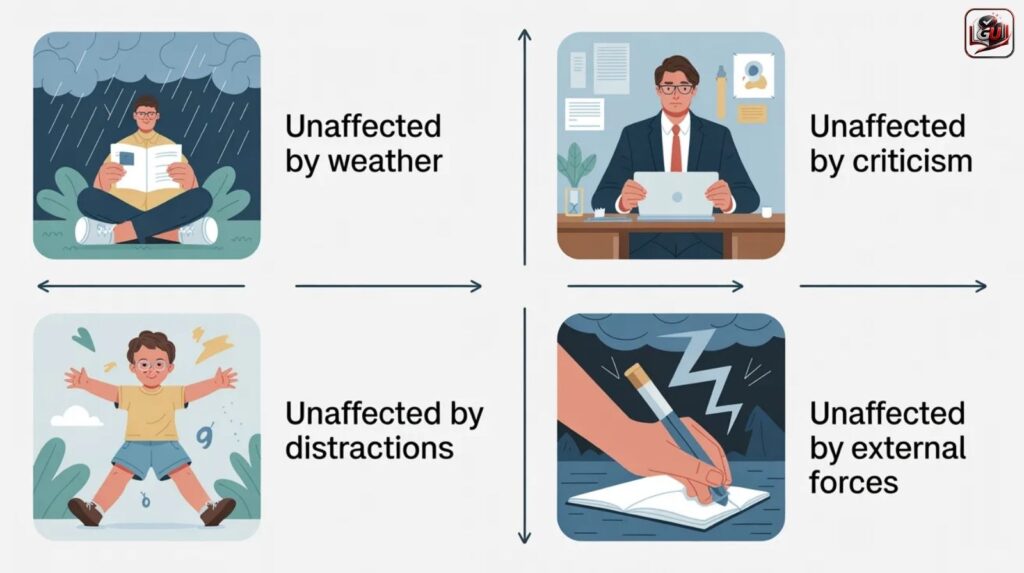
The word appears in many types of writing.
Emotional Situations
- He seemed completely unaffected by the argument.
- She remained unaffected after hearing the criticism.
Business and Technology
- The company’s servers were unaffected by the cyberattack.
- Sales remained unaffected despite market changes.
Weather and Environment
- The northern region was unaffected by the storm.
- Several roads remained unaffected after the flood.
Health and Medical Writing
- Fortunately, the patient’s lungs were unaffected.
- The treatment left surrounding tissues unaffected.
These examples show how widely the word is used in everyday English.
Common Mistakes to Avoid
Here are a few mistakes many writers make.
Incorrect Spellings
❌ Uneffected
❌ Unaffacted
❌ Uneffacted
Correct Spelling
✅ Unaffected
Incorrect Grammar Usage
❌ The issue was uneffected by policy changes.
Correct Grammar Usage
✅ The issue was unaffected by policy changes.
Always proofread your work carefully before publishing.
FAQs
Q. Is uneffected ever correct?
A: No. “Uneffected” is generally considered an incorrect or nonstandard spelling in modern English.
Q. What is the correct spelling: unaffected or uneffected?
A: The correct spelling is unaffected.
Q. What does unaffected mean?
A: It means something has not been influenced, changed, harmed, or emotionally disturbed.
Q. Why do people confuse unaffected and uneffected?
A: The confusion usually happens because of the similar words “affect” and “effect.”
Q. Can I use unaffected in formal writing?
A: Yes. “Unaffected” is completely acceptable in academic, professional, business, and casual writing.
Q. Is unaffected an adjective?
A: Yes. It is commonly used as an adjective.
Q. What is an example sentence using unaffected?
A: “The airport operations remained unaffected during the strike.”
Final Thoughts on Unaffected vs Uneffected
When comparing unaffected vs uneffected, the answer is simple: unaffected is the correct and widely accepted English word, while “uneffected” is considered a spelling mistake in most situations.
Understanding this difference can improve your grammar, strengthen your writing, and help you communicate more professionally. Whether you are writing blog posts, emails, essays, or social media captions, using the correct spelling builds trust and clarity.
The next time you hesitate between these two words, remember this simple rule:
If something is not changed or influenced, it is unaffected.
Keep practicing correct spelling habits, and your writing will become stronger, clearer, and more confident over time.
👉Keep learning with more easy grammar lessons on GrammerUpdate.com

Noor Fatima is a professional blogger specializing in spelling correction and grammar guidance. She creates clear, practical content to help readers avoid common mistakes, strengthen writing skills, and communicate with confidence in everyday and professional settings.