
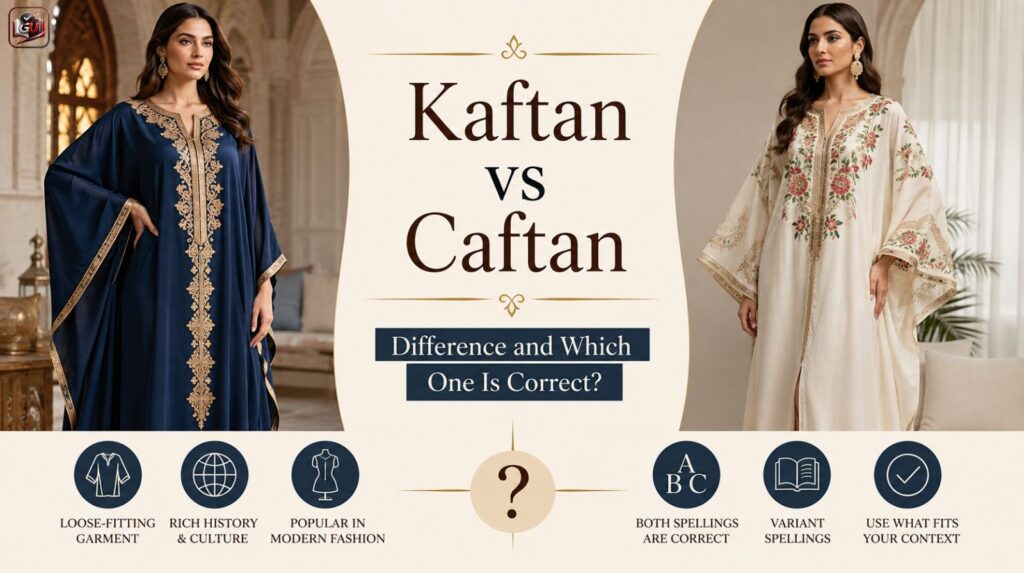
Have you ever seen the words kaftan and caftan and wondered whether they describe two different garments? You’re not alone. The spelling changes by just one letter, but that small difference can create confusion when you’re writing about clothing, fashion, history, or culture.
So, kaftan vs caftan which spelling is correct?
The short answer is that both “kaftan” and “caftan” are recognized English spellings for the same general type of loose-fitting garment. Neither is simply a misspelling of the other. However, kaftan is a widely used spelling in modern English, while caftan also appears frequently, particularly in fashion and historical writing.
The difference often comes down to language tradition, regional usage, transliteration, and editorial preference rather than a difference in the basic garment itself.
In this guide, we’ll look at the meanings, origins, spelling differences, examples, usage patterns, and the situations in which one spelling may be more appropriate than the other.
See Also: Covenant vs Contract: What’s The Difference?
Kaftan vs Caftan: What Is the Difference?
The main difference between kaftan and caftan is spelling, not the fundamental meaning.
Both terms generally refer to a long, loose-fitting garment, traditionally worn in various parts of the Middle East, Central Asia, North Africa, and surrounding regions. Over time, the style spread into other cultures and became part of modern fashion.
Kaftan meaning
A kaftan is a loose, usually long garment that may have long sleeves and an open or partially open front. Traditional versions can be associated with various cultures and historical periods.
For example:
She wore a beautifully embroidered kaftan to the evening celebration.
Here, kaftan refers to the garment itself.
Caftan meaning
Caftan has essentially the same core meaning. It is another established English spelling of the word.
For example:
The designer created a lightweight caftan for summer vacations.
Again, the word describes a loose-fitting garment.
Are kaftan and caftan different garments?
Usually, no.
There isn’t a universal rule saying that a kaftan has one specific design while a caftan has another. In many dictionaries and fashion contexts, the two spellings refer to the same broad garment category.
That said, specific designers, brands, regions, or publications may use one spelling consistently. If you’re referring to a particular brand or product, follow that brand’s spelling.
Kaftan vs Caftan: Which Spelling Is Correct?
Both “kaftan” and “caftan” are correct English spellings.
The spelling you choose depends largely on context and convention.
When should you use “kaftan”?
Kaftan is a strong choice when you’re writing general English and want a spelling that closely reflects the form commonly seen in contemporary discussions of the garment.
Examples include:
- traditional kaftan
- Moroccan kaftan
- Turkish kaftan
- silk kaftan
- embroidered kaftan
- modern kaftan dress
If you’re writing a general article, kaftan is a perfectly natural choice.
When should you use “caftan”?
Caftan is also standard English usage and can be found in dictionaries, fashion publications, historical writing, and descriptions of clothing.
For example:
- summer caftan
- silk caftan
- designer caftan
- traditional caftan
- embroidered caftan
So, calling caftan incorrect would be misleading.
Which one should you choose?
If you don’t have a specific style guide or naming convention to follow, choose one spelling and use it consistently throughout your writing.
For SEO content, this is particularly useful because readers may search for either version. You can naturally mention both near the beginning:
“Kaftan” and “caftan” are two accepted spellings for a similar type of loose-fitting garment.
That answers the spelling question immediately without making the article awkward.
See Also: Solicited vs Unsolicited: Differences, Meaning & Usage
The History Behind the Words Kaftan and Caftan
Understanding the history of the term helps explain why English ended up with more than one spelling.
A word that traveled across languages
The garment and its name have a long history across different regions. The English forms kaftan and caftan ultimately reflect words that passed through different languages and systems of transliteration.
The spelling wasn’t created in modern English from scratch.
Instead, the word traveled through languages and cultures, and writers represented its pronunciation using the spelling conventions available to them.
That’s one reason you may encounter forms such as:
- kaftan
- caftan
- kaftan-like variations in historical sources
This isn’t unusual. English contains many words whose spellings developed through contact with other languages.
Why does the first letter change?
The K/C difference is largely connected to how the original or intermediary word was represented in different languages.
When words move between writing systems, there isn’t always a single perfect way to represent their sounds using the Latin alphabet.
For example, one language might favor a k representation while another historical convention might use c.
Over time, both forms can become established.
Historical clothing vs modern fashion
The word has also evolved alongside the garment.
Historically, kaftan-type garments could be associated with court dress, regional clothing, ceremonial clothing, and everyday wear depending on the culture and period.
Modern fashion, meanwhile, often uses kaftan or caftan to describe relaxed garments inspired by these traditional forms.
Therefore, the modern fashion meaning shouldn’t automatically be treated as identical to every historical version of the garment.
Kaftan vs Caftan in Modern Fashion
Today, both spellings appear in fashion, but the word can describe a surprisingly broad range of clothing.
Modern kaftan styles
A contemporary kaftan may be made from:
- cotton
- silk
- linen
- chiffon
- velvet
- satin
- lightweight synthetic fabrics
Some designs look like flowing dresses, while others retain a more traditional silhouette.
For example, a beach kaftan might be loose, lightweight, and colorful, while a formal kaftan could feature embroidery, beading, or decorative patterns.
Modern caftan styles
Caftan can describe many of the same fashion designs.
A retailer might call a flowing vacation garment a “caftan,” while another retailer might call almost the same design a “kaftan.”
That doesn’t necessarily mean the products belong to completely different categories.
The naming often reflects:
- brand preference
- regional terminology
- target market
- historical association
- fashion editorial style
Why fashion terminology can be inconsistent
Fashion doesn’t always follow rigid vocabulary rules.
Designers frequently adapt historical garments for modern audiences. As a result, the same basic silhouette can receive different names depending on the designer or market.
That’s why you’ll sometimes see kaftan dress, caftan dress, and simply kaftan or caftan used for similar clothing.
Kaftan vs Caftan: A Simple Comparison
| Feature | Kaftan | Caftan |
|---|---|---|
| Spelling | Correct | Correct |
| Basic meaning | Loose-fitting garment | Loose-fitting garment |
| General use | Modern and historical | Modern and historical |
| Garment category | Similar | Similar |
| Major difference | Spelling/convention | Spelling/convention |
| Suitable for formal writing | Yes | Yes |
| Suitable for fashion writing | Yes | Yes |
| Is it a misspelling? | No | No |
The most important takeaway is simple: kaftan and caftan are generally variant spellings, not two completely different words.
See Also: That’s vs Thats: Difference, Meaning & Which Is Correct?
How to Use Kaftan and Caftan Correctly in a Sentence
Knowing that both spellings are correct is useful, but you also need to know how to use them naturally.
Examples with “kaftan”
Here are some natural examples:
- She bought a colorful kaftan for her holiday.
- The museum displayed a traditional kaftan.
- The designer presented a collection inspired by the kaftan.
- Her embroidered kaftan featured intricate patterns.
- A lightweight kaftan is popular as resort wear.
Examples with “caftan”
You can use caftan in essentially similar contexts:
- She wore a flowing caftan to the garden party.
- The exhibition included a historic caftan.
- The collection featured silk caftans in several designs.
- He described the garment as a traditional caftan.
- The designer used the classic caftan silhouette in a modern collection.
Avoid switching randomly
One thing writers should avoid is unnecessary inconsistency.
For example, don’t write:
The article discusses the history of the kaftan. Later, the caftan became popular in another region. The modern kaftan is different from the caftan.
If you’re using the two words simply as spelling variants, switching back and forth can make readers think you’re describing two distinct garments.
Instead, establish your terminology early:
The terms kaftan and caftan are both used for this type of loose-fitting garment. This article uses “kaftan” as the primary spelling.
That makes your writing much clearer.
Regional and Cultural Context Matters
One of the biggest mistakes people make when discussing kaftan vs caftan is assuming that one spelling represents one culture and the other spelling represents another.
The reality is more complicated.
Traditional garments vary across cultures
Kaftan-like garments have appeared in different cultural settings, and their construction, decoration, purpose, and social meaning can vary considerably.
A garment called a kaftan in one context might not look exactly like a garment described with the same word somewhere else.
That’s normal for historical clothing terminology.
Think about the word coat. A coat can mean many different things depending on its historical period, country, material, and design.
The same principle applies here.
Moroccan fashion
Moroccan clothing traditions provide one prominent modern example of kaftan fashion.
Moroccan kaftans can feature elaborate embroidery, decorative details, rich fabrics, and formal styling. They have also become increasingly visible in international fashion.
However, it’s important not to assume that every garment called a kaftan represents Moroccan clothing. The broader term has a much longer and wider history.
See Also: To Many vs Too Many: Difference And Which Is Correct?
Middle Eastern and Central Asian connections
Kaftan-type garments have also been associated historically with various Middle Eastern and Central Asian traditions.
Different societies adapted the garment to their own needs, climates, materials, customs, and social structures.
Therefore, when writing about historical clothing, context matters more than simply choosing between K and C.
Case Study: Why Both Spellings Can Appear in Fashion Writing
Consider a hypothetical fashion writer preparing an article about flowing garments for summer.
The writer searches for the garment and finds products labeled both kaftan and caftan.
At first, the writer assumes that the two terms describe separate styles. One product is called a “silk kaftan,” while another is advertised as a “printed caftan.” The designs look remarkably similar.
After checking established dictionary definitions and historical references, the writer discovers that the two spellings can refer to the same broad type of garment.
The writer then examines the brands more carefully. One retailer consistently uses kaftan, while another prefers caftan. Neither is necessarily making a linguistic error. They’re following their own terminology.
The writer decides to use kaftan as the main spelling because it fits the article’s intended audience, but mentions caftan early in the article as an alternative spelling.
That approach solves two problems at once.
First, readers understand that the terms are related. Second, the article remains useful to people who searched for “caftan” rather than “kaftan.”
This example demonstrates an important writing principle: when variant spellings are both legitimate, clarity and consistency matter more than declaring one form “wrong.”
What Dictionaries Tell Us About Kaftan and Caftan
Dictionaries are useful when you’re trying to settle spelling questions because they distinguish established words from accidental misspellings.
Major English dictionaries recognize forms of kaftan and/or caftan as established terms for a type of loose-fitting garment.
That matters because online discussions sometimes incorrectly label caftan as a typo for kaftan, or vice versa.
A spelling doesn’t become incorrect simply because another spelling is more common in a particular context.
Dictionary spelling vs preferred spelling
There’s an important distinction here:
Correct doesn’t always mean most common.
For example, a dictionary can recognize two spellings while a particular publication strongly prefers one.
That happens frequently in English.
A newspaper may follow one style guide. A fashion company may use another. A historical scholar may preserve terminology from a source language.
So, if you’re writing professionally, check the style requirements of the publication you’re writing for.
2025–2026 Data: What Does Search Behavior Tell Us?
Current search behavior can provide useful context, but search-volume data should be interpreted carefully.
Search engines don’t determine whether a spelling is linguistically correct. They primarily reflect what people search for, publish, click, and discuss.
In 2025–2026, online fashion terminology continues to show considerable variation. Retail listings, fashion blogs, magazines, and social platforms may use both kaftan and caftan.
This creates an important SEO opportunity.
See Also: Wait vs Weight: Difference, Meaning & Correct Usage
Don’t treat keyword variation as a spelling error
If your target audience searches:
- kaftan
- caftan
- kaftan dress
- caftan dress
- traditional kaftan
- traditional caftan
- silk kaftan
- silk caftan
you don’t need to create separate low-quality pages for every variation.
Instead, create one genuinely useful page that explains the relationship between the terms.
Google’s guidance on creating helpful, people-first content emphasizes usefulness and satisfying the reader’s underlying need rather than producing pages solely to manipulate search rankings.
For this topic, the underlying search intent is straightforward:
“Are kaftan and caftan different, and which spelling should I use?”
A strong article answers that question directly.
Why exact search numbers can be misleading
Keyword databases can report different numbers because they use different datasets, geographic markets, and methodologies.
Therefore, it’s better not to claim that one spelling is universally “X times more popular” without a clearly identified, current dataset.
For an E-E-A-T-focused article, transparent wording is safer:
Both spellings remain visible in contemporary English-language fashion and clothing content, while usage varies by publication, market, and cultural context.
That’s more defensible than inventing a precise global percentage.
Kaftan vs Caftan for SEO: Which Keyword Should You Target?
If you’re creating an article about this spelling question, kaftan vs caftan is an excellent primary keyword because it directly reflects comparison-based search intent.
Primary keyword
Kaftan vs caftan
Related semantic keywords
Naturally incorporate terms such as:
- kaftan meaning
- caftan meaning
- kaftan spelling
- caftan spelling
- traditional kaftan
- kaftan dress
- loose-fitting garment
Don’t force these terms into every paragraph.
Use them where they genuinely help explain the subject.
Long-tail keywords
Potential long-tail searches include:
- Is kaftan or caftan correct?
- What is the difference between kaftan and caftan?
- Is caftan another spelling of kaftan?
- How do you spell kaftan?
- Is caftan a correct word?
- Kaftan vs caftan which spelling is correct?
These phrases reveal exactly what readers want to know.
See Also: Labelling vs Labeling: Which Spelling Is Correct And How Should You Use It?
Common Mistakes When Using Kaftan and Caftan
Even though the spelling difference is simple, writers can still make several mistakes.
Mistake 1: Calling caftan incorrect
This is the biggest mistake.
Caftan is an established spelling, so automatically calling it wrong oversimplifies the language.
Mistake 2: Assuming they always describe different garments
They generally refer to the same broad garment category, although individual cultures, designers, and retailers may use the terms differently.
Mistake 3: Ignoring cultural context
A traditional garment shouldn’t be discussed as though it has one universal history.
Different regions have their own clothing traditions and terminology.
Mistake 4: Switching spellings without explanation
If your article uses both words, explain near the beginning that they are variant spellings.
Mistake 5: Treating search volume as proof of correctness
A word isn’t correct simply because more people search for it.
Language authority comes from established usage, dictionaries, historical evidence, and accepted conventions not keyword volume alone.
A Quick Decision Guide: Which One Should You Use?
Use this simple checklist when you’re unsure.
Choose “kaftan” when:
- You’re writing general modern English.
- Your publication prefers “kaftan.”
- Your source consistently uses “kaftan.”
- You’re discussing a product specifically labeled “kaftan.”
- You want to use the spelling commonly associated with many modern fashion contexts.
Choose “caftan” when:
- Your source uses “caftan.”
- A brand or retailer officially calls its product a caftan.
- You’re following a publication’s established terminology.
- You’re quoting or discussing historical terminology where that spelling is relevant.
- Your audience is accustomed to the caftan spelling.
Use both when explaining the spelling difference
If the purpose of your article is specifically to explain kaftan vs caftan, mentioning both is appropriate.
For example:
Kaftan and caftan are accepted spelling variants used for a similar type of loose-fitting garment.
That’s concise and accurate.
Mini Quiz Kaftan vs Caftan
1. Kaftan or Caftan?
Which spelling is also accepted in English?
A) Caftan
B) Keften
C) Kafton
D) Caften
Answer: A) Caftan
2. Same Garment?
Are “kaftan” and “caftan” generally used for the same type of garment?
A) Yes
B) No
C) Only in winter
D) Only in fashion magazines
Answer: A) Yes
3. What Is a Kaftan?
What does a kaftan generally describe?
A) A type of shoe
B) A loose-fitting garment
C) A winter hat
D) A handbag
Answer: B) A loose-fitting garment
4. Is Caftan Wrong?
Is “caftan” simply a spelling mistake?
A) Yes
B) No
C) Sometimes always
D) Only online
Answer: B) No
5. Spot the Correct Spelling
Which sentence uses “kaftan” correctly?
A) She wore a beautiful kaftan.
B) She wore a beautiful kafton.
C) She wore a beautiful kaften.
D) She wore a beautiful kaftin.
Answer: A) She wore a beautiful kaftan.
6. One-Letter Difference
What is the main difference between “kaftan” and “caftan”?
A) Their basic meaning
B) Their spelling
C) Their fabric
D) Their length
Answer: B) Their spelling
7. Fashion Check
Which can be described as a kaftan?
A) A loose, flowing garment
B) A pair of boots
C) A baseball cap
D) A belt
Answer: A) A loose, flowing garment
8. Both Are Correct?
Which statement is true?
A) Only kaftan is correct
B) Only caftan is correct
C) Both spellings are established
D) Neither spelling is correct
Answer: C) Both spellings are established
9. Pick the Natural Sentence
Which sentence sounds natural?
A) She bought a silk caftan.
B) She bought a silk caften.
C) She bought a silk kafton.
D) She bought a silk kaftin.
Answer: A) She bought a silk caftan.
10. Historical Connection
Kaftan-type garments have been associated with which broad regions?
A) Middle East and Central Asia
B) Only North America
C) Only Australia
D) Only Antarctica
Answer: A) Middle East and Central Asia
11. Modern Fashion
Can a modern kaftan be worn as a fashionable dress?
A) Yes
B) No
C) Only by children
D) Only during winter
Answer: A) Yes
12. Writing Tip
If you choose “kaftan” in an article, what should you generally do?
A) Change spelling every sentence
B) Use it consistently
C) Avoid the word completely
D) Replace it with “coat”
Answer: B) Use it consistently
13. SEO Quick Check
Which phrase is a useful comparison keyword?
A) Kaftan vs caftan
B) Kaftan under shoes
C) Caftan weather
D) Kaftan mathematics
Answer: A) Kaftan vs caftan
14. Cultural Context
Should writers consider cultural and historical context when discussing kaftans?
A) Yes
B) No
C) Only for advertisements
D) Only for children’s clothing
Answer: A) Yes
15. Final Verdict
What is the best answer to “Kaftan vs Caftan which one is correct?”
A) Kaftan only
B) Caftan only
C) Both are accepted spellings
D) Neither is correct
Answer: C) Both are accepted spellings
FAQs
Q. Is “kaftan” the correct spelling?
A: Yes. Kaftan is a correct and established English spelling for a type of loose-fitting garment.
Q. Is “caftan” also correct?
A: Yes. Caftan is also an established spelling. It isn’t automatically a misspelling of “kaftan.”
Q. Are kaftan and caftan the same thing?
A: Generally, yes. Both words usually refer to a loose-fitting, often long garment. Specific designs can vary depending on culture, historical period, or fashion context.
Q. Which spelling is more common?
A: Usage varies by region, publication, industry, and context. Kaftan is widely used in modern English, while caftan remains an established and recognizable alternative.
Q. How do you spell the clothing item: kaftan or caftan?
A: You can spell it kaftan or caftan. Both forms are recognized. If you’re writing for a particular publication or describing a specific product, follow the terminology used by that source.
Q. Is a kaftan a dress?
A: It can function as a dress in modern fashion, but kaftan is a broader clothing term. Not every traditional kaftan is necessarily designed or classified as a Western-style dress.
Q. Why are there two spellings?
A: The variation developed through the word’s movement across languages and different transliteration and spelling conventions. Both forms eventually became established in English usage.
Final Verdict:
So, kaftan vs caftan which spelling is correct?
Both are correct.
The two words generally refer to the same broad type of loose-fitting garment, and the difference is primarily a matter of spelling and usage tradition.
Kaftan is a very common choice in contemporary English and fashion writing. Caftan, however, is also an established English spelling and shouldn’t be dismissed as an error.
If you’re writing an article, choose the form that best matches your audience, source material, publication style, or product terminology. Most importantly, stay consistent once you’ve made your choice.
When discussing the spelling itself, mention both terms so readers immediately understand the relationship.
In short:
Kaftan = correct
Caftan = correct
Kaftan vs caftan = usually a spelling variation, not a difference between two entirely separate garments.
If you’ve been unsure which form to use, you don’t need to worry about accidentally choosing a “wrong” word. Pick the appropriate spelling for your context, use it consistently, and focus on the cultural and fashion meaning behind the garment.
👉Keep learning with more easy grammar lessons on GrammerUpdate.com

Noor Fatima is a professional blogger specializing in spelling correction and grammar guidance. She creates clear, practical content to help readers avoid common mistakes, strengthen writing skills, and communicate with confidence in everyday and professional settings.