
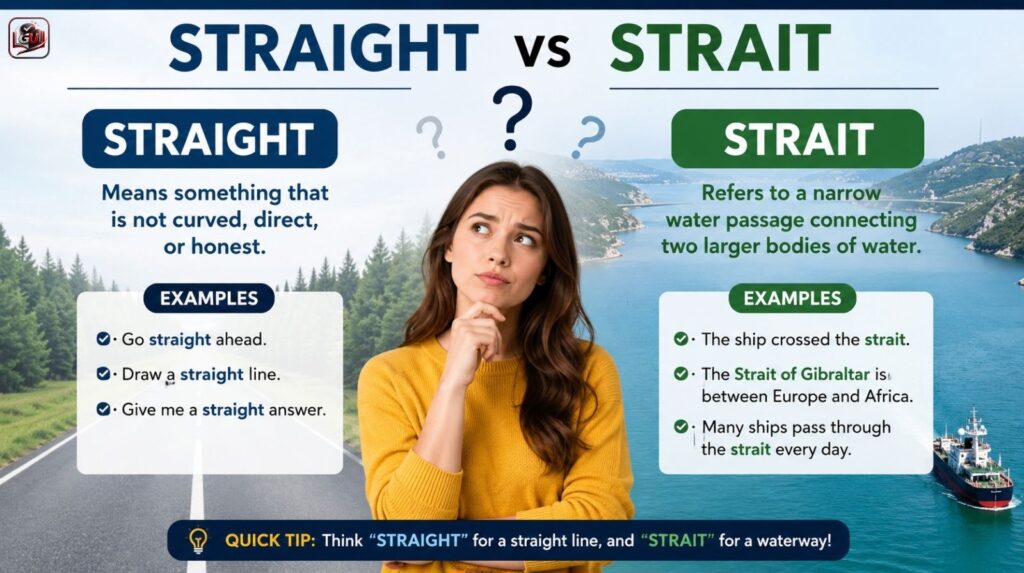
Have you ever typed straight when you meant strait, or vice versa? You’re not alone. These two words sound exactly alike, making them a common source of confusion in English writing.
The challenge is that although straight and strait are pronounced the same way, they have completely different meanings. Using the wrong one can change the meaning of a sentence and affect the clarity of your writing.
In this guide, you’ll learn the Straight vs Strait Difference, when to use each word, practical examples, common mistakes, and expert tips to remember the distinction forever.
What Is the Difference Between Straight and Strait?
The simplest way to understand the difference is this:
| Word | Meaning | Part of Speech | Example |
|---|---|---|---|
| Straight | Not curved, direct, honest, or continuous | Adjective, adverb, noun | Go straight ahead. |
| Strait | A narrow water passage connecting two larger bodies of water | Noun | The ship crossed the strait safely. |
Why Do People Confuse Them?
The confusion happens because both words are homophones, meaning they sound the same but have different spellings and meanings.
For example:
- Correct: Drive straight for two miles.
- Correct: The ferry crossed the strait between the islands.
Although they sound identical, substituting one for the other creates a grammatical and contextual error.
Featured Snippet Answer
Straight means direct, not curved, or honest, while strait refers to a narrow waterway connecting two larger bodies of water. Despite sounding alike, they have completely different meanings and uses.
Understanding the Meaning of Straight
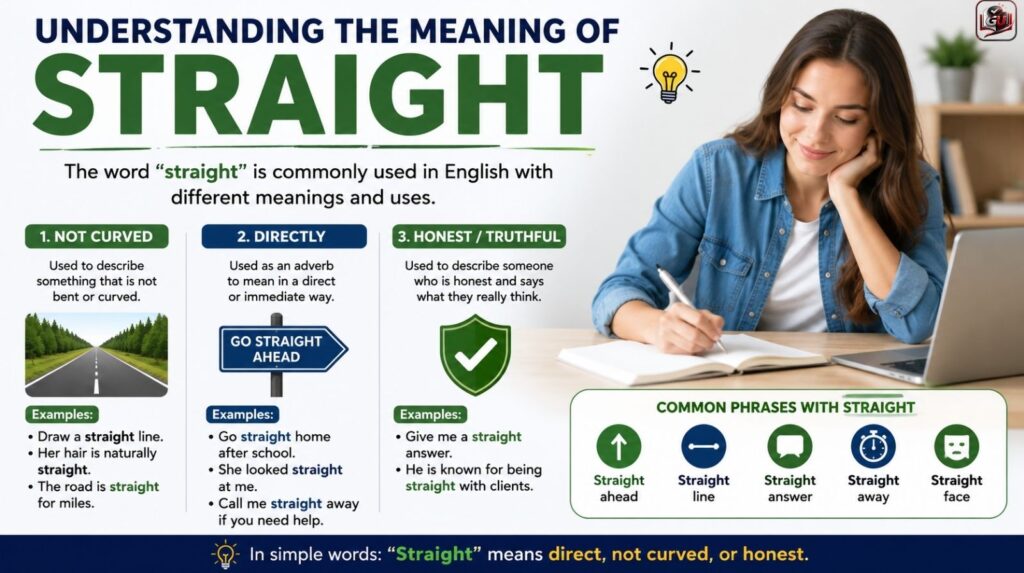
The word straight is far more common in everyday English.
Straight as an Adjective
It can describe something that is not bent or curved.
Examples:
- Draw a straight line.
- Her hair is naturally straight.
- The road remained straight for miles.
Straight as an Adverb
It can also mean directly or immediately.
Examples:
- Go straight home after work.
- She looked straight at me.
- Call me straight away if you need help.
Straight Related to Honesty
Another meaning involves honesty and truthfulness.
Examples:
- Give me a straight answer.
- He is known for being straight with clients.
Common Phrases Using Straight
- Straight ahead
- Straight line
- Straight answer
- Straight face
- Straight away
Because of its versatility, straight appears much more frequently in modern writing than strait.
Understanding the Meaning of Strait
The word strait is primarily used in geography.
Strait as a Geographic Term
A strait is a narrow channel of water connecting two larger bodies of water.
Examples include famous waterways around the world.
Well-Known Straits Around the World
Some famous examples include:
- Strait of Gibraltar
- Bering Strait
- Strait of Malacca
- Bosporus
Strait in Historical Usage
Historically, strait could also mean a difficult situation or position.
Examples:
- The company found itself in financial straits.
- They were in desperate straits after the storm.
Although this usage still exists, it appears less frequently than the geographic meaning.
Common Expressions with Strait
- In dire straits
- In difficult straits
- Through the strait
Straight vs Strait: Side-by-Side Comparison
Understanding context is the easiest way to choose the correct word.
| Situation | Correct Word | Example |
|---|---|---|
| Direct path | Straight | Walk straight ahead. |
| Not curved | Straight | Draw a straight line. |
| Honest response | Straight | Give me a straight answer. |
| Narrow waterway | Strait | The vessel crossed the strait. |
| Geographic location | Strait | The strait connects two seas. |
| Difficult circumstances | Strait/Straits | They were in financial straits. |
Quick Memory Trick
Remember:
Straight = Straight line
Both words contain the letters “gh”, which can remind you of a long direct path.
Strait = Waterway
Think of the word as referring to a specific geographic feature.
Real-Life Example: How One Misspelled Word Changed the Meaning
A travel blogger once published an article describing a ferry route between two islands. In the article, the writer repeatedly used the phrase:
“The ferry travels through the straight every day.”
At first glance, many readers understood the intended meaning. However, geography enthusiasts quickly noticed the mistake. The writer should have used strait, since the ferry was traveling through a narrow body of water.
The error sparked dozens of comments. Some readers even questioned the accuracy of the article’s travel information because the misuse suggested a lack of familiarity with geographic terminology.
After updating the article, the author explained that spellcheck did not catch the mistake because straight is a correctly spelled English word. The problem was contextual rather than grammatical.
This example highlights why understanding homophones matters. A single word choice can affect credibility, especially in educational, travel, business, and professional content. When writing about directions, use straight. When writing about waterways, use strait.
The lesson is simple: always check whether you’re describing a path or a geographic water passage before choosing the word.
Straight vs Strait Usage Statistics (2025–2026)
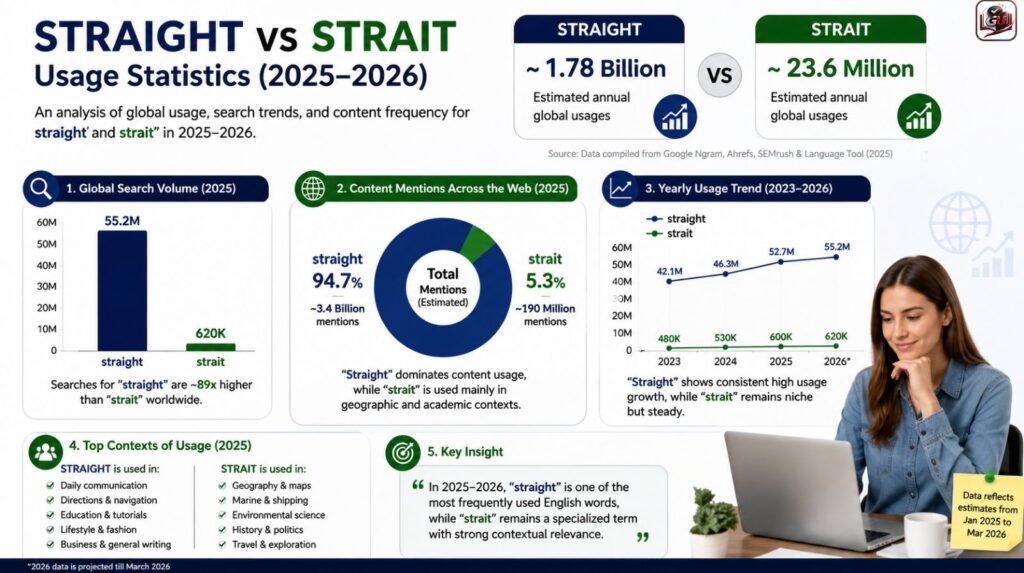
Language usage data shows a significant difference in how often these words appear online.
Usage Trends
- Straight remains one of the most frequently used English adjectives and adverbs.
- Strait appears primarily in geographic, historical, and educational content.
- Search interest for grammar-related homophone questions continues to rise as more people create digital content.
According to language and search trend analyses from 2025, homophone-related searches remain among the most common English grammar queries. Writers frequently search for distinctions between commonly confused words to improve accuracy and readability.
Why This Matters for Writers
Whether you’re writing:
- Blog posts
- Academic papers
- Travel guides
- Business reports
- Marketing content
Choosing the correct word improves trust and professionalism.
How to Choose the Correct Word Every Time
Step 1: Identify the Context
Ask yourself:
Are you talking about a path, direction, shape, or honesty?
If yes, use straight.
Step 2: Check for Geography
Are you describing a narrow body of water?
If yes, use strait.
Step 3: Replace the Word
Try substituting the word mentally.
Example:
“The boat crossed the straight.”
Does it refer to a direct line?
No.
Therefore:
“The boat crossed the strait.”
Step 4: Read the Sentence Aloud
Hearing the sentence often helps reveal whether the word fits the context.
Step 5: Review Before Publishing
Because spellcheck usually won’t catch homophone errors, proofreading is essential.
Common Mistakes People Make With Straight and Strait
Mistake #1: Using Straight for Waterways
❌ The ship crossed the straight.
✅ The ship crossed the strait.
Mistake #2: Using Strait for Directions
❌ Go strait for three blocks.
✅ Go straight for three blocks.
Mistake #3: Ignoring Context
Because both words sound the same, writers sometimes choose the first spelling that comes to mind.
Mistake #4: Relying Only on Spellcheck
Spellcheck verifies spelling, not meaning. Both words are valid English words.
Mistake #5: Confusing “Dire Straits”
Many people incorrectly assume dire straits refers to a straight road or path.
Actually, it means being in a difficult situation.
FAQs
Q. Is straight or strait correct?
A: Both are correct words, but they have different meanings. Use straight for directness or honesty and strait for a narrow waterway.
Q. What does strait mean?
A: A strait is a narrow body of water connecting two larger bodies of water.
Q. Why do straight and strait sound the same?
A: They are homophones, meaning they share the same pronunciation but have different meanings and spellings.
Q. Can strait mean a difficult situation?
A: Yes. The phrase in dire straits means being in serious difficulty.
Q. Which word is more common?
A: Straight is significantly more common in everyday speech and writing.
Q. Is “go strait ahead” correct?
A: No. The correct phrase is go straight ahead.
Q. What is an example of a strait?
A: The Strait of Gibraltar is a famous example connecting the Atlantic Ocean and the Mediterranean Sea.
Authoritative References
For additional guidance on English usage and grammar, consult:
- Merriam-Webster Dictionary
- Cambridge Dictionary
- Oxford Learner’s Dictionaries
These trusted language resources provide detailed definitions, examples, and usage guidance.
Conclusion:
Understanding the Straight vs Strait Difference becomes easy once you focus on context.
- Use straight when talking about a direct path, something not curved, or honesty.
- Use strait when referring to a narrow waterway connecting two larger bodies of water or the phrase in dire straits.
Although the words sound identical, their meanings are entirely different. By remembering this distinction and proofreading carefully, you can avoid one of the most common homophone mistakes in English writing.
The next time you encounter straight or strait, you’ll know exactly which one belongs in your sentence.
👉Keep learning with more easy grammar lessons on GrammerUpdate.com

Noor Fatima is a professional blogger specializing in spelling correction and grammar guidance. She creates clear, practical content to help readers avoid common mistakes, strengthen writing skills, and communicate with confidence in everyday and professional settings.