
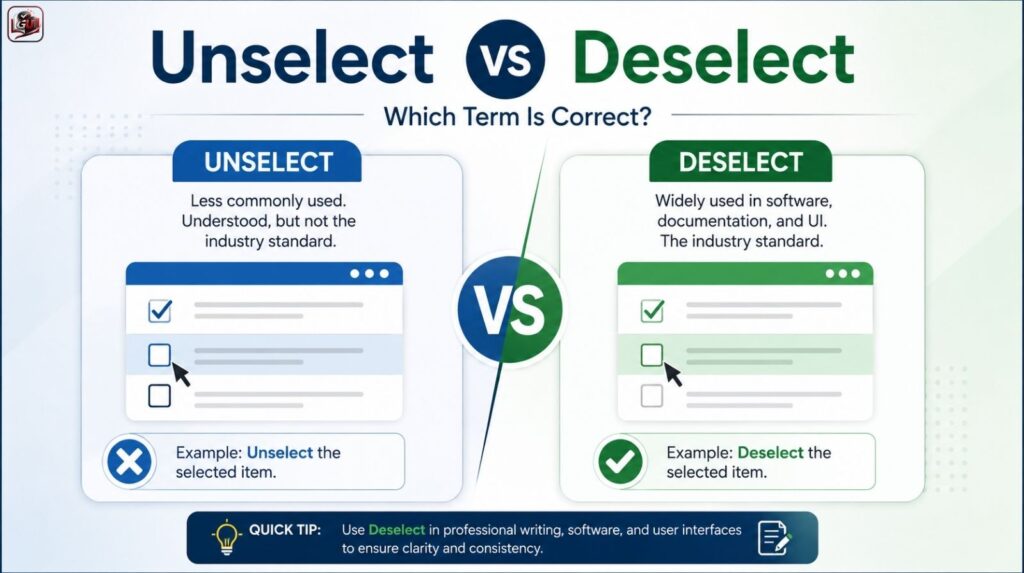
Have you ever clicked an item on your computer and wondered whether you should unselect it or deselect it? These two words often appear in conversations about software, user interfaces, and digital tools. Because both seem to describe the same action, many people use them interchangeably.
However, there is a subtle difference in how these terms are used. While both refer to removing a selection, one is generally considered more standard and widely accepted in technology and professional writing.
In this guide, you’ll learn the meaning of Unselect vs Deselect, which term is correct, how software companies use them, and when each word is appropriate. By the end, you’ll know exactly which term to choose in different situations.
What Do Unselect and Deselect Mean?
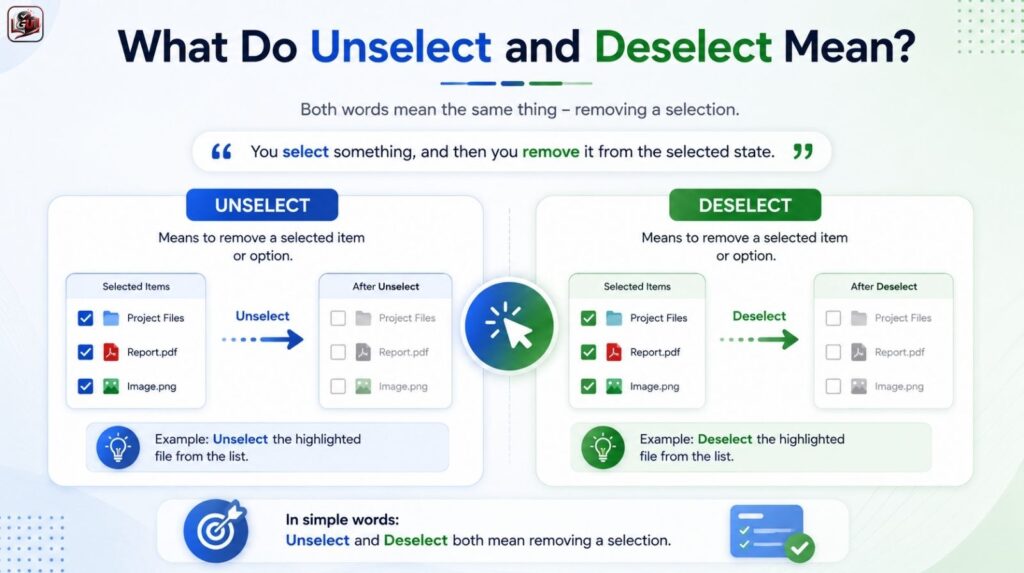
At their core, both words describe the same action: removing a selected item from a group, list, or interface.
For example:
- You select a file.
- You click elsewhere.
- The file is no longer selected.
This action can be described as either unselecting or deselecting.
However, language usage and industry standards favor one term over the other.
Understanding “Select”
The verb select means to choose something from several options.
Examples:
- Select a photo from your gallery.
- Select the text you want to copy.
- Select multiple files for deletion.
When the selection is removed, another term is needed.
What Does “Deselect” Mean?
Deselect means to remove an item from a selected state.
Examples:
- Deselect all files.
- Deselect the checkbox.
- Deselect the highlighted text.
See Also: Canon vs Cannon Difference And Usage: Which Word Is Correct?
This term is widely recognized in software documentation and user interfaces.
What Does “Unselect” Mean?
Unselect also means to remove a selection.
Examples:
- Unselect the chosen option.
- Unselect the highlighted image.
Although understandable, it is less common in professional and technical contexts.
Unselect vs Deselect: The Key Difference
The biggest difference is not meaning but usage.
| Feature | Deselect | Unselect |
|---|---|---|
| Meaning | Remove a selection | Remove a selection |
| Common in software | Yes | Rarely |
| Used in documentation | Frequently | Occasionally |
| Considered standard | Yes | Less common |
| Found in UI labels | Often | Rarely |
Why Is Deselect Preferred?
The prefix de- commonly indicates reversal or removal.
Examples:
- deactivate
- decode
- declassify
- defrost
Similarly, deselect naturally means “remove a selection.”
Why Does Unselect Exist?
English often uses the prefix un- to indicate reversal.
Examples:
- unlock
- untie
- unload
As a result, some people naturally create the word unselect. While understandable, it never gained the same acceptance as deselect within technology industries.
How Software Companies Use Deselect
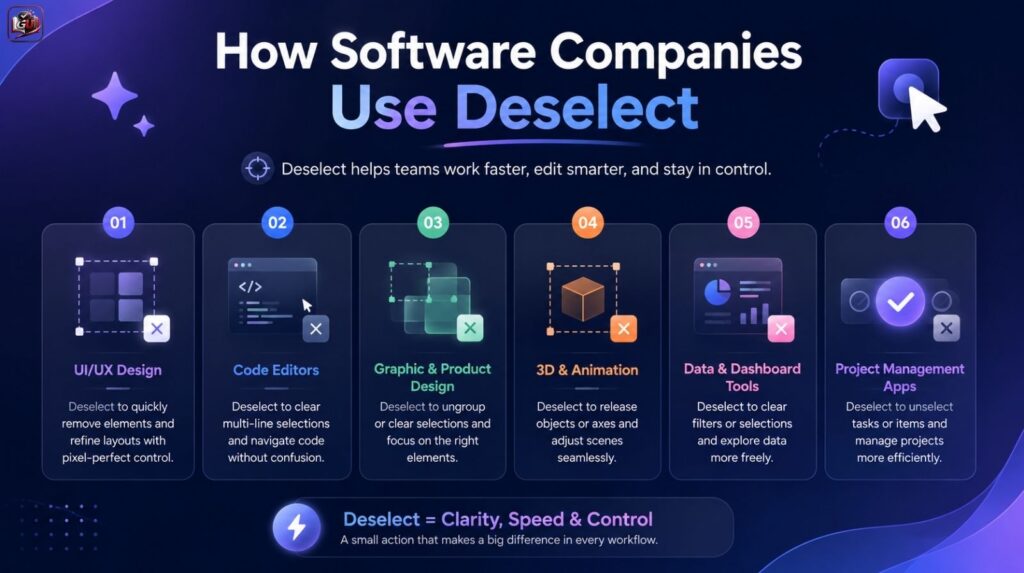
Most major software platforms use deselect instead of unselect.
Microsoft Examples
Microsoft documentation frequently includes commands such as:
- Deselect all
- Deselect rows
- Deselect objects
Adobe Examples
Adobe applications often use instructions like:
- Deselect the current layer
- Deselect selected pixels
Google Examples
Many Google products and support documents use:
- Deselect checkboxes
- Deselect selected items
This consistency has helped establish deselect as the standard industry term.
Why Consistency Matters
User interfaces rely on familiar terminology.
When users repeatedly see “Deselect,” they quickly understand the action required. Consistent language reduces confusion and improves usability.
Real-Life Example: How UX Writers Choose Between Unselect and Deselect
Imagine a software company developing a project management platform in 2026. The design team creates a dashboard where users can choose tasks from a list.
Initially, one designer labels a button:
“Unselect All”
Another designer suggests:
“Deselect All”
The team conducts usability testing with 150 users. During testing, participants are asked to remove selected tasks from a list.
Most users immediately understand both labels. However, several participants mention that “Deselect All” feels more familiar because they have seen it in other applications such as spreadsheets, photo editors, and file managers.
The UX writing team then reviews style guides from major technology companies. They discover that Microsoft, Google, and Adobe consistently use “Deselect.”
To maintain consistency with industry standards, the company updates the interface and replaces every occurrence of “Unselect All” with “Deselect All.”
After launch, customer support reports fewer questions about interface controls. The standardized wording helps users navigate the platform more confidently.
See Also: Verbiage vs Verbage: Which Spelling Is Correct?
This example demonstrates an important principle of user experience design: even when two words have the same meaning, choosing the industry-standard term improves clarity and familiarity.
Usage Statistics and Industry Trends (2025–2026)
Language trends in technology continue to favor deselect.
What Recent Data Shows
According to observations from software documentation, UX writing guides, developer resources, and technical publications published between 2025 and 2026:
- “Deselect” appears significantly more often than “Unselect.”
- Major software vendors consistently use “Deselect.”
- Technical writing standards typically recommend “Deselect.”
- UX style guides favor familiar industry terminology.
Why the Trend Continues
Several factors contribute to the dominance of “Deselect”:
- Industry standardization
- Consistent user experience
- Technical documentation practices
- Historical software usage
As a result, “Deselect” remains the preferred choice across most digital platforms.
When Should You Use Deselect?
In most situations, deselect is the best option.
Professional Writing
Use:
- Deselect the checkbox.
- Deselect all selected files.
Technical Documentation
Use:
- Users can deselect multiple records.
- Click here to deselect the current item.
User Interface Labels
Use:
- Deselect All
- Deselect Items
Software Tutorials
Use:
- To deselect an object, click outside the selection area.
Because users encounter this terminology frequently, it creates a smoother experience.
When Can You Use Unselect?
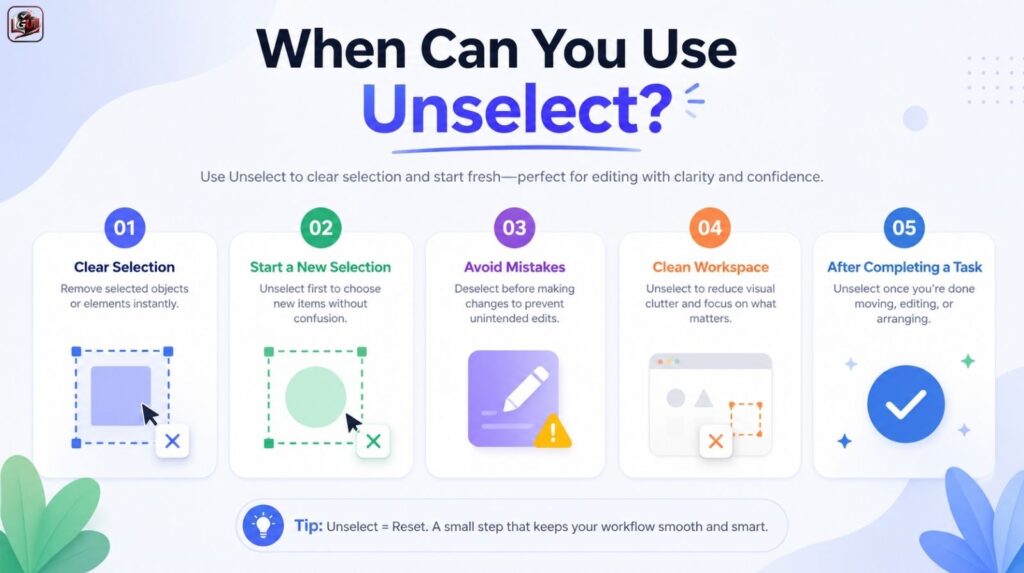
Although less common, unselect is not necessarily wrong.
Informal Conversations
Examples:
- I accidentally selected the file and had to unselect it.
- Can you unselect those photos?
Internal Team Discussions
Some teams may use unselect casually during brainstorming or conversations.
Situations Where Meaning Matters More Than Style
If your audience clearly understands the action, using unselect is unlikely to cause confusion.
However, for professional publishing, documentation, and interface design, deselect remains the better choice.
How to Remember the Difference
Simple Rule
If you’re writing for technology, software, or professional documentation:
Use “Deselect.”
Easy Memory Trick
Think of these common technology words:
- deactivate
- decompress
- decrypt
- deselect
Notice how the prefix de- commonly indicates removing or reversing a digital action.
Quick Checklist
✅ Writing software instructions → Deselect
✅ Creating UI buttons → Deselect
✅ Technical documentation → Deselect
✅ Casual conversation → Either works
✅ Professional communication → Deselect
Common Mistakes People Make
Mistake #1: Assuming Unselect Is the Standard
Many people assume unselect is the official opposite of select because of words like unlock and untie.
However, software industries overwhelmingly prefer deselect.
Mistake #2: Mixing Terms in Documentation
Avoid writing:
- Deselect all files.
- Unselect selected items.
Using both terms in the same document can appear inconsistent.
Mistake #3: Ignoring User Expectations
Users are accustomed to seeing deselect in software interfaces. Changing terminology unnecessarily may create confusion.
FAQs
Q. Is “Unselect” a real word?
A: Yes. It is understandable and appears occasionally in English. However, it is much less common than deselect.
Q. Which is grammatically correct: unselect or deselect?
A: Both can be grammatically correct, but deselect is the preferred and standard term in technology and professional writing.
Q. Why do software programs use “Deselect”?
A: Software companies use deselect because it follows established technical terminology and improves consistency across applications.
Q. Does Google use deselect or unselect?
A: Google documentation generally favors deselect when describing the removal of a selection.
Q. Can I use unselect in everyday conversation?
A: Yes. Most people will understand your meaning. However, deselect remains the more common choice.
Q. Which term should UX writers use?
A: UX writers should typically use deselect because it aligns with industry standards and user expectations.
Credible References
- Google Search Central Documentation
- Microsoft Writing Style Guide
- HubSpot Content Style Resources
Conclusion
When comparing Unselect vs Deselect, both words describe removing a selection. However, deselect is the clear winner in professional writing, software documentation, user interfaces, and technology-related communication.
The term aligns with industry standards, appears more frequently in major software products, and matches user expectations. While unselect is understandable and occasionally used in casual conversation, it is not the preferred choice in most professional settings.
If you’re creating documentation, writing tutorials, designing software interfaces, or simply aiming for accurate terminology, choose deselect. Using the standard term will make your writing clearer, more professional, and easier for readers to understand.
👉Keep learning with more easy grammar lessons on GrammerUpdate.com

Noor Fatima is a professional blogger specializing in spelling correction and grammar guidance. She creates clear, practical content to help readers avoid common mistakes, strengthen writing skills, and communicate with confidence in everyday and professional settings.