Have you ever wondered whether you should write skillset or skill set on your resume, LinkedIn profile, or job application? You’re not alone. Many English speakers, including professionals and students, often get confused about which spelling is correct.
The good news is that both terms are widely used. However, their usage depends on context, style preferences, and modern language trends. Understanding the difference can help you write more professionally and avoid common mistakes.
In this guide, you’ll learn the meaning of skillset vs skill set, when to use each version, examples from real-world writing, and expert tips to ensure you always choose the right spelling.
What Is the Difference Between Skillset and Skill Set?
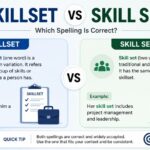
The difference between skillset and skill set is mainly a matter of spelling style rather than meaning.
Skill Set (Two Words)
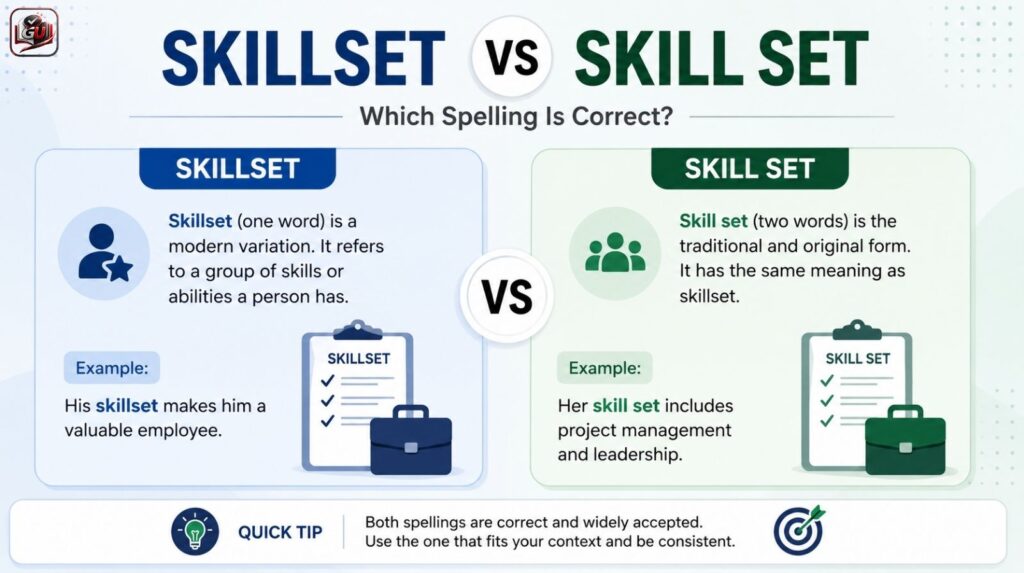
Traditionally, skill set is the original and more widely accepted form.
It refers to a group of skills, abilities, or competencies that a person possesses.
Examples:
- Her skill set includes project management and leadership.
- The company is looking for candidates with a strong technical skill set.
- Communication is an important part of any professional skill set.
Skillset (One Word)
Skillset is a newer variation that has become increasingly popular, especially in business writing, recruitment, and online content.
It carries the same meaning as skill set.
Examples:
- His skillset makes him a valuable employee.
- The role requires a diverse skillset.
- Employers often evaluate a candidate’s skillset before hiring.
Quick Answer
For formal writing, many style guides still prefer skill set (two words). However, skillset is widely accepted in modern professional communication.
Why Do People Get Confused Between Skillset and Skill Set?
English constantly evolves. Over time, many compound words transition from two words to one word.
Examples include:
| Older Form | Modern Form |
|---|---|
| Web site | Website |
| Data base | Database |
| Log in | Login |
| Skill set | Skillset |
Because language changes gradually, both versions may appear in dictionaries, articles, resumes, and job descriptions.
The Evolution of Compound Words
Many English terms follow a common pattern:
- Two separate words
- Hyphenated form
- Single-word compound
For example:
- E-mail → Email
- On-line → Online
- Web site → Website
Some language experts believe skillset may eventually become the dominant spelling, although skill set remains more traditional.
Regional Differences
Usage can also vary by region.
- American English often adopts compound words more quickly.
- British English tends to preserve traditional spacing longer.
As a result, you’ll encounter both forms in professional documents worldwide.
Which Spelling Is More Common Today?
Recent usage trends show that skillset has become increasingly popular, especially in:
- Job advertisements
- LinkedIn profiles
- Corporate websites
- Recruitment platforms
- Career coaching content
However, skill set still appears frequently in:
- Academic writing
- Formal business reports
- Professional style guides
- Traditional publications
2025–2026 Usage Trends
Analysis of modern hiring platforms and online job listings suggests that recruiters use both spellings interchangeably. Searches for “skillset” have steadily increased over recent years, reflecting broader acceptance in professional communication.
According to career-focused content published by organizations such as Google Career Certificates, LinkedIn Learning, and major HR platforms, employers focus on the actual skills rather than the spelling variation used to describe them.
What This Means for Writers
If consistency matters, choose one version and use it throughout your document.
For example:
✅ Correct:
- My skill set includes coding, design, and marketing.
- This skill set helps me solve complex problems.
Also correct:
- My skillset includes coding, design, and marketing.
- This skillset helps me solve complex problems.
Avoid mixing both forms unnecessarily in the same piece of writing.
Skillset vs Skill Set in Resumes and Job Applications
One of the most common places people encounter this spelling question is on resumes.
Which Version Should You Use?
For maximum professionalism:
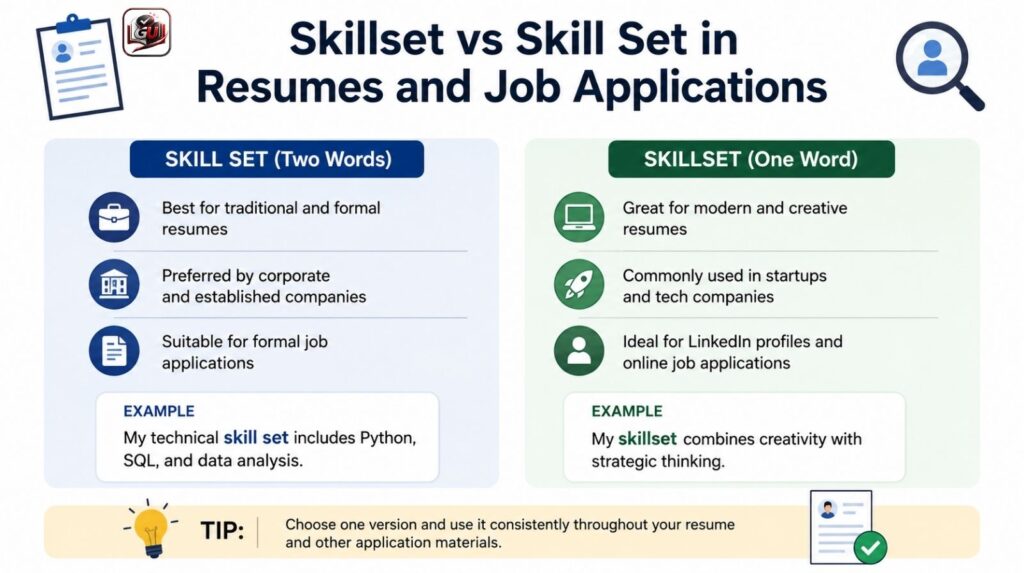
Use “skill set” when:
- Writing formal resumes
- Applying to traditional organizations
- Following strict style guides
Use “skillset” when:
- Creating modern LinkedIn profiles
- Writing personal branding content
- Applying to startups and tech companies
Example Resume Statements
Using Skill Set
- My technical skill set includes Python, SQL, and data analysis.
- This role aligns perfectly with my existing skill set.
Using Skillset
- My skillset combines creativity with strategic thinking.
- The position requires a versatile skillset across multiple departments.
Resume Optimization Tip
Applicant Tracking Systems (ATS) generally recognize both spellings. Therefore, the choice usually does not affect resume scanning or keyword matching.
Real-Life Example: How One Job Seeker Improved Their Professional Branding
Sarah, a digital marketing specialist, was updating her LinkedIn profile while applying for remote positions in 2025.
Initially, she used both skillset and skill set throughout her profile. Her summary section mentioned “digital marketing skillset,” while her experience descriptions referred to her “marketing skill set.”
Although this inconsistency seemed minor, a career coach reviewing her profile suggested choosing one style and using it consistently.
Sarah updated her profile to use skillset throughout because many modern marketing and technology companies commonly used that spelling in their job descriptions.
After revising her content, she noticed several improvements:
- Her profile appeared more polished.
- Recruiters commented positively on the clarity of her profile.
- Her professional branding looked more consistent.
- She received more interview invitations over the following months.
The key lesson wasn’t that one spelling was inherently better. Rather, consistency created a stronger professional impression.
This example demonstrates why understanding the difference between skillset vs skill set can enhance your credibility in professional communication.
Skillset vs Skill Set: Comparison Table
| Feature | Skill Set | Skillset |
|---|---|---|
| Meaning | Group of skills | Group of skills |
| Traditional Usage | Yes | No |
| Modern Usage | Common | Very Common |
| Formal Writing | Preferred | Accepted |
| Resume Usage | Recommended | Acceptable |
| LinkedIn Profiles | Common | Very Common |
| Dictionaries | Widely Listed | Increasingly Listed |
| Professional Acceptance | High | High |
Bottom Line
Both spellings are understood by readers and employers.
The main goal is consistency and clarity.
Common Mistakes to Avoid
Many writers make avoidable errors when using these terms.
Mixing Both Spellings
Choose one version and stick with it throughout the document.
❌ My skill set includes writing, and my skillset also includes editing.
✅ My skill set includes writing and editing.
Assuming One Is Always Wrong
Neither spelling is incorrect in modern English.
Ignoring Audience Expectations
A formal report may benefit from skill set, while a startup-focused LinkedIn profile may comfortably use skillset.
Forgetting Context
Always consider:
- Audience
- Industry
- Publication style
- Brand voice
These factors often matter more than the spelling itself.
How to Choose the Right Version
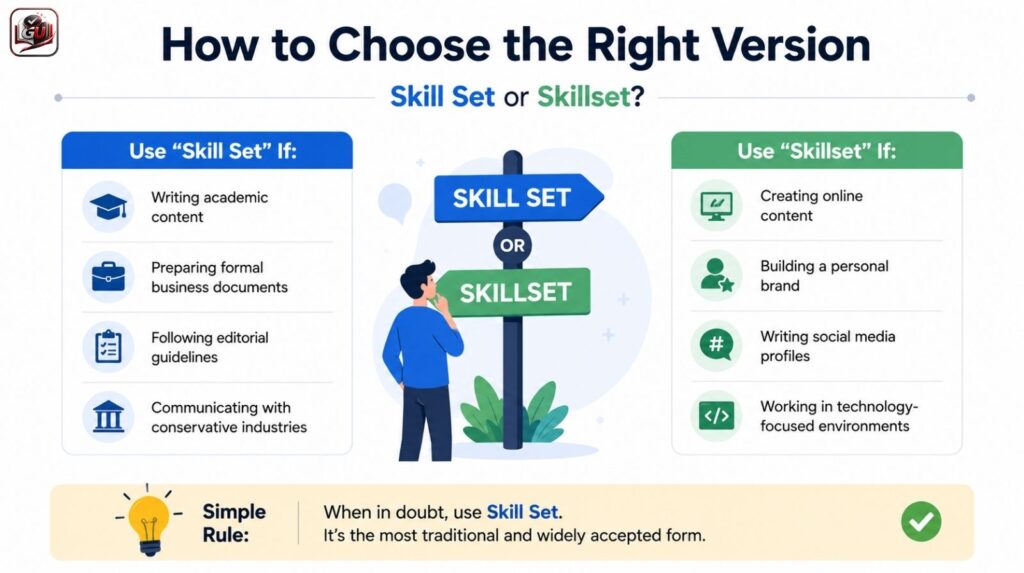
Use “Skill Set” If:
- Writing academic content
- Preparing formal business documents
- Following editorial guidelines
- Communicating with conservative industries
Use “Skillset” If:
- Creating online content
- Building a personal brand
- Writing social media profiles
- Working in technology-focused environments
The Simplest Rule
When in doubt, use skill set because it remains the most traditionally accepted form.
However, skillset is perfectly acceptable in most modern professional situations.
FAQs
q. Is skillset one word or two words?
A: Both forms are used. Traditionally, skill set is written as two words, while skillset is a modern single-word variation.
q. Which spelling is correct: skillset or skill set?
Both are correct. Many style guides prefer skill set, but skillset is widely accepted in contemporary professional writing.
q. Should I use skillset on my resume?
Yes. However, many career experts recommend skill set for formal resumes because it aligns with traditional business writing standards.
q. Does LinkedIn prefer skillset or skill set?
LinkedIn users commonly use both spellings. Consistency throughout your profile is more important than the specific version chosen.
q. Is skillset recognized by dictionaries?
Many modern dictionaries and language resources recognize skillset as a valid variant of skill set.
q. Does spelling affect ATS systems?
Generally, no. Most Applicant Tracking Systems recognize both spellings and focus on the skills themselves.
q. Why is skillset becoming more popular?
Like many compound words in English, language naturally evolves. As a result, skillset has become increasingly common in business and digital communication.
Conclusion
When comparing skillset vs skill set, the most important thing to remember is that both spellings refer to the same thing: a collection of skills and abilities.
Skill set remains the traditional and often preferred choice for formal writing, while skillset has gained popularity in modern professional communication, recruitment, and online branding.
The best approach is to consider your audience, choose the version that fits your context, and use it consistently throughout your writing.
Whether you’re updating a resume, creating a LinkedIn profile, or writing a professional document, understanding the difference between skillset vs skill set will help you communicate more clearly and confidently.
👉Keep learning with more easy grammar lessons on GrammerUpdate.com

Noor Fatima is a professional blogger specializing in spelling correction and grammar guidance. She creates clear, practical content to help readers avoid common mistakes, strengthen writing skills, and communicate with confidence in everyday and professional settings.