
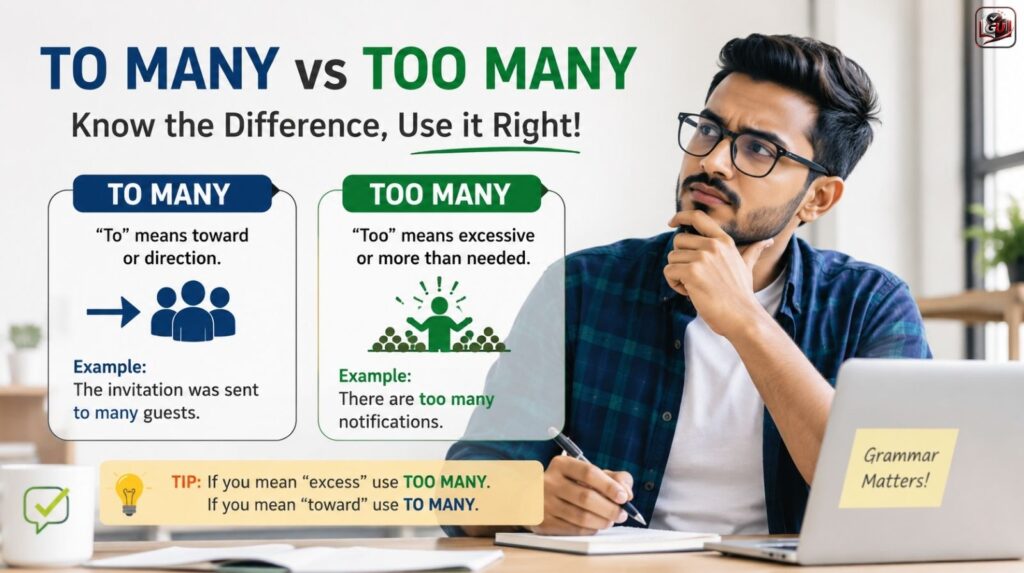
Have you ever written “to many people” and wondered whether it should actually be “too many people”? You’re not alone. Many English learners and even native speakers occasionally confuse these two expressions because they look almost identical.
The good news is that the difference is simple once you understand how each word works in a sentence.
In this guide, you’ll learn the meaning of to many vs too many, when to use each one, common mistakes to avoid, practical examples, and an easy trick to remember the correct spelling every time.
What Is the Difference Between To Many and Too Many?
Quick Answer
Too many is the correct phrase when you want to say there is an excessive number of something.
To many is not usually a complete phrase by itself. It only appears when the word to functions as a preposition and happens to be followed by many.
Featured Snippet Answer
| Phrase | Meaning | Correct Usage |
|---|---|---|
| Too Many | More than needed or desired | ✅ Common and correct |
| To Many | “To” + “many” used separately in a sentence | ✅ Rare and context-dependent |
Examples
✅ There are too many cars on the road.
✅ I ate too many cookies.
✅ The teacher assigned too many homework tasks.
Rare Example:
✅ The announcement was sent to many employees across the company.
In this example, to is a preposition indicating direction, while many employees is the object.
What Does “Too Many” Mean?
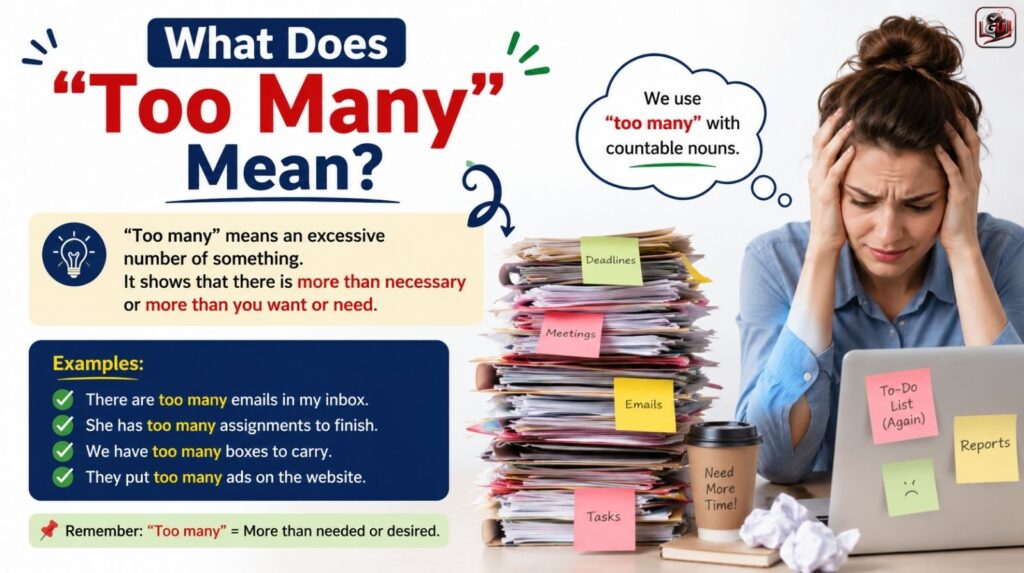
The phrase too many means an excessive quantity of countable items.
You use it when the amount exceeds what is necessary, acceptable, or desired.
Structure
Too + Many + Countable Noun
Examples
- There are too many emails in my inbox.
- We invited too many guests.
- She bought too many books.
- The website displays too many advertisements.
Why It Matters
Using too many correctly helps communicate dissatisfaction, overload, or excess.
For example:
- “There are many notifications.”
- “There are too many notifications.”
The second sentence suggests a problem because the number is excessive.
What Does “To Many” Mean?
The phrase to many is not a grammatical unit with its own meaning.
Instead:
- To acts as a preposition.
- Many begins a noun phrase.
Examples of Correct Usage
- The email was delivered to many customers.
- The message appealed to many readers.
- The survey results were shown to many participants.
Notice that to many is not expressing excess. It simply means something is directed toward a large group.
Why People Confuse Them
The confusion occurs because:
- Both phrases sound identical when spoken.
- English contains several homophones.
- Spell-check tools sometimes fail to catch the mistake.
For example:
❌ There are to many mistakes.
✅ There are too many mistakes.
To Many vs Too Many: Side-by-Side Comparison
Comparison Table
| Feature | To Many | Too Many |
|---|---|---|
| Meaning | Direction toward many people/things | Excessive number |
| Part of Speech | Preposition + adjective | Adverb + adjective |
| Indicates Excess? | No | Yes |
| Common Usage | Rare | Very common |
| Example | Sent to many customers | Too many customers complained |
Easy Memory Trick
Remember:
Too = Also or Excess
The word too contains an extra “o.”
Think of that extra letter as representing something extra or excessive.
- Too much
- Too little
- Too expensive
- Too many
Whenever you mean more than necessary, use too.
Common Mistakes and How to Avoid Them
Many writers accidentally use to many when they mean too many.
Incorrect Examples
❌ There are to many tabs open.
❌ We received to many applications.
❌ She bought to many shoes.
See Also: Wait vs Weight: Difference, Meaning & Correct Usage
Correct Versions
✅ There are too many tabs open.
✅ We received too many applications.
✅ She bought too many shoes.
Proofreading Tip
When reviewing your writing, replace too many with excessive numbers of.
If the sentence still makes sense, too many is probably correct.
Example:
“There are too many meetings.”
“There are excessive numbers of meetings.”
The meaning remains clear.
Real-Life Case Study: A Workplace Email Mistake
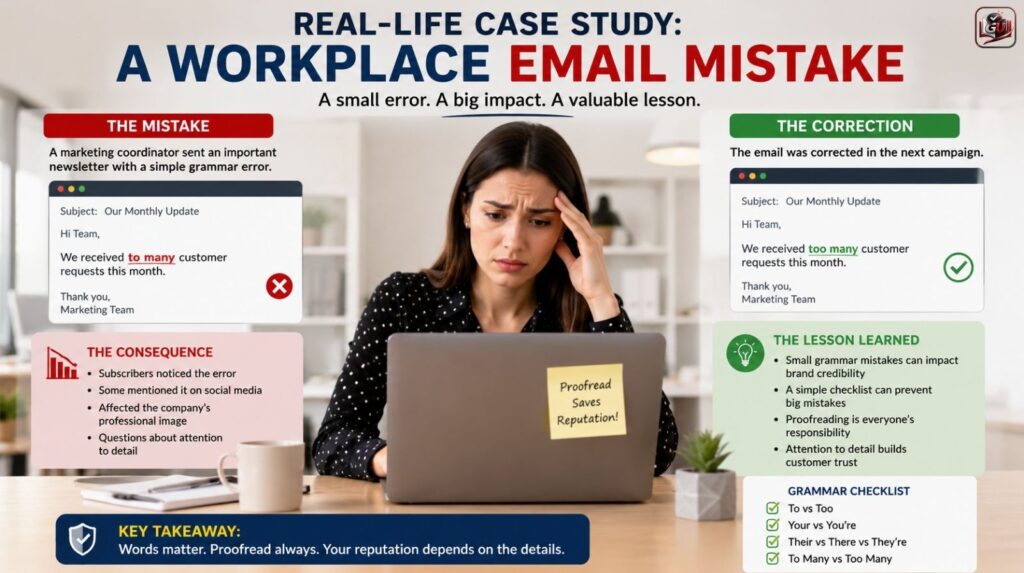
A marketing coordinator at a mid-sized software company was preparing a monthly newsletter for thousands of subscribers. During the final review, she wrote:
“We received to many customer requests this month.”
The email passed through several team members because everyone focused on the design and promotional content rather than grammar.
After sending the newsletter, several subscribers noticed the mistake and mentioned it on social media. Although the error was minor, it affected the company’s professional image. A few readers questioned the brand’s attention to detail.
The marketing team later corrected the sentence to:
“We received too many customer requests this month.”
This small correction completely changed the professionalism of the message.
The incident became a useful lesson within the company. Editors introduced a grammar checklist before publication and specifically highlighted commonly confused words such as:
- To vs Too
- Your vs You’re
- Their vs There vs They’re
- To Many vs Too Many
The result was a significant reduction in publishing errors and improved audience trust.
See Also: Manor vs Manner: Which One Is Correct?
Language Usage Statistics (2025–2026)
Recent language-analysis tools and writing platforms continue to report that homophone errors remain among the most common writing mistakes.
Key Findings
- Grammar-checking platforms identify to/too confusion as one of the top English spelling mistakes.
- Educational websites report millions of monthly searches related to commonly confused English words.
- Search interest for grammar-related questions continues growing due to remote work, online learning, and content creation.
- Professional communication studies show that grammatical errors can negatively influence credibility and reader trust.
These trends highlight why understanding the difference between to many and too many remains important in 2025 and beyond.
How to Remember the Difference Forever
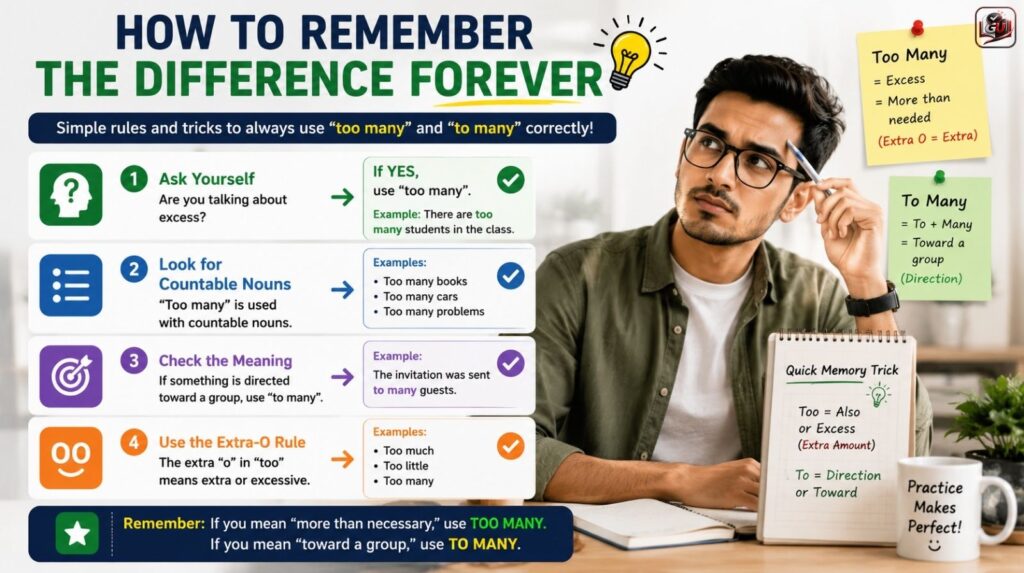
Step 1: Ask Yourself a Question
Are you talking about excess?
If yes, use too many.
Step 2: Look for Countable Nouns
Examples:
- Too many books
- Too many cars
- Too many meetings
Step 3: Check the Meaning
If something is directed to a group, then to many may be correct.
Example:
“The invitation was sent to many guests.”
Step 4: Use the Extra-O Rule
The extra O in too means extra amount.
This trick works almost every time.
References
FAQs
Q. Is “to many” ever correct?
A: Yes. It is correct when to functions as a preposition.
Example:
“The letter was sent to many recipients.”
Q. Which is more common: to many or too many?
A: Too many is far more common because people frequently describe excessive quantities.
Q. Can I say “too many people”?
A: Yes. This is one of the most common uses of the phrase.
Example:
“There were too many people at the event.”
Q. Why do people confuse to and too?
A: They are pronounced the same way, making them easy to mix up in writing.
See Also: Oftentimes vs Often Times: Which One Is Correct?
Q. Is “too many” grammatically correct?
A: Yes. It is a standard and widely accepted English expression.
Q. What is the difference between too much and too many?
A: Too much is used with uncountable nouns.
Example:
- Too much water
Too many is used with countable nouns.
Example:
- Too many bottles
Q. How can I quickly remember the correct spelling?
A: Remember that too has an extra “o,” which represents something extra or excessive.
Conclusion
Understanding the difference between to many vs too many is easier than it first appears. In most situations where you want to express an excessive number of people or things, too many is the correct choice.
Meanwhile, to many is only correct when the word to functions independently as a preposition, such as in the sentence, “The message was sent to many customers.”
The next time you write, remember the simple rule: if you mean “more than necessary,” use “too many.” That extra “o” can save you from a common grammar mistake and make your writing look more professional and polished.
👉Keep learning with more easy grammar lessons on GrammerUpdate.com

Noor Fatima is a professional blogger specializing in spelling correction and grammar guidance. She creates clear, practical content to help readers avoid common mistakes, strengthen writing skills, and communicate with confidence in everyday and professional settings.