
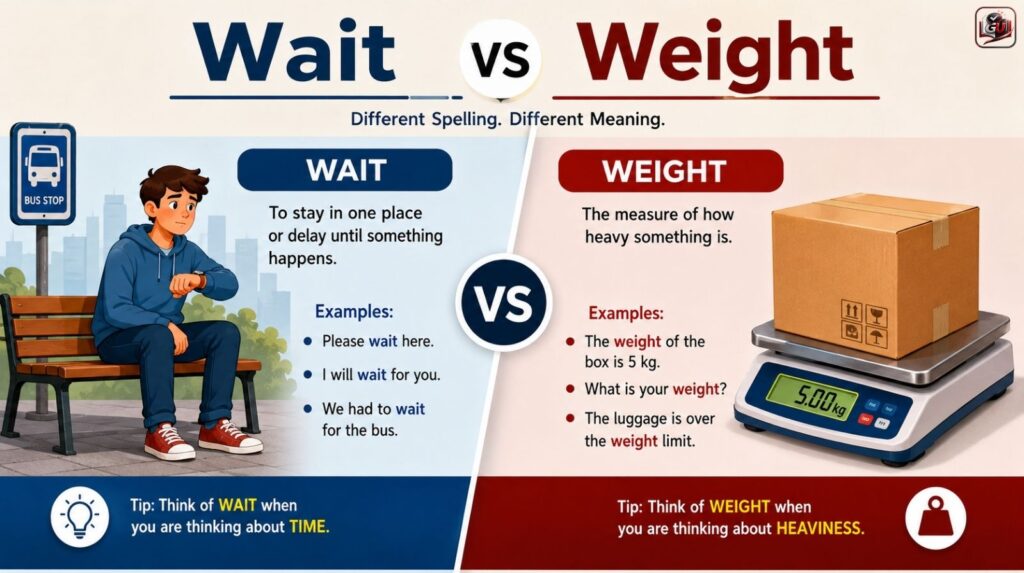
Have you ever typed “please weight here” instead of “please wait here”? Or wondered whether wait and weight are interchangeable because they sound almost identical?
You’re not alone. These two words are among the most commonly confused homophones in English. Although they share the same pronunciation, they have completely different meanings, spellings, and grammatical roles.
In this guide, you’ll learn the difference between wait vs weight, when to use each word, common mistakes to avoid, plenty of real-world examples, and easy memory tricks so you’ll never confuse them again.
See Also: Instalments vs Installments Which Is Correct And Use It?
What Is the Difference Between Wait and Weight?
Quick Answer (Featured Snippet)
The difference between wait and weight is simple:
| Word | Meaning | Part of Speech | Example |
|---|---|---|---|
| Wait | To stay until something happens | Verb / Noun | Please wait outside. |
| Weight | How heavy something is | Noun (occasionally verb) | The weight of the package is 5 kg. |
Although both words sound exactly the same, they refer to completely different ideas.
What Does “Wait” Mean?
The word wait means to remain in one place or delay an action until something happens.
It usually functions as a verb.
Examples of Wait
- Please wait for your turn.
- We had to wait for the bus.
- She waited patiently outside.
- I’ll wait until tomorrow.
- They waited nearly two hours.
Wait as a Noun
Sometimes wait is also used as a noun.
Examples:
- The restaurant had a long wait.
- The wait was worth it.
Common Expressions with Wait
- Wait a minute
- Wait and see
- Wait your turn
- Can’t wait
- Wait for approval
- Wait in line
- Worth the wait
Example:
I can’t wait to see the new movie.
What Does “Weight” Mean?
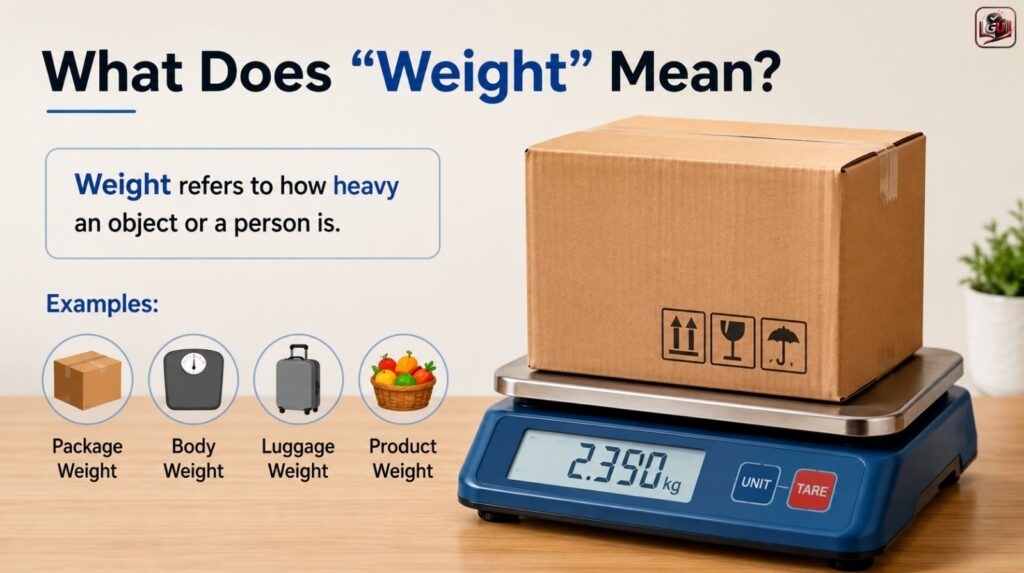
Weight refers to how heavy a person, object, or animal is.
It is most commonly used as a noun.
Examples of Weight
- The box weighs a lot because of its weight.
- What is your weight?
- The luggage exceeds the allowed weight.
- Weight training improves strength.
- The package’s weight is 12 kilograms.
See Also: Sneek vs Sneak: Which Spelling Is Correct And How To Use It?
Weight in Different Contexts
Physical Weight
- Body weight
- Package weight
- Shipping weight
Science
Weight is the force caused by gravity acting on an object.
Fitness
People often talk about:
- Weight loss
- Weight gain
- Weight lifting
- Weight management
Wait vs Weight: Side-by-Side Comparison
| Feature | Wait | Weight |
|---|---|---|
| Pronunciation | Same | Same |
| Meaning | Stay until something happens | Measure of heaviness |
| Part of Speech | Verb, noun | Mostly noun |
| Related Words | Waiting, waited | Weigh, weighs, weighed |
| Common Context | Time, patience | Mass, heaviness, fitness |
Why Do People Confuse Wait and Weight?
They Sound Exactly the Same
These words are homophones, meaning they have identical pronunciation but different spellings and meanings.
Examples:
- Wait here.
- Check the package weight.
Both are pronounced similarly, making spelling mistakes common in writing.
Spell Check Doesn’t Always Catch It
Because both are real English words, grammar tools may not recognize the mistake if you use the wrong one.
Incorrect:
Please weight outside.
The sentence is grammatically valid because weight is a real word, but the meaning becomes incorrect.
Correct:
Please wait outside.
Similar Letter Patterns
Both words begin with “w” and end with “t,” making them visually similar.
This increases confusion, especially among English learners.
Wait vs Weight in Everyday Sentences
Using Wait
✅ Please wait here.
✅ Wait until your teacher arrives.
✅ I’ll wait for your response.
✅ Don’t wait too long.
Using Weight
✅ The weight of the suitcase is 18 kilograms.
✅ His weight has changed this year.
✅ The weight limit is 25 pounds.
✅ Weight training builds muscle.
Common Mistakes to Avoid
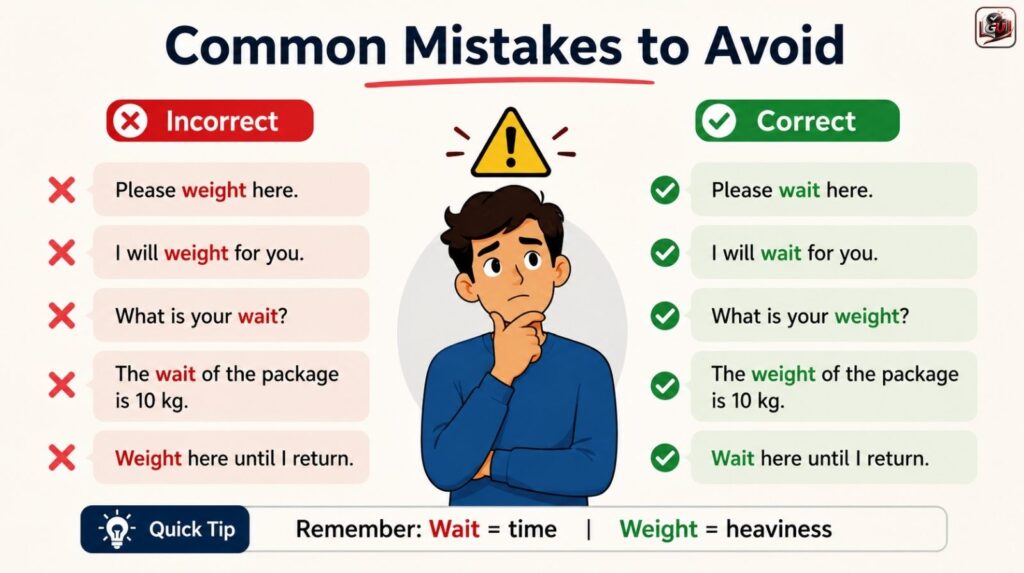
Incorrect:
❌ Please weight for me.
Correct:
✅ Please wait for me.
Incorrect:
❌ The wait of the package is 10 kg.
Correct:
✅ The weight of the package is 10 kg.
Incorrect:
❌ I measured my wait this morning.
Correct:
✅ I measured my weight this morning.
Incorrect:
❌ Weight here until I return.
Correct:
✅ Wait here until I return.
Wait vs Weight in Grammar
Wait Is Usually a Verb
Examples:
- Wait here.
- Wait patiently.
- Wait for instructions.
Weight Is Usually a Noun
Examples:
- Body weight
- Shipping weight
- Weight limit
See Also: Coma vs Comma: What’s The Difference And When To Use Each?
Related Word: Weigh
Many learners confuse weight with weigh.
Remember:
- Weight = noun
- Weigh = verb
Examples:
- The package weighs 5 kg.
- The package’s weight is 5 kg.
Wait vs Weight in American and British English
The meanings are identical in both American and British English.
Only measurement units commonly differ:
American English:
- Pounds
British English:
- Kilograms or stones (for body weight)
The words themselves are used exactly the same way.
Real-Life Example: A Costly Shipping Error
A small online business selling handmade home décor began expanding internationally. During one busy holiday season, a new employee was responsible for entering shipping information into the company’s order management system. While reviewing customer instructions, they confused wait and weight in internal notes and documentation.
One shipping label incorrectly listed a package’s weight because the employee misunderstood instructions that said to wait for the final packaging before weighing the parcel. As a result, the package was processed with an estimated rather than actual weight.
The courier later recalculated the shipping charges, resulting in unexpected fees and delivery delays. Several customers contacted support because their orders arrived later than expected.
The company responded by creating a proofreading checklist for shipping documents and customer communication. Employees also received a short grammar guide covering commonly confused English words such as wait vs weight, accept vs except, and affect vs effect.
Although the mistake was relatively small, it demonstrated how confusing similar-sounding words can lead to misunderstandings, operational delays, and additional costs. Clear communication and careful proofreading helped the business prevent similar errors in the future.
Wait vs Weight Usage Statistics (2025–2026)
Recent language trends and digital writing data highlight how often these words are confused:
- Google search interest for “wait vs weight” remains steady because it is a frequent grammar question from students and English learners.
- Educational platforms report that homophones continue to rank among the most searched English grammar topics.
- Grammar-checking tools process millions of corrections involving commonly confused word pairs each month, including wait vs weight, especially in emails, school assignments, and workplace writing.
- English language learning websites consistently feature homophone lessons among their most-visited grammar resources.
See Also: Totaled vs Totalled: Which Spelling Is Correct?
These trends show that understanding the distinction between wait and weight is valuable for improving writing accuracyn both academic and professional settings.
Easy Memory Tricks
Remember “Wait” = Time
If you’re talking about time, use wait.
Example:
Wait five minutes.
Think:
Wait = Watch the clock.
Remember “Weight” = Heavy
If you’re talking about heaviness, use weight.
Think:
Weight = Heavy object.
Another Trick
Ask yourself:
Can I measure it?
If yes → Weight
If no → Wait
FAQs
Q. Is it wait or weight for someone?
A: Use wait.
Correct:
I’ll wait for you.
Q. What is the difference between wait and weight?
A: Wait means to remain until something happens.
Weight means how heavy something is.
Q. Is weight a verb?
A: Usually, weight is a noun. The related verb is weigh.
Example:
- The package weighs 10 kg.
- Its weight is 10 kg.
Q. Why are wait and weight confusing?
A: Because they are homophones they sound the same but have different spellings and meanings.
Q. How can I remember the difference?
A: Associate wait with time and weight with heaviness.
Q. Is “please weight here” correct?
A: No.
Correct sentence:
Please wait here.
Q. Can weight refer to importance?
A: Yes. In some contexts, weight can mean significance or influence.
Example:
Her opinion carries great weight.
Conclusion
Understanding the wait vs weight difference is easier once you remember their core meanings. Wait relates to time, patience, or delaying an action, while weight refers to how heavy something is or the importance of something. Even though they sound identical, using the correct spelling is essential for clear communication.
Whenever you’re unsure, ask yourself a simple question: Am I talking about time or heaviness? If it’s about time, choose wait. If it’s about heaviness or measurement, choose weight.
With regular practice and the examples in this guide, you’ll avoid this common homophone mistake and write with greater confidence.
👉Keep learning with more easy grammar lessons on GrammerUpdate.com

Noor Fatima is a professional blogger specializing in spelling correction and grammar guidance. She creates clear, practical content to help readers avoid common mistakes, strengthen writing skills, and communicate with confidence in everyday and professional settings.