Have you ever paused while writing an email and wondered whether you should write workday or work day?
You’re not alone. Many English learners, students, and professionals use these two forms interchangeably, assuming they mean exactly the same thing. While they are closely related, workday and work day are not always interchangeable. Choosing the correct form can make your writing appear more polished and professional.
In this guide, you’ll learn the difference between workday vs work day, discover when each one is appropriate, avoid common mistakes, and see plenty of real-world examples. By the end, you’ll know exactly which version to use in every situation.
What Is the Difference Between Workday and Work Day?
The simplest way to understand the difference is this:
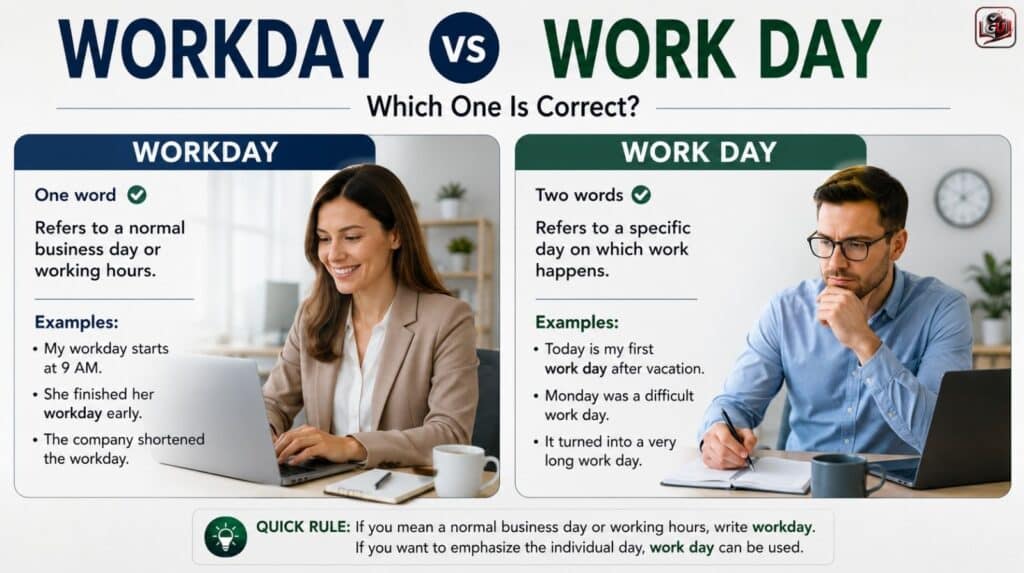
- Workday (one word) is a standard compound noun referring to a normal day spent working or official business hours.
- Work day (two words) simply combines the noun work with the noun day, usually emphasizing the specific day itself rather than the concept of working hours.
Although both expressions refer to work-related time, workday is far more common in modern English.
Workday Meaning
A workday refers to:
- A typical business day
- Scheduled working hours
- The period during which employees normally work
See Also: Copyright vs Copywrite: Differences, Usage, Meaning, And Common Mistakes
Examples
- My workday starts at 8:30 a.m.
- She finished her workday early.
- The company shortened the workday during summer.
Notice that the focus is on the period of work rather than the calendar day.
Work Day Meaning
A work day emphasizes an actual day on which work happens.
It may be used when the writer wants to stress the word day instead of treating the phrase as one compound noun.
Examples
- Today is my first work day after vacation.
- Monday was a difficult work day because of several meetings.
- It turned into a very long work day.
While these examples are grammatically acceptable, many modern style guides would still recommend writing workday in most situations.
Workday vs Work Day: Side-by-Side Comparison
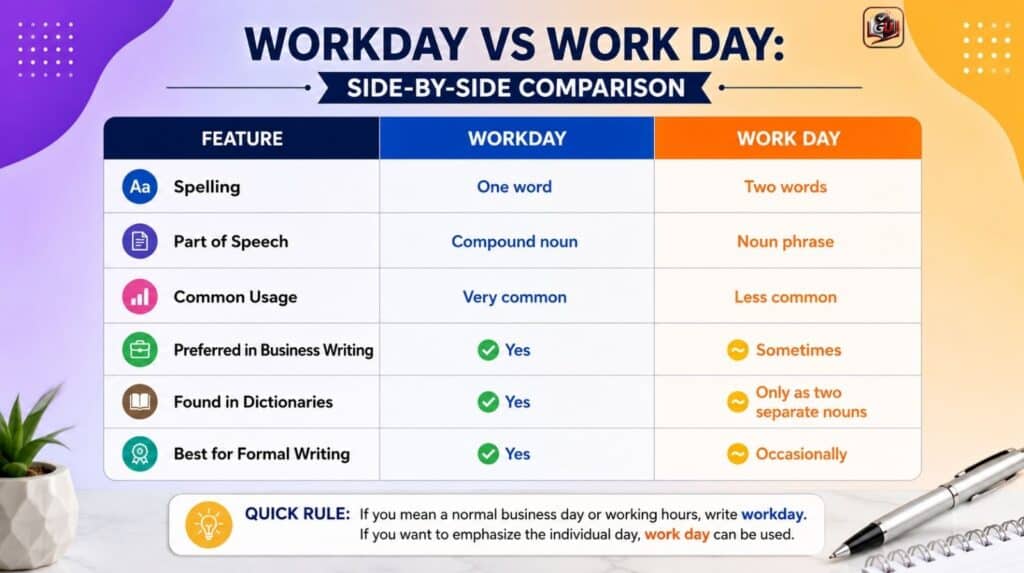
| Feature | Workday | Work Day |
|---|---|---|
| Spelling | One word | Two words |
| Part of Speech | Compound noun | Noun phrase |
| Common Usage | Very common | Less common |
| Preferred in business writing | ✅ Yes | Sometimes |
| Found in dictionaries | ✅ Yes | Only as two separate nouns |
| Best for formal writing | ✅ Yes | Occasionally |
Quick Rule
If you mean a normal business day or working hours, write workday.
If you intentionally want to emphasize the individual day, work day can sometimes work naturally.
Why Is “Workday” More Common Today?
English constantly creates compound words.
Words such as:
- notebook
- keyboard
- workplace
- workplace safety
- workload
were once written as separate words before becoming standard compounds.
The same happened with workday.
As English evolved, dictionaries and style guides increasingly accepted workday as the standard spelling because readers recognize it more quickly.
Today, you’ll find workday in newspapers, business documents, HR manuals, academic writing, and professional emails.
See Also: Oftentimes vs Often Times: Which One Is Correct?
Dictionary Definitions
Major dictionaries define workday similarly:
- A day on which work is performed.
- The number of hours employees normally work in one day.
- A normal business day.
These definitions reinforce that the one-word version has become the accepted standard.
When Should You Use Workday?
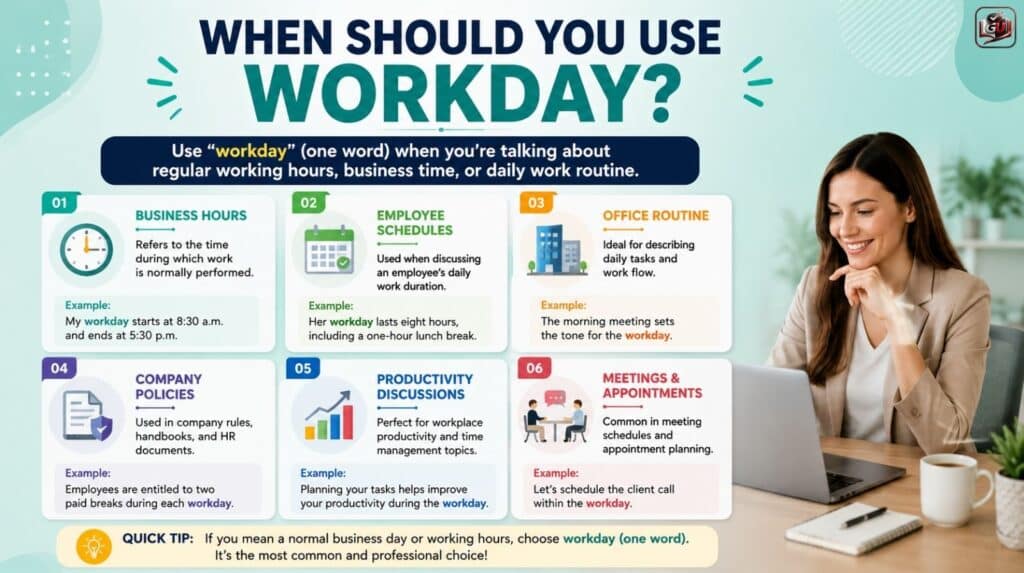
Use workday whenever you’re talking about:
Business Hours
- My workday ends at five.
Employee Schedules
- Her workday lasts eight hours.
Office Routine
- The meeting interrupted everyone’s workday.
Company Policies
- Employees receive two breaks during each workday.
Productivity Discussions
- Taking short breaks improves the average workday.
Common Expressions Using Workday
These expressions almost always use the one-word spelling:
- workday schedule
- workday routine
- workday productivity
- workday lunch
- workday stress
- workday morning
- workday afternoon
- workday meeting
When Can You Use Work Day?
Although less common, work day still appears in natural English.
Usually, writers choose it when emphasizing the actual calendar day.
Examples:
- My first work day after maternity leave felt exciting.
- Friday was an exhausting work day.
- Tomorrow will be my final work day before retirement.
These examples sound perfectly natural because the emphasis falls on the individual day.
Situations Where “Work Day” Sounds Better
Sometimes spacing improves clarity.
For example:
- It was my last work day before moving abroad.
- His first work day was unforgettable.
- Every work day presented a new challenge.
Even here, many editors would still accept workday.
Common Mistakes People Make
Many writers misuse these spellings simply because they look similar.
Here are the most frequent errors.
Mistake 1: Using Two Words Everywhere
❌ My work day starts at 9.
✅ My workday starts at 9.
Mistake 2: Assuming They’re Always Different
Some people believe they’re completely unrelated.
They’re not.
They share nearly the same meaning, but workday has become the standard spelling.
Mistake 3: Inconsistent Writing
Example:
❌ My workday starts at 8.
Later that work day we had lunch.
Choose one style and stay consistent.
Real-Life Case Study: How One Small Space Changed a Professional Email
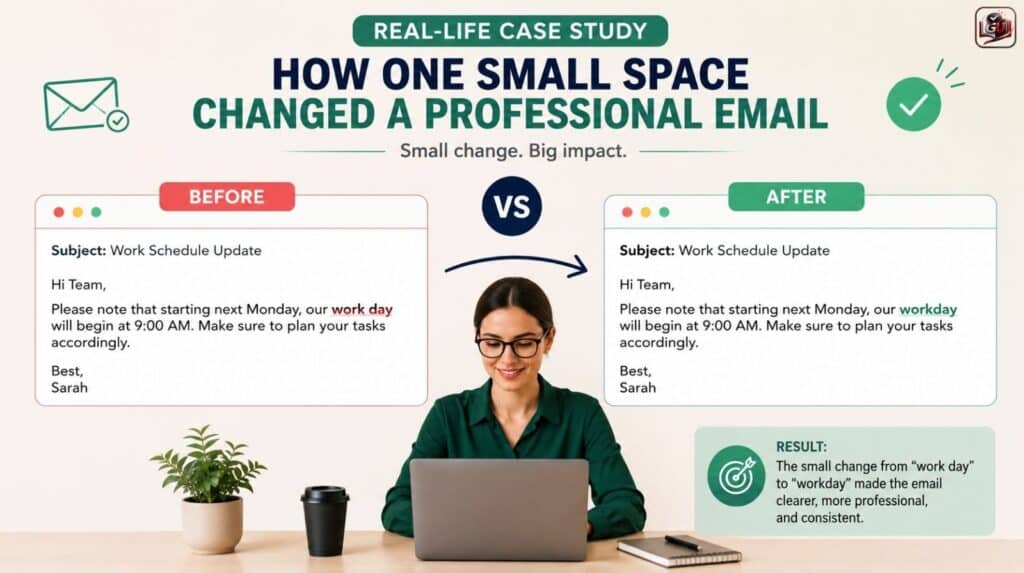
Sarah, a project coordinator at a multinational technology company, was preparing a welcome guide for newly hired employees. The guide explained office schedules, HR policies, and expectations for daily routines. Throughout the document, she alternated between workday and work day without realizing it.
During the editorial review, a senior communications manager pointed out the inconsistency. Although the difference seemed minor, the mixed spelling made the document appear less polished and raised questions about whether the two terms referred to different concepts. The team consulted their corporate style guide, which recommended using workday as the standard term for regular working hours and business schedules.
After updating every instance to workday, the guide became more consistent and easier to read. New employees no longer wondered if the two spellings had separate meanings, and the HR department adopted the same convention across all future training materials, emails, and policy documents.
See Also: To Bad vs Too Bad: Which Is Correct And How To Use It?
This example shows how a single space can influence clarity, consistency, and professionalism especially in business writing where readers expect standardized language.
Language Trend and Usage Statistics (2025–2026)
Language databases, digital publishing trends, and major dictionaries consistently show that workday is the dominant spelling in modern English. Searches across business websites, HR documentation, and online publications reveal that the one-word form is overwhelmingly preferred for referring to regular working hours or business days.
Recent writing trends (2025–2026) indicate:
- Workday appears significantly more often in professional documents, company policies, and workplace communication.
- Corporate style guides increasingly standardize workday for consistency.
- The two-word form, work day, still appears but is typically reserved for stylistic emphasis or specific contexts.
- Search engines also return substantially more results for workday, reflecting current usage patterns.
For writers aiming for clarity and SEO performance, using workday in most situations aligns with modern English conventions.
Best Practices for Using Workday Correctly
Follow this checklist whenever you’re unsure:
✅ Use workday for normal business hours.
✅ Keep your spelling consistent throughout the document.
✅ Use workday in emails, reports, blogs, and professional writing.
✅ Reserve work day only when emphasizing a specific day.
✅ Check your organization’s style guide if one exists.
FAQs
Q. Is workday one word or two?
A: Workday is the standard one-word spelling and is preferred in most professional and general writing.
Q. Is work day incorrect?
A: No. It is grammatically correct but less common. It is usually used when emphasizing the individual day rather than the concept of working hours.
Q. Which spelling is more common?
A: Workday is much more common in modern English, business communication, dictionaries, and published writing.
Q. Can I use workday in formal writing?
A: Yes. In fact, workday is the preferred spelling for formal documents, reports, business emails, and workplace policies.
Q. Is Workday also a company name?
A: Yes. Workday is also the name of a well-known enterprise software company. However, when used in lowercase within sentences, workday simply refers to a normal day of work. Context makes the meaning clear.
Q. Does workday mean eight hours?
A: Not necessarily. A workday refers to the scheduled period during which someone works. Depending on the employer or country, it may be six, seven, eight, or more hours.
Conclusion
Understanding workday vs work day is easier than it first appears. In modern English, workday is the preferred spelling for referring to a normal business day or regular working hours, making it the best choice for emails, reports, blogs, and professional communication. While work day is still grammatically correct in certain contexts particularly when emphasizing a specific day it is used much less frequently.
When in doubt, choose workday. It matches current dictionary standards, aligns with modern business writing, and helps keep your writing clear, consistent, and professional.
👉Keep learning with more easy grammar lessons on GrammerUpdate.com

Noor Fatima is a professional blogger specializing in spelling correction and grammar guidance. She creates clear, practical content to help readers avoid common mistakes, strengthen writing skills, and communicate with confidence in everyday and professional settings.