Have you ever read the words muscle and mussel and wondered if they mean the same thing? You’re not alone. These two words sound almost identical when spoken, which is why many English learners and even native speakers mix them up.
The confusion is understandable, but the meanings couldn’t be more different. A muscle helps your body move, while a mussel is a type of shellfish commonly found in oceans and rivers. Using the wrong word can completely change the meaning of a sentence and sometimes lead to funny misunderstandings.
In this guide, you’ll learn the key differences between muscle vs mussel, when to use each word, common mistakes to avoid, real-life examples, and simple memory tricks that will help you remember the correct spelling every time.
What Is the Difference Between Muscle and Mussel?
The main difference is simple:
| Word | Meaning | Category |
|---|---|---|
| Muscle | Tissue in the body that helps movement | Anatomy |
| Mussel | A shellfish that lives in water | Seafood/Marine Life |
Quick Answer
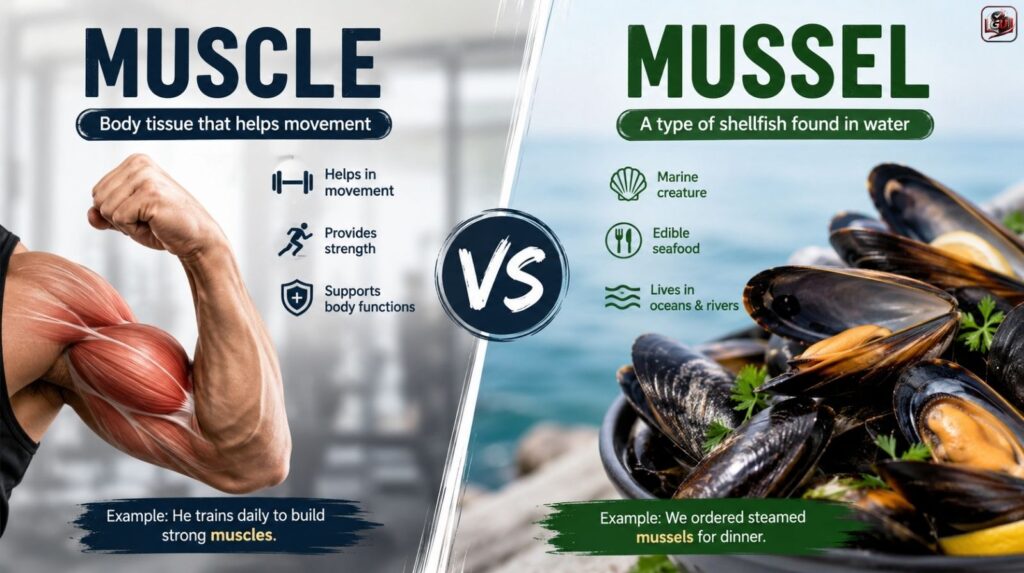
- Muscle = Body tissue used for movement.
- Mussel = An edible shellfish found in freshwater or saltwater.
Although they are pronounced similarly, their meanings are entirely different.
Example Sentences
Muscle
- Exercise helps build muscle strength.
- He injured a muscle during training.
- Athletes work hard to develop their muscles.
Mussel
- The restaurant serves fresh mussels.
- A mussel lives inside a hard shell.
- Many coastal cuisines include mussels as a delicacy.
Understanding the Meaning of Muscle
The word muscle refers to soft tissue in humans and animals that contracts and relaxes to create movement.
How Muscles Work
Muscles help the body:
- Walk
- Run
- Lift objects
- Maintain posture
- Support internal organs
Without muscles, movement would be impossible.
Types of Muscles
Skeletal Muscles
These muscles connect to bones and help voluntary movement.
Examples:
- Biceps
- Triceps
- Quadriceps
Smooth Muscles
These are found inside organs such as the stomach and intestines.
Cardiac Muscle
This specialized muscle makes up the heart and pumps blood throughout the body.
Example of Muscle in Everyday Use
- She gained muscle after six months of strength training.
- The doctor explained that the pain came from a strained muscle.
- Building muscle requires proper nutrition and exercise.
Understanding the Meaning of Mussel
A mussel is a shellfish that belongs to a group of aquatic mollusks.
These creatures usually live attached to rocks, docks, or riverbeds and are protected by two hard shells.
Characteristics of Mussels
Mussels are:
- Aquatic animals
- Protected by shells
- Common in oceans and rivers
- Popular seafood in many countries
Mussels as Food
Many cuisines around the world use mussels in dishes such as:
- Seafood pasta
- Steamed mussels
- Seafood soups
- Paella
See Also: Eying vs Eyeing: Which Spelling Is Correct In English?
Example of Mussel in Sentences
- We ordered steamed mussels for dinner.
- The fisherman collected mussels from the shoreline.
- Mussels are rich in protein and minerals.
Why Do People Confuse Muscle and Mussel?
The confusion happens mainly because these words are homophones or near-homophones.
Similar Pronunciation
In many English accents:
- Muscle → “MUH-suhl”
- Mussel → “MUH-suhl”
They sound almost identical when spoken.
Different Spellings
Although pronunciation is similar, the spellings differ:
- Muscle contains “cle”
- Mussel contains “sel”
Different Meanings
The meanings are completely unrelated:
- One belongs to anatomy.
- The other belongs to marine biology and food.
Common Mistakes
Incorrect:
❌ I ate delicious muscles at the seafood restaurant.
Correct:
✅ I ate delicious mussels at the seafood restaurant.
Incorrect:
❌ Weightlifting helps build mussels.
Correct:
✅ Weightlifting helps build muscles.
Muscle vs Mussel: Side-by-Side Comparison
Quick Comparison Table
| Feature | Muscle | Mussel |
|---|---|---|
| Meaning | Body tissue | Shellfish |
| Category | Anatomy | Marine Life |
| Found In | Humans and animals | Oceans and rivers |
| Function | Movement and strength | Aquatic organism |
| Edible? | No | Yes |
| Example | Arm muscle | Steamed mussel |
Easy Memory Trick
Think:
MusCLE = CLimbing, lifting, exercising
The letters CL can remind you of physical activity.
MusSEL = SEAfood
The letters SE can remind you of the sea.
This simple trick helps many learners remember the difference instantly.
Real-Life Example: How One Misspelled Word Changed the Meaning
Imagine a fitness coach creating a social media post.
He intended to write:
“Build stronger muscles with these simple exercises.”
However, he accidentally typed:
“Build stronger mussels with these simple exercises.”
The audience quickly noticed the mistake. Instead of talking about fitness, the sentence appeared to suggest helping shellfish become stronger.
The post attracted humorous comments because the meaning completely changed.
This type of error is surprisingly common in digital communication, blog writing, and social media content. Search engines may understand the intended meaning, but readers can become confused. In professional writing, a small spelling mistake can reduce credibility and distract readers from the message.
The lesson is clear: always double-check whether you’re discussing body strength (muscle) or seafood (mussel). A single letter can dramatically alter what readers understand.
Muscle vs Mussel in Modern English Usage
Understanding real-world usage helps you choose the correct word confidently.
Muscle in Health and Fitness
The word muscle frequently appears in:
- Fitness articles
- Medical publications
- Sports discussions
- Exercise programs
Examples:
- Muscle growth
- Muscle recovery
- Muscle strength
- Muscle mass
See Also: Honor vs Honour Which Spelling Is Correct? A Complete Guide To Understanding The Difference
Mussel in Food and Marine Topics
The word mussel often appears in:
- Seafood recipes
- Marine biology articles
- Restaurant menus
- Fishing guides
Examples:
- Blue mussel
- Fresh mussels
- Mussel farming
- Mussel harvesting
Which Word Is More Common?
According to language usage trends and major English dictionaries, muscle appears significantly more often in everyday English because health, fitness, and anatomy topics are discussed more frequently than shellfish-related topics.
Language Statistics and Usage Trends (2025–2026)
Recent language trend analyses from major dictionary databases and search behavior studies show that:
- Fitness-related searches continue to grow globally.
- Health and exercise content remains among the most searched online categories.
- Terms involving muscle strength, muscle recovery, and muscle growth receive millions of monthly searches.
- Mussel-related searches are typically seasonal and often connected to recipes, seafood consumption, and marine studies.
This difference explains why learners encounter muscle much more frequently than mussel in everyday reading and online content.
Key Takeaway
While both words remain important, muscle is substantially more common in general English communication.
How to Remember Muscle vs Mussel Easily
Method 1: Think About the Topic
Ask yourself:
Are you talking about the body?
→ Use muscle
Are you talking about seafood?
→ Use mussel
Method 2: Use Visual Associations
Muscle:
- Gym
- Exercise
- Strength
- Athletes
Mussel:
- Ocean
- Shell
- Seafood
- Fishing
Method 3: Practice Example Sentences
The more examples you read and write, the easier the distinction becomes.
Examples:
- Running helps strengthen leg muscles.
- The chef prepared garlic butter mussels.
Common Expressions Using Muscle
Muscle Memory
The ability to perform actions automatically after repetition.
Example:
- Typing becomes easier through muscle memory.
Flex Your Muscles
To show strength or power.
Example:
- The company flexed its muscles in the competitive market.
Muscle Power
Physical strength used to perform tasks.
Example:
- The workers relied on muscle power to move heavy equipment.
FAQs
Q. Is muscle the same as mussel?
A: No. A muscle is body tissue used for movement, while a mussel is a shellfish that lives in water.
Q. Why do muscle and mussel sound alike?
A: They are near-homophones, meaning they have very similar pronunciations despite different spellings and meanings.
Q. Is mussel a seafood?
A: Yes. Mussels are edible shellfish commonly served in many cuisines worldwide.
Q. How do you spell the body part: muscle or mussel?
A: The correct spelling for the body tissue is muscle.
Q. Can you eat a muscle?
A: No. In standard English, muscle refers to body tissue. The edible seafood is called a mussel.
Q. Which word is more common in English?
A: Muscle is generally more common because it appears frequently in health, fitness, and medical discussions.
Q. What is the easiest way to remember the difference?
A: Remember:
- Muscle = body
- Mussel = seafood
Credible References
For additional information, consult:
- Merriam-Webster Dictionary
- Cambridge Dictionary
- Oxford Learner’s Dictionaries
Conclusion
Understanding muscle vs mussel is easier once you know their meanings. A muscle is the tissue that helps humans and animals move, while a mussel is a shellfish commonly found in oceans and rivers and often eaten as seafood.
Because the words sound similar, they are frequently confused. However, remembering that muscle relates to the body and mussel relates to seafood will help you choose the correct spelling every time.
Whether you’re writing about fitness, health, cooking, or marine life, using the right word improves clarity and professionalism. Keep practicing with real examples, and you’ll never mix up muscle vs mussel again.
👉Keep learning with more easy grammar lessons on GrammerUpdate.com

Noor Fatima is a professional blogger specializing in spelling correction and grammar guidance. She creates clear, practical content to help readers avoid common mistakes, strengthen writing skills, and communicate with confidence in everyday and professional settings.