Have you ever come across the words “convertor” and “converter” and wondered if they mean the same thing? It’s a common question, especially when both spellings appear online, in software tools, technical documents, and everyday writing. At first glance, they seem interchangeable, which makes it easy to assume that either one is correct.
However, when it comes to modern English, one spelling is far more widely accepted than the other. Using the wrong version may not always be a serious mistake, but it can make your writing look inconsistent or less professional.
So, is it convertor or converter? In this article, we’ll break down the difference, explain which spelling is considered correct, look at real-world examples, and share a few simple tips to help you remember the right choice every time.
What Is the Difference Between Convertor and Converter?
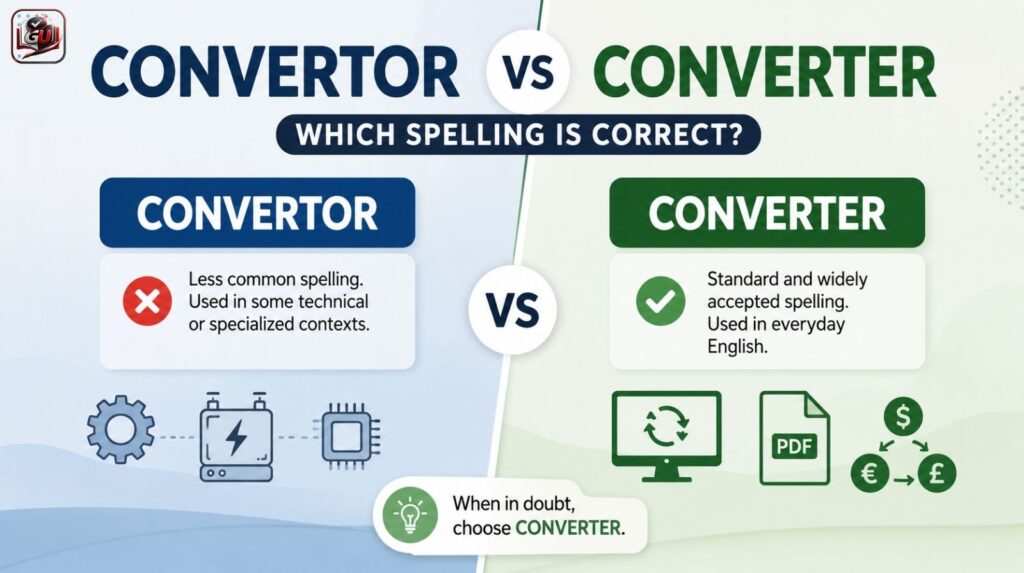
The primary difference between convertor and converter is usage frequency and acceptance in standard English.
| Word | Meaning | Common Usage |
|---|---|---|
| Converter | A device, tool, software, or person that converts something from one form to another | Standard and preferred spelling |
| Convertor | Alternative spelling of converter | Rare and mostly technical usage |
In modern English dictionaries, converter is overwhelmingly preferred.
Why Is Converter More Common?
English often forms nouns from verbs by adding -er.
Examples include:
- Teach → Teacher
- Build → Builder
- Write → Writer
- Convert → Converter
Because of this standard word formation pattern, converter feels more natural and familiar to English speakers.
Quick Answer
If you’re writing an article, email, academic paper, website content, or business document, use converter.
Is Converter the Correct Spelling?
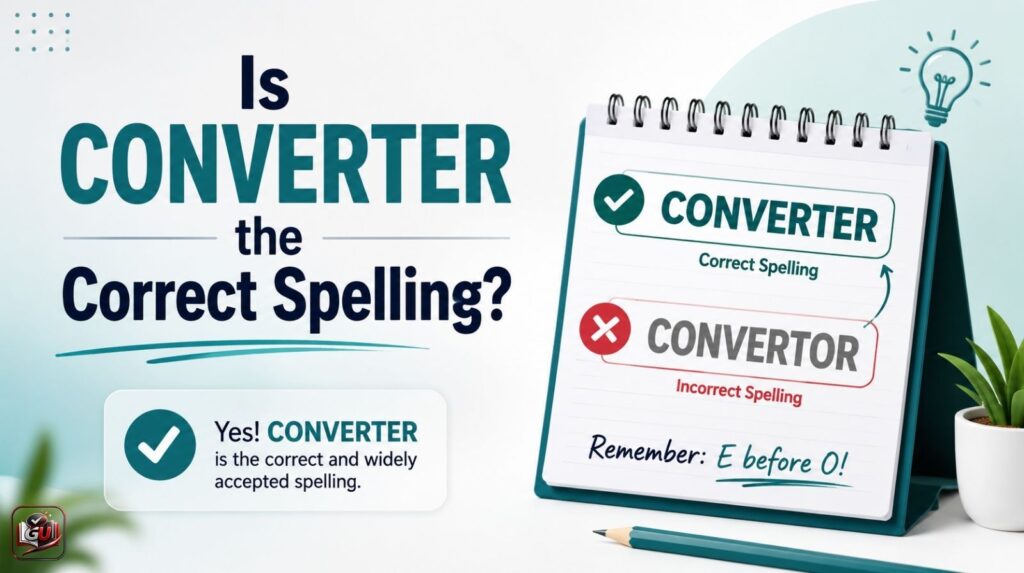
Yes. Converter is considered the correct spelling in most writing situations.
Dictionary Recognition
Major dictionaries recognize converter as the standard term.
A converter can refer to:
- A software tool that changes file formats
- An electrical device
- A currency conversion tool
- A person who converts beliefs or opinions
- A vehicle component
Examples of Correct Usage
- I used a PDF converter to change the file format.
- The power converter supports multiple voltages.
- This online converter changes dollars into euros.
- The video converter processed the file quickly.
Each example sounds natural because converter is the preferred form.
Why Many Writers Choose Converter
The spelling aligns with common English grammar rules and appears more frequently in books, websites, educational materials, and professional writing.
Why Do Some People Use Convertor?
Although less common, convertor is not entirely incorrect.
Certain technical industries have historically used the spelling convertor for specific equipment or systems.
Technical and Engineering Usage
Some engineering documents have used terms such as:
- Rotary convertor
- Phase convertor
- Frequency convertor
However, even many technical fields now prefer converter.
Regional and Historical Influence
Language evolves over time. Older publications occasionally used convertor, and some organizations retained the spelling in product names or technical specifications.
Modern Trend
Today, most style guides, dictionaries, software companies, and educational resources recommend converter.
Therefore, unless you’re referring to a specific technical product named “convertor,” using converter is usually the safest choice.
Convertor vs Converter in Everyday Writing
For most people, the choice is simple.
Use Converter for General Writing
Examples include:
- Blog posts
- Emails
- Academic assignments
- Website content
- Marketing materials
- Business documents
Example:
Our currency converter provides real-time exchange rates.
Use Convertor Only When Necessary
If a manufacturer officially names a product using “convertor,” keep the original spelling.
Example:
The company released a new phase convertor designed for industrial applications.
Common Writing Situations
Software Tools
Correct:
- Image converter
- Video converter
- PDF converter
Finance
Correct:
- Currency converter
- Exchange rate converter
Technology
Correct:
- File converter
- Audio converter
- Data converter
In nearly all these cases, converter is the preferred choice.
Real-Life Example: How a Small Website Improved Search Visibility
A content publisher specializing in software tutorials noticed that several articles were receiving less traffic than expected. One of their most popular topics involved file conversion tools.
Initially, the website published multiple articles using the keyword “PDF Convertor.” The content team believed both spellings were equally common, so they used the term throughout titles, headings, and body content.
After reviewing keyword research data, they discovered that users overwhelmingly searched for “PDF converter” rather than “PDF convertor.” Search volumes were significantly higher for the standard spelling.
The team updated article titles, headings, image alt text, meta descriptions, and internal links to use converter consistently. They also revised product comparison pages and tutorial guides.
Over the following months, the articles became more aligned with actual user search behavior. As a result, the pages attracted more relevant visitors because they matched the language people were naturally typing into search engines.
The lesson was clear: understanding the difference between convertor vs converter isn’t just a grammar issue. Using the spelling that users expect can improve readability, user experience, and search visibility. For content creators, choosing the standard spelling often helps communicate more effectively with readers while matching common search intent.
Convertor vs Converter: Common Mistakes People Make
Many writers make similar errors when choosing between these spellings.
Mistake #1: Assuming Both Are Equally Common
While both words exist, converter is far more common.
Correct:
✅ File converter
Less common:
⚠ File convertor
Mistake #2: Copying Outdated Sources
Older manuals and technical documents may use convertor.
Always verify modern usage before adopting a spelling.
Mistake #3: Ignoring Audience Expectations
Readers generally expect to see converter because it is the standard form.
Using an uncommon spelling can make content look less polished.
Mistake #4: Mixing Both Spellings
Avoid switching between the two versions in the same article.
Example:
❌ PDF Convertor Guide
❌ Best Converter Tools
Choose one spelling and remain consistent.
Usage Statistics and Language Trends (2025–2026)
Language data from major search engines, publishing platforms, and digital content databases continues to show that converter dominates online usage.
Key Trends
- “Converter” appears substantially more often in online publications.
- Software companies overwhelmingly use “converter.”
- Educational websites prefer “converter.”
- Search queries for “converter” significantly exceed those for “convertor.”
According to language usage patterns visible across major digital platforms during 2025–2026, converter remains the dominant spelling for both general and professional communication.
What This Means for Writers
If your goal is clarity, professionalism, and alignment with modern English usage, converter is usually the best choice.
How to Remember the Correct Spelling
Remembering the correct spelling becomes easier when you connect it to other common English words.
Simple Memory Trick
Think about:
- Writer
- Teacher
- Builder
- Reader
These words all end in -er.
Following the same pattern:
Convert → Converter
Easy Formula
Verb + er = Person, Tool, or Device
Examples:
- Read → Reader
- Teach → Teacher
- Print → Printer
- Convert → Converter
Practice Sentences
- I downloaded a video converter.
- The currency converter updated automatically.
- The file converter supports multiple formats.
Repeated exposure helps reinforce the correct spelling.
FAQs
Q. Is convertor a real word?
A: Yes. Convertor is a recognized alternative spelling, but it is much less common than converter.
Q. Which spelling should I use in everyday writing?
A: Use converter. It is the preferred and widely accepted spelling in modern English.
Q. Why do some technical documents use convertor?
A: Some engineering and industrial fields historically used the spelling convertor. Certain products may still retain the term.
Q. Is converter correct for software tools?
A: Yes. Terms like PDF converter, video converter, and file converter are standard.
Q. Which spelling is better for SEO?
A: Generally, converter is better because it matches the spelling most users search for online.
Q. Do dictionaries recognize both spellings?
A: Many dictionaries list both spellings, but converter is usually presented as the primary form.
Q. Is convertor wrong?
A: Not necessarily. However, it is uncommon and may appear unusual in modern writing.
Trusted References
For additional guidance on English spelling and usage, consult:
- Merriam-Webster Dictionary
- Cambridge Dictionary
- Google Search Central
Conclusion
When comparing Convertor vs Converter, the answer is straightforward: converter is the standard spelling used in modern English.
Although convertor exists and occasionally appears in technical contexts, most dictionaries, style guides, businesses, educators, and writers prefer converter. It aligns with common English word-formation rules, looks more natural to readers, and reflects how people typically search and communicate online.
If you’re writing blog posts, academic papers, marketing content, emails, or professional documents, choose converter for clarity and consistency.
The next time you encounter the question “Convertor vs Converter: Which spelling is correct?”, you’ll know that converter is usually the right choice. Using the standard spelling helps your writing appear more professional, trustworthy, and reader-friendly.
👉Keep learning with more easy grammar lessons on GrammerUpdate.com

Noor Fatima is a professional blogger specializing in spelling correction and grammar guidance. She creates clear, practical content to help readers avoid common mistakes, strengthen writing skills, and communicate with confidence in everyday and professional settings.