Have you ever written useable and wondered whether it was correct, or if usable was the better choice? You are not alone. Many writers, students, bloggers, and professionals encounter this spelling dilemma because both words appear in dictionaries and online content.
The confusion often arises because English contains many words where adding “-able” creates a valid adjective. However, spelling conventions and modern usage trends can make one form significantly more common than another.
In this guide, you’ll learn the difference between useable vs usable, discover which spelling is preferred in modern English, see real-world examples, and learn how to use the correct form confidently in everyday writing.
What Is the Difference Between Useable and Usable?
The short answer is simple:
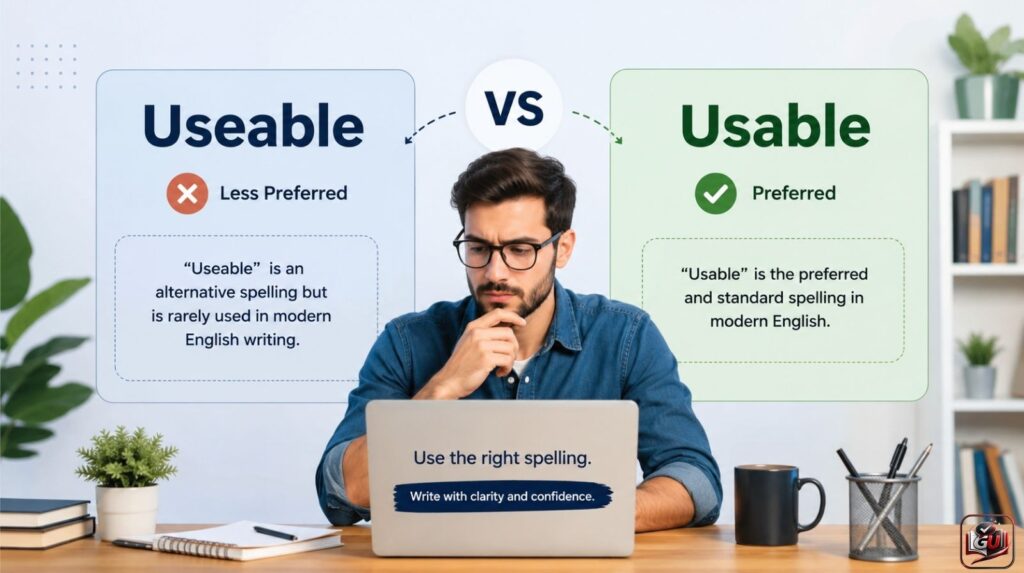
Both “useable” and “usable” are correct spellings. However, “usable” is the preferred and more widely accepted form in modern English.
Why Are There Two Spellings?
The adjective comes from the noun use and means:
Suitable for use or capable of being used.
Historically, both spellings developed over time. However, language usage gradually shifted toward usable because it is shorter and aligns with modern spelling preferences.
Quick Definition
| Word | Meaning | Status |
|---|---|---|
| Useable | Capable of being used | Correct but less common |
| Usable | Capable of being used | Preferred modern spelling |
Example Sentences
- The software is still usable after the update.
- We found a usable solution to the problem.
- The old laptop remains usable despite its age.
Although you may occasionally see useable, most editors and style guides recommend usable.
Why Is “Usable” More Common Today?
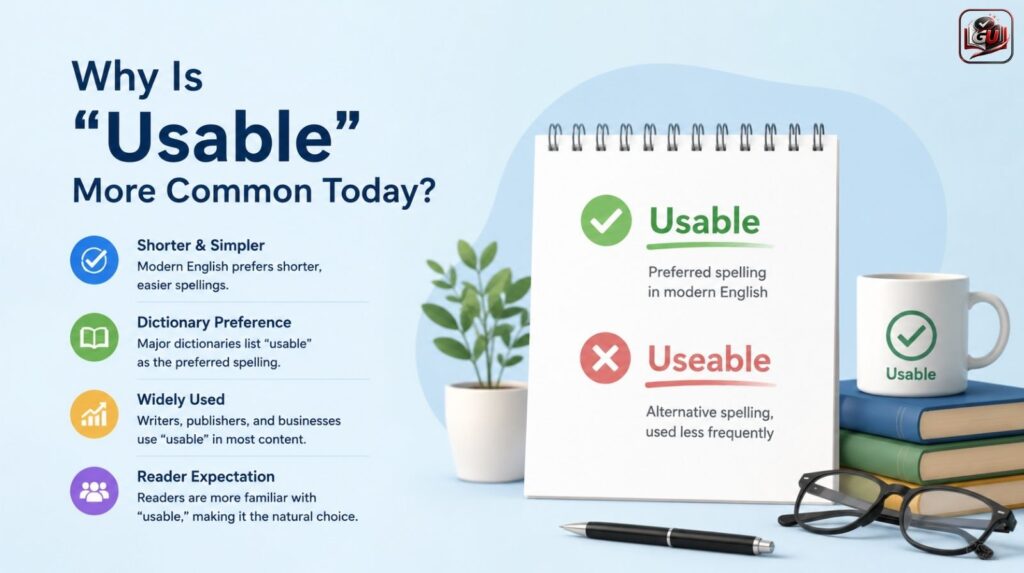
Language evolves based on how people write and communicate. Over the years, publishers, businesses, educators, and style guides have increasingly favored usable.
Simpler Spelling Wins
Many English words become simplified over time.
For example:
- Judgement → Judgment (in many contexts)
- Ageing → Aging (American English)
- Useable → Usable
The shorter version often becomes the standard because it is easier to read and write.
Preferred by Modern Dictionaries
Major dictionaries list both forms, but they typically identify usable as the primary spelling.
Preferred in Professional Writing
You will find usable far more frequently in:
- Academic papers
- Business reports
- Technical documentation
- Website content
- Marketing materials
Therefore, if you’re writing for a broad audience, usable is usually the safest choice.
Useable vs Usable in Modern English
When comparing useable vs usable, modern English strongly favors usable. While readers will understand either spelling, the preferred form appears more professional and current.
When Should You Use “Usable”?
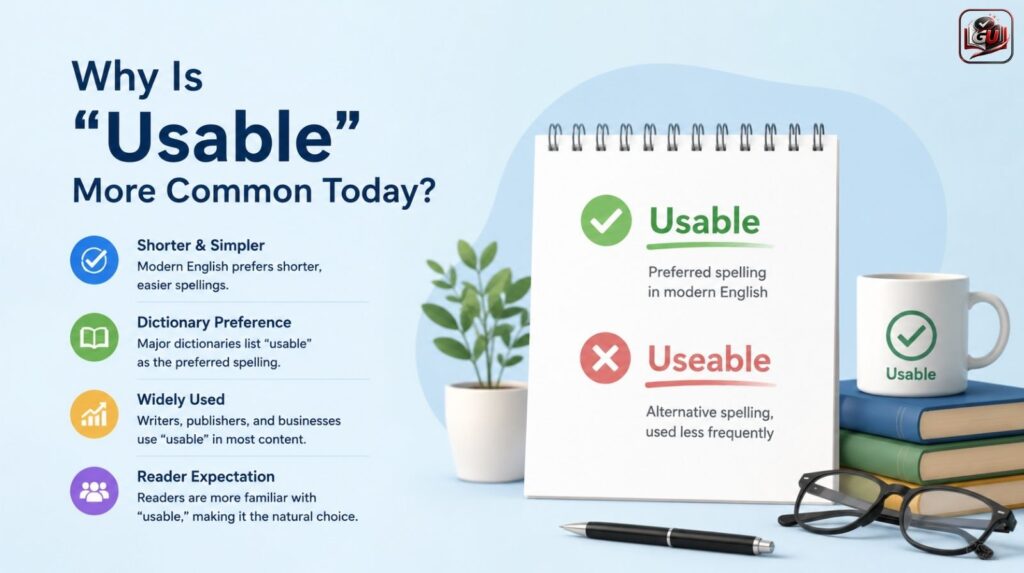
The best practice is straightforward:
Use “Usable” in Most Situations
Whether you are writing:
- Blog posts
- Emails
- School assignments
- Product descriptions
- SEO content
- Business documents
the spelling usable is generally recommended.
Examples in Everyday Writing
Technology
The application remains usable on older devices.
Education
The teacher provided a usable template for students.
Business
The data was organized into a usable format.
Home Improvement
After repairs, the room became fully usable again.
Because readers encounter this spelling more often, it feels natural and familiar.
Real-Life Example: How One Content Team Improved Consistency
A digital marketing agency managing over 500 blog articles noticed an unusual issue during a content audit. Several writers were using both useable and usable throughout the website.
At first, this seemed insignificant. After all, both spellings are technically correct. However, the inconsistency created challenges for editing, branding, and search optimization.
The editorial team reviewed major dictionaries, style guides, and competitor websites. They discovered that most professional publications consistently used usable.
As a result, the company updated its internal style guide and instructed writers to use only usable moving forward.
Over the following months, the team revised existing content and standardized terminology across the site. This improved readability, created a more professional appearance, and reduced editing time because writers no longer debated which version to use.
The lesson was simple: even when multiple spellings are technically acceptable, choosing one standard form improves consistency and user experience. For most organizations, usable has become that standard.
Useable vs Usable: Comparison Table
The following table highlights the key differences.
| Feature | Useable | Usable |
|---|---|---|
| Correct spelling | Yes | Yes |
| Modern preference | No | Yes |
| Common in publishing | Rare | Very common |
| Preferred in SEO content | No | Yes |
| Used in business writing | Rarely | Frequently |
| Recommended for students | No | Yes |
| Recommended for professionals | No | Yes |
Quick Rule to Remember
If you’re unsure which spelling to choose:
Use “usable.”
It is the form most readers expect to see.
Usage Statistics and Language Trends (2025–2026)
Recent language trend analysis from major dictionary databases, educational resources, and online publishing platforms shows that usable overwhelmingly dominates modern written English.
Key Findings
- Most major publications use usable as their default spelling.
- Educational institutions generally teach usable as the preferred form.
- Professional style guides recommend usable for consistency.
- Online content creators overwhelmingly favor usable.
Why This Matters
Search engines evaluate content quality based partly on readability and consistency. While using useable will not necessarily hurt rankings, using the more common spelling aligns with reader expectations and professional standards.
For SEO-focused writing, consistency is especially important because it helps maintain clarity throughout content.
Common Mistakes Writers Make
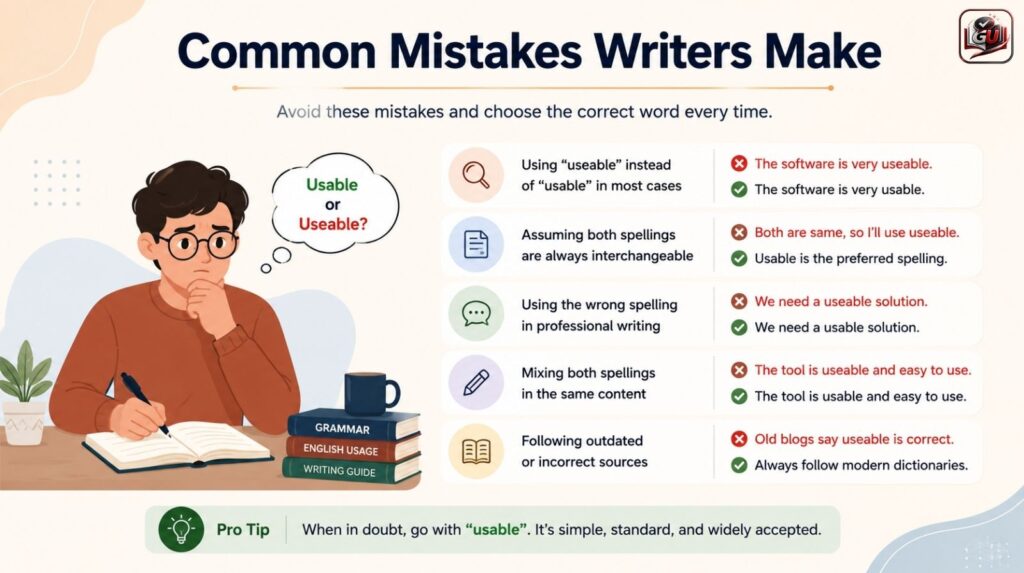
Understanding these mistakes can help you avoid confusion.
Mixing Both Spellings
Incorrect:
- The software is usable.
- The report is useable.
Using both spellings in the same document creates inconsistency.
Assuming Useable Is Wrong
Some writers believe useable is completely incorrect.
It is not.
The spelling exists in dictionaries but is simply less common.
Following Outdated Usage
Older books and publications may contain useable more frequently. Modern writing standards generally favor usable.
Ignoring Style Guides
Businesses and publishers often maintain style guides. If a guide specifies usable, follow that recommendation consistently.
How to Remember the Correct Spelling
A simple memory trick can help.
Think of Modern Usage
When in doubt:
Usable = Usual Choice
Both words begin with Us-, making the association easy to remember.
Three-Step Checklist
Before publishing your writing:
✔ Check spelling consistency
✔ Prefer usable over useable
✔ Follow your style guide
This quick review can prevent unnecessary editing corrections later.
FAQs
Q. Is useable a real word?
A: Yes. Useable is a legitimate English word and appears in several dictionaries. However, it is less common than usable.
Q. Which spelling is correct: useable or usable?
A: Both are correct, but usable is the preferred spelling in modern English.
Q. Is usable American or British English?
A: Both American and British English commonly use usable.
Q. Should I avoid using useable?
A: Not necessarily. However, most editors and style guides recommend using usable instead.
Q. Which spelling is better for SEO?
A: Usable is generally the better choice because it is more widely recognized and commonly searched.
Q. Why do dictionaries list both spellings?
A: English often preserves historical spelling variations. Although both forms remain valid, one may become more dominant over time.
Q. Can I use useable in academic writing?
A: You can, but most academic institutions and publishers prefer usable for consistency.
Trusted References
For additional guidance on English spelling and usage, consult:
- Google Search Central Writing Guidelines
- Merriam-Webster Dictionary
- Cambridge Dictionary
These resources regularly update language recommendations and usage trends.
Conclusion
Understanding useable vs usable is easier than it first appears. Both spellings are technically correct and share the same meaning: something that can be used.
However, modern English strongly favors usable. It is the preferred spelling in professional writing, academic work, business communication, digital content, and SEO-focused articles.
If your goal is clarity, consistency, and professionalism, choose usable whenever possible. Doing so aligns your writing with current language standards and helps readers immediately recognize the term.
The next time you face the useable vs usable debate, remember the simple rule: usable is the preferred modern choice.
👉Keep learning with more easy grammar lessons on GrammerUpdate.com

Noor Fatima is a professional blogger specializing in spelling correction and grammar guidance. She creates clear, practical content to help readers avoid common mistakes, strengthen writing skills, and communicate with confidence in everyday and professional settings.