
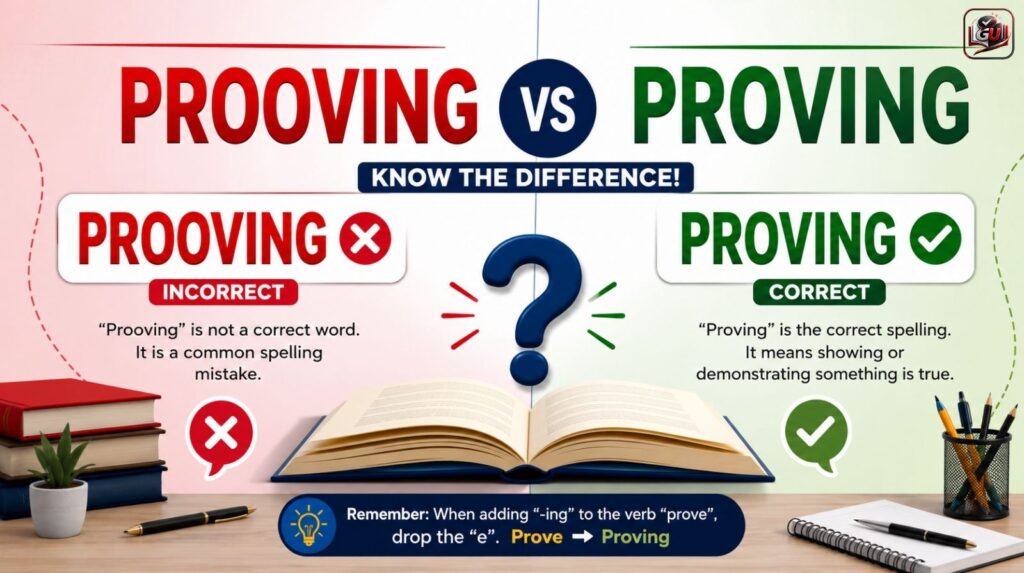
Sometimes a single extra letter can make an English word look completely correct and that is exactly what happens with Prooving vs Proving. Many people type “prooving” without even realizing it might be wrong because it looks natural at first glance. Whether you are writing an email, school assignment, blog post, or social media caption, this spelling confusion is more common than most people think.
The real problem is that English spelling rules are not always as straightforward as they seem. Words often change form when adding “-ing,” which is why many writers get stuck between “prooving” and “proving.”
In this guide, you will learn which spelling is actually correct, why the confusion happens, and simple ways to remember the right word so you can write with more confidence every time.
Understanding the Difference Between Prooving vs Proving
The main difference is simple:
| Word | Correct or Incorrect | Meaning |
|---|---|---|
| Proving | ✅ Correct | Demonstrating or showing something is true |
| Prooving | ❌ Incorrect | Misspelling of “proving” |
The correct spelling is proving.
“Proving” comes from the verb prove, which means to demonstrate truth, evidence, or validity.
Examples of Correct Usage
- She is proving her skills at work.
- The lawyer is proving the client’s innocence.
- Scientists are proving the theory through research.
- He kept proving everyone wrong.
Examples of Incorrect Usage
- ❌ She is prooving her point.
- ❌ They are prooving the results.
- ❌ I am prooving my abilities.
The word “prooving” is not accepted in standard English dictionaries or grammar rules.
Why People Write “Prooving” Instead of “Proving”
Many people assume that because the word “prove” contains a double “o,” the continuous form should also keep both vowels. However, English spelling rules often change words when adding suffixes like “-ing.”
The Grammar Rule Behind “Proving”
When verbs ending in silent “e” take “-ing,” the silent “e” is usually removed.
For example:
| Base Verb | + ing Form |
|---|---|
| Make | Making |
| Write | Writing |
| Drive | Driving |
| Prove | Proving |
This follows a standard English grammar structure.
Pronunciation Creates Confusion
Another reason people type “prooving” is pronunciation. The “oo” sound in “prove” may lead writers to think the spelling must remain the same.
However, pronunciation and spelling do not always match perfectly in English.
For example:
- Move → Moving
- Improve → Improving
- Approve → Approving
Notice that none of these words keep a double “o” before adding “-ing.”
What Does “Proving” Actually Mean?
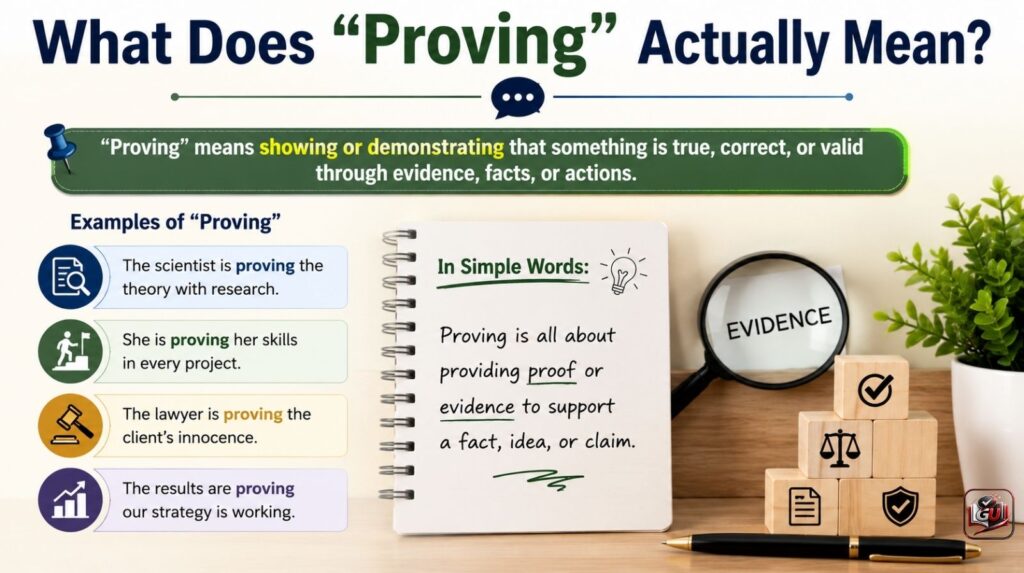
The word “proving” has several meanings depending on context. It generally refers to showing evidence, demonstrating ability, or confirming truth.
Proving in Everyday English
In daily conversation, “proving” often relates to showing capability or correctness.
Examples:
- She is proving herself as a leader.
- The student is proving his understanding of math.
- They are proving their commitment to quality.
Proving in Business and Marketing
Businesses frequently use the word “proving” in marketing campaigns and branding.
Examples:
- Customer reviews are proving the product’s value.
- Data is proving the effectiveness of the strategy.
- The company is proving its reliability through results.
Proving in Legal and Academic Writing
In legal and academic fields, “proving” refers to evidence-based validation.
Examples:
- The attorney is proving negligence in court.
- Researchers are proving the hypothesis with experiments.
Common Grammar Mistakes Similar to Prooving vs Proving
The confusion around “prooving” is part of a larger pattern in English spelling.
Here are other commonly misspelled words:
| Incorrect | Correct |
|---|---|
| Moveing | Moving |
| Writeing | Writing |
| Makeing | Making |
| Hopeing | Hoping |
| Liveing | Living |
Why These Errors Happen
These mistakes occur because English learners often apply pronunciation logic instead of grammar rules.
However, spelling changes in English frequently depend on word structure rather than sound alone.
Easy Rule to Remember
If a verb ends with silent “e”:
➡ Remove the “e” before adding “-ing.”
Example:
- Prove → Proving
- Write → Writing
- Drive → Driving
This single grammar rule can eliminate many spelling mistakes instantly.
Prooving vs Proving in SEO and Content Writing

Correct spelling matters heavily in SEO, blogging, and professional communication.
Misspelled keywords can reduce credibility and negatively impact user trust.
Why Correct Spelling Matters for SEO
Google’s algorithms are increasingly focused on content quality and user experience. According to recent SEO studies, spelling and readability influence engagement metrics such as bounce rate and time on page.
When readers notice obvious spelling mistakes like “prooving,” they may assume the content lacks authority.
This can hurt:
- Reader trust
- Brand professionalism
- Search rankings indirectly
- Conversion rates
Search Trends Around Spelling Mistakes
Interestingly, users still search for incorrect spellings online.
For example:
- “prooving meaning”
- “prooving or proving”
- “is prooving correct”
This happens because people often search exactly how they think a word is spelled.
Therefore, many SEO writers strategically include common misspellings naturally while clarifying the correct form.
Best Practice for Writers
Use the incorrect version only when discussing the mistake itself.
Correct example:
Many users search for “prooving,” but the correct spelling is “proving.”
Avoid repeatedly using incorrect spellings unnaturally throughout the article.
Real-Life Case Study: How a Small Blog Improved Credibility Through Better Grammar
In 2025, a small educational blog focused on English learning noticed declining engagement despite publishing regular content. The site owner discovered that many articles contained spelling inconsistencies, including mistakes like “prooving,” “writting,” and “moveing.”
Although the content ideas were strong, readers frequently left comments pointing out grammar errors. The website’s bounce rate increased, and average session duration dropped significantly.
The owner decided to conduct a full proofreading audit. Every article was updated with correct spelling, clearer formatting, and improved readability. They also added grammar-checking tools during the editing process.
Within four months, the blog experienced noticeable improvements:
- Higher reader trust
- Longer page engagement
- Increased social shares
- Better ranking positions for educational keywords
One article specifically targeting “Prooving vs Proving” began ranking for multiple search queries because it answered the confusion directly while maintaining professional accuracy.
This example demonstrates that proper spelling is not just about grammar. It also affects SEO performance, audience trust, and overall content quality.
2025–2026 Language and Content Accuracy Statistics
Recent studies show that grammar and spelling still strongly impact online credibility.
Key Statistics
- According to research from HubSpot, readers are less likely to trust websites containing noticeable grammar mistakes.
- A 2025 digital publishing survey found that professionally edited articles receive significantly higher engagement rates.
- Google’s helpful content systems increasingly reward clear, accurate, people-first writing.
- Studies from Google Search Central emphasize high-quality, trustworthy content for better visibility.
These trends show why spelling accuracy matters more than ever for bloggers, businesses, and students.
How to Remember the Correct Spelling Easily

Remembering “proving” becomes simple with a few practical tricks.
Trick #1 Remove the Silent “E”
Think of this pattern:
- Prove → Proving
- Move → Moving
- Improve → Improving
The silent “e” disappears before “-ing.”
Trick #2 Say the Root Word First
Instead of focusing on pronunciation, think about the base word “prove.”
Then apply the grammar rule naturally.
Trick #3 Read More Professionally Written Content
Frequent exposure to correct spelling improves writing habits automatically.
Reading high-quality blogs, books, and articles helps reinforce correct patterns over time.
Quick Comparison Checklist
Correct Usage Checklist
✅ Use “proving” in all formal and informal writing
✅ Remove silent “e” before adding “-ing”
✅ Proofread SEO articles carefully
✅ Use grammar tools for editing
Avoid These Mistakes
❌ Writing “prooving”
❌ Assuming pronunciation determines spelling
❌ Ignoring proofreading in professional content
FAQs
Q. Is “prooving” a real word?
A: No. “Prooving” is not considered a correct English word. The proper spelling is “proving.”
Q. Why is it “proving” and not “prooving”?
A: Because English grammar rules remove the silent “e” from “prove” before adding “-ing.”
Q. Can I use “prooving” informally?
A: No. Even in casual writing, “prooving” is considered a spelling mistake.
Q. What does “proving” mean?
A: “Proving” means demonstrating that something is true, valid, or correct.
Q. Is “proving” used in business writing?
A: Yes. Businesses commonly use “proving” when discussing results, evidence, and performance.
Q. Does spelling affect SEO rankings?
A: Indirectly, yes. Poor spelling can reduce trust, engagement, and content quality signals.
Q. How can I avoid spelling mistakes like this?
A: Use proofreading tools, follow grammar rules, and read professionally edited content regularly.
Conclusion
The confusion between Prooving vs Proving is extremely common, but the correct spelling is always proving.
The mistake usually happens because people rely on pronunciation instead of grammar rules. However, once you remember that silent “e” verbs drop the “e” before adding “-ing,” the spelling becomes much easier.
Whether you are writing blog posts, emails, academic papers, or SEO content, using correct spelling improves professionalism, credibility, and reader trust.
Next time you hesitate between “prooving” and “proving,” remember this simple rule:
✅ Proving = Correct
❌ Prooving = Incorrect
For better writing results, always proofread carefully and focus on clarity, readability, and accuracy.
👉Keep learning with more easy grammar lessons on GrammerUpdate.com

Noor Fatima is a professional blogger specializing in spelling correction and grammar guidance. She creates clear, practical content to help readers avoid common mistakes, strengthen writing skills, and communicate with confidence in everyday and professional settings.