If you’ve ever paused while writing and wondered whether to use quantify or qualify, you’re definitely not alone. These two words look and sound similar, which is why many students, writers, and even professionals mix them up. But despite their similar spelling, they have completely different meanings.
For example, when talking about numbers, results, or data, one word fits perfectly. On the other hand, when discussing requirements, conditions, or descriptions, the other word is the correct choice. Using the wrong one can make your sentence confusing and sometimes even change the meaning entirely.
The good news is that the difference between quantify vs qualify is actually easy to understand once it’s explained in a simple way. In this guide, we’ll break down both words with clear meanings, real-life examples, common mistakes, and easy tips so you can use them correctly and confidently in everyday writing.
What Does “Quantify” Mean?
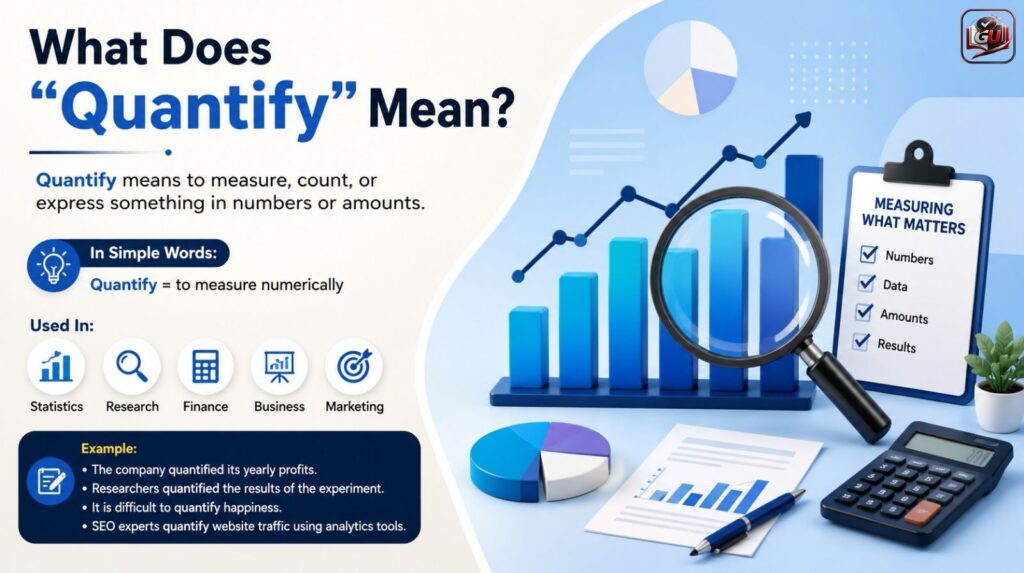
The word quantify means to measure, count, or express something in numbers or amounts.
It is commonly used in:
- Mathematics
- Statistics
- Research
- Data analysis
- Business reporting
- Marketing analytics
Simple Definition of Quantify
Quantify = to measure numerically
Examples of Quantify in Sentences
- The company quantified its yearly profits.
- Researchers quantified the results of the experiment.
- It is difficult to quantify happiness.
- SEO experts quantify website traffic using analytics tools.
Common Contexts Where “Quantify” Is Used
Business and Finance
Companies quantify:
- Revenue
- Growth
- Sales performance
- Customer acquisition costs
Example:
The finance department quantified quarterly expenses before the audit.
Research and Data Analysis
Scientists and researchers quantify results using measurements and statistics.
Example:
The researchers quantified pollution levels in urban areas.
Marketing and SEO
Digital marketers quantify campaign performance using metrics.
Example:
Google Analytics helps marketers quantify user engagement.
According to recent digital marketing reports from 2025, businesses increasingly rely on data-driven strategies to measure online performance and ROI. Accurate quantification has become essential for decision-making.
What Does “Qualify” Mean?
The word qualify means to meet requirements, describe characteristics, or make something less absolute.
Unlike quantify, qualify is usually related to quality, conditions, eligibility, or description, not numbers.
Simple Definition of Qualify
Qualify = to meet conditions or describe something
Examples of Qualify in Sentences
- She qualified for the final interview.
- The statement needs additional details to qualify the claim.
- Only experienced candidates qualify for the position.
- The adjective qualifies the noun in grammar.
Common Contexts Where “Qualify” Is Used
Eligibility and Requirements
This is the most common use.
Example:
You must qualify for the scholarship before applying.
Grammar and Writing
In grammar, qualify means modifying or limiting another word.
Example:
The phrase “very talented” qualifies the noun.
Sales and Marketing
Sales teams qualify leads before contacting them further.
Example:
The company qualified potential customers based on buying intent.
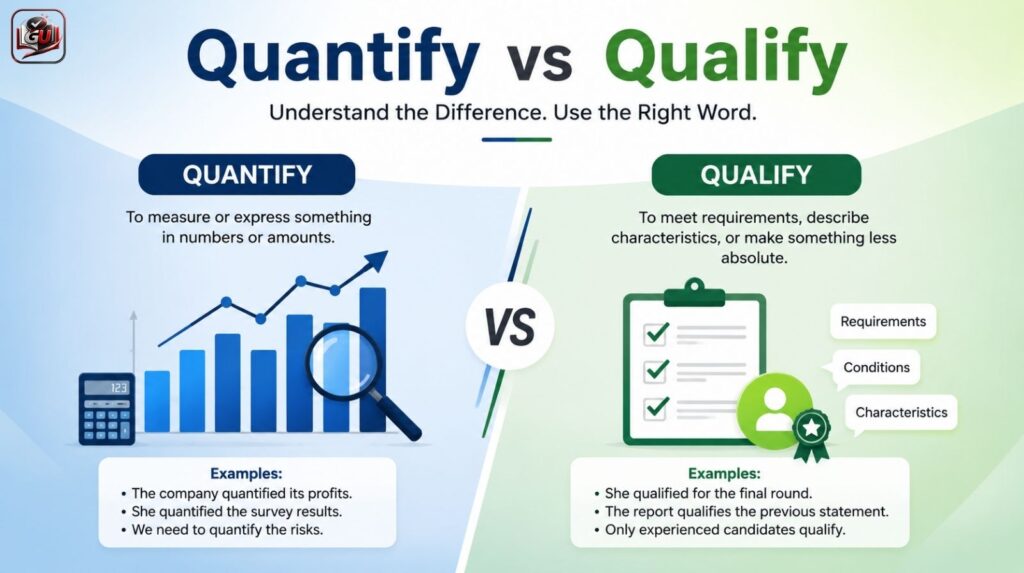
Quantify vs Qualify: Main Differences
Although the words look and sound similar, their functions are completely different.
| Feature | Quantify | Qualify |
|---|---|---|
| Main Meaning | Measure in numbers | Meet conditions or describe |
| Related To | Quantity | Quality/Requirements |
| Used In | Statistics, research, finance | Eligibility, grammar, hiring |
| Focus | Numerical data | Characteristics or conditions |
| Example | Quantify profits | Qualify for a job |
Quick Memory Trick
- Quantify → Quantity → Numbers
- Qualify → Quality → Conditions or characteristics
This simple association helps many learners remember the difference instantly.
When to Use Quantify Correctly
Understanding practical usage is the best way to avoid mistakes.
Use Quantify for Numbers and Measurement
Whenever data, amounts, percentages, or measurable results are involved, use quantify.
Correct examples:
- Analysts quantified customer retention rates.
- The app quantifies daily fitness activity.
- Teachers quantified test performance statistically.
Use Quantify in Professional Writing
Business reports often require measurable outcomes.
Example:
Managers should quantify employee productivity using performance metrics.
Use Quantify in Academic Content
Research papers often include quantified findings.
Example:
Scientists quantified the chemical reactions during testing.
Common Mistake With Quantify
Incorrect:
The employee quantified for the competition.
Correct:
The employee qualified for the competition.
Why?
Because competitions involve eligibility, not numerical measurement.
When to Use Qualify Correctly
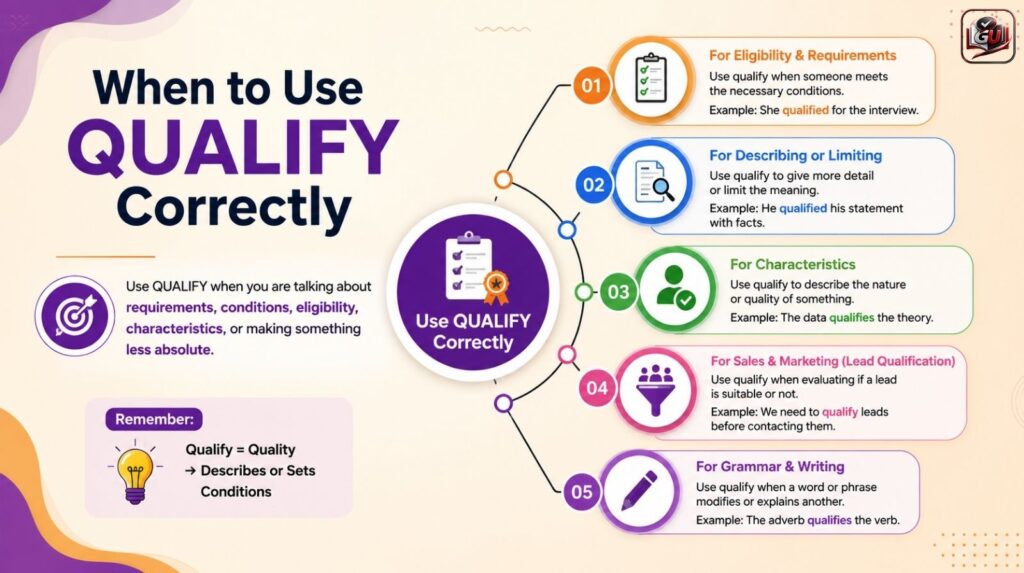
Use qualify when discussing requirements, limitations, descriptions, or approval.
Use Qualify for Eligibility
Correct examples:
- He qualified for the championship.
- Students must qualify academically.
- You may qualify for financial aid.
Use Qualify in Grammar
Writers qualify statements to make them more precise.
Example:
The lawyer qualified his statement carefully.
Use Qualify in Hiring and Sales
Businesses qualify candidates and leads before moving forward.
Example:
Recruiters qualify applicants through interviews.
Common Mistake With Qualify
Incorrect:
The scientist qualified the data using percentages.
Correct:
The scientist quantified the data using percentages.
Because percentages involve numerical measurement.
Real-Life Case Study: How Businesses Use Quantify and Qualify Together
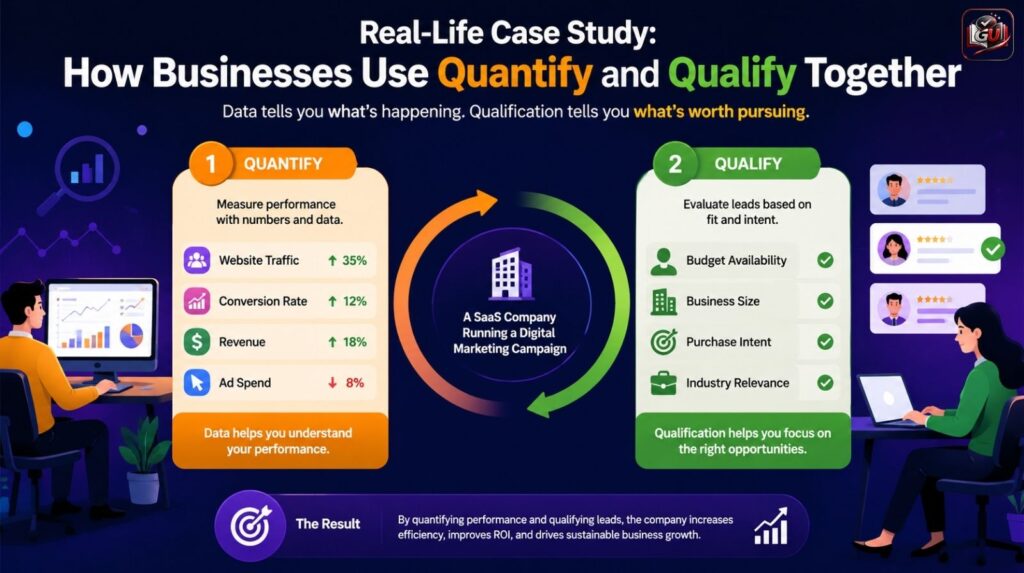
Modern companies often use both concepts in marketing, hiring, and customer research.
Consider a SaaS company running a digital marketing campaign in 2026.
The marketing team first quantifies campaign performance by analyzing:
- Website traffic
- Conversion rates
- Bounce rates
- Ad spending
- Revenue growth
For example, they may discover that:
- Traffic increased by 35%
- Conversion rates improved by 12%
- Customer retention rose by 18%
These are measurable results, so the correct word is quantify.
Next, the sales department begins to qualify leads. Instead of focusing on numbers, they evaluate whether potential customers meet certain conditions:
- Budget availability
- Business size
- Purchase intent
- Industry relevance
A lead may qualify if the customer matches the ideal buyer profile.
This example shows how businesses use both terms differently but together in real-world operations.
Quantification handles measurable metrics, while qualification focuses on suitability and requirements.
Data and Statistics: Why Correct Word Usage Matters in 2025–2026
Language clarity has become increasingly important in digital communication.
According to content marketing research published between 2025 and 2026:
- Over 72% of businesses prioritize clear communication in SEO content.
- Companies using data-driven reporting regularly quantify KPIs and performance metrics.
- Recruitment platforms increasingly use automated systems to qualify applicants based on predefined conditions.
In professional writing, confusing quantify and qualify can create misunderstandings in:
- Research papers
- Financial reports
- SEO articles
- Marketing campaigns
- Legal documents
This is why grammar accuracy remains essential for credibility and trust.
Common Mistakes People Make With Quantify vs Qualify
Many learners accidentally interchange these words because they sound similar.
Mistake #1 — Using “Qualify” for Numbers
Incorrect:
We qualified the sales growth.
Correct:
We quantified the sales growth.
Mistake #2 — Using “Quantify” for Eligibility
Incorrect:
She quantified for the finals.
Correct:
She qualified for the finals.
Mistake #3 — Confusing Business Usage
Incorrect:
The team quantified leads before calling them.
Correct:
The team qualified leads before calling them.
Why?
Lead qualification involves determining suitability, not measuring numbers.
Step-by-Step Guide to Remember the Difference
Step 1: Look for Numbers
Ask yourself:
Is this about measurements, percentages, or statistics?
If yes, use quantify.
Step 2: Look for Conditions or Requirements
Ask:
Is this about eligibility, suitability, or description?
If yes, use qualify.
Step 3: Use the Memory Formula
- Quantity → Quantify
- Quality → Qualify
Step 4: Practice With Examples
| Sentence | Correct Word |
|---|---|
| The scientist ___ the results. | Quantified |
| She ___ for the scholarship. | Qualified |
| Analysts ___ website traffic. | Quantified |
| Applicants must ___ first. | Qualify |
Quantify vs Qualify in SEO and Content Writing
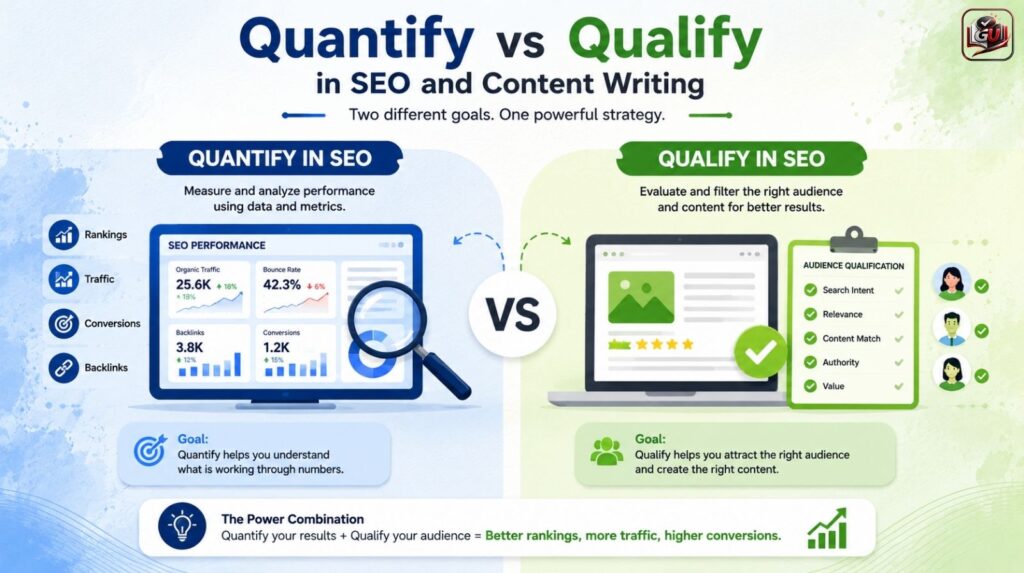
SEO writers often use both words in different contexts.
Quantify in SEO
SEO professionals quantify performance metrics such as:
- Organic traffic
- Click-through rate
- Rankings
- Conversions
Example:
SEO tools quantify keyword performance.
Qualify in SEO
Content marketers qualify leads and audiences.
Example:
High-quality content helps qualify potential customers.
Understanding this distinction improves professional communication and content clarity.
FAQs
Q. Is quantify the same as qualify?
A: No. Quantify means measuring something numerically, while qualify means meeting conditions or describing characteristics.
Q. What is an example of quantify?
A: Example:
The company quantified annual profits using financial reports.
Q. What is an example of qualify?
A: Example:
She qualified for the university scholarship.
Q. Can quantify and qualify be used together?
A: Yes. Businesses often quantify data and qualify leads in the same process.
Q. Is quantify related to quantity?
A: Yes. The word quantify comes from the idea of quantity or numerical measurement.
Q. Is qualify related to quality?
A: Partly. Qualify often relates to characteristics, conditions, or suitability rather than numbers.
Q. Why do people confuse quantify and qualify?
A: People confuse them because the words sound similar and are often used in professional environments. However, their meanings are completely different.
Conclusion
Understanding the difference between quantify vs qualify is essential for clear and professional communication. Although the words sound similar, their meanings are very different.
- Quantify refers to measuring or expressing something numerically.
- Qualify refers to meeting conditions, describing characteristics, or limiting statements.
Whether you are writing academic papers, business reports, SEO content, or professional emails, using the correct word improves clarity and credibility.
Remember this simple rule:
- Quantify = Quantity = Numbers
- Qualify = Quality/Conditions = Eligibility or description
The next time you write or speak, pause for a moment and ask yourself whether you are discussing measurements or requirements. That quick check will help you choose the correct word every time.
External References
👉Keep learning with more easy grammar lessons on GrammerUpdate.com

Noor Fatima is a professional blogger specializing in spelling correction and grammar guidance. She creates clear, practical content to help readers avoid common mistakes, strengthen writing skills, and communicate with confidence in everyday and professional settings.