
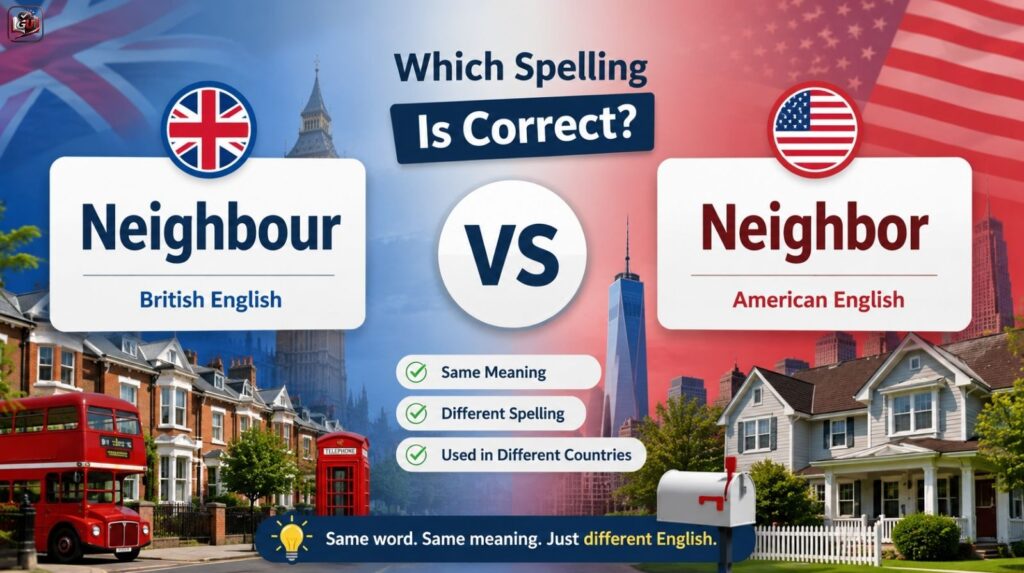
Have you ever come across the words neighbour and neighbor and wondered if one of them is a spelling mistake? You’re not alone. These two versions of the same word often confuse students, writers, and even native English speakers, especially when both appear in books, websites, and everyday writing.
At first glance, the difference seems minor just a single letter. However, that small change has everything to do with the type of English being used. Choosing the right spelling can make your writing look more professional, consistent, and appropriate for your audience.
In this guide, we’ll break down the difference between neighbour vs neighbor, explain why both spellings exist, show where each one is commonly used, and help you confidently choose the correct version every time you write.
What Is the Difference Between Neighbour and Neighbor?
The difference between neighbour and neighbor is purely a spelling variation.
| Word | English Version | Meaning |
|---|---|---|
| Neighbour | British English | A person living nearby |
| Neighbor | American English | A person living nearby |
Both words have the exact same pronunciation and meaning. The only distinction is regional spelling.
Definition of Neighbour
In British English, neighbour refers to someone who lives near your home.
Example:
- My neighbour helped me carry the groceries.
- We invited our neighbours to dinner.
Definition of Neighbor
In American English, the preferred spelling is neighbor.
Example:
- Our neighbor is very friendly.
- The new neighbor moved in last week.
Quick Answer
If you write for a UK, Australian, Canadian, or New Zealand audience, use neighbour.
If you write for a US audience, use neighbor.
Why Are There Two Different Spellings?
The difference dates back to the historical development of English.
The British English Tradition
British English preserved many spellings influenced by French and Latin. As a result, words such as:
- Colour
- Favourite
- Honour
- Neighbour
retained the -our ending.
The American English Reform
In the early 1800s, lexicographer Noah Webster promoted simplified spellings in American English.
His reforms changed many words:
| British English | American English |
|---|---|
| Colour | Color |
| Honour | Honor |
| Labour | Labor |
| Neighbour | Neighbor |
The goal was to make spelling more straightforward and uniquely American.
Why the Difference Still Exists Today
English evolved differently across regions. Therefore, both spelling systems became accepted standards and remain widely used worldwide.
Neighbour vs Neighbor: Which Spelling Is Correct?
Both Spellings Are Correct
A common misconception is that one spelling is wrong.
In reality:
✔ Neighbour is correct in British English.
✔ Neighbor is correct in American English.
Choose Based on Your Audience
When writing, consistency matters more than the spelling itself.
For example:
For UK Readers
My neighbour owns a beautiful garden.
For US Readers
My neighbor owns a beautiful garden.
Avoid Mixing Styles
Incorrect example:
My neighbour is friendly and my favorite neighbor is next door.
This creates inconsistency because it combines British and American spelling conventions.
Instead, stick to one style throughout the document.
When Should You Use Neighbour?
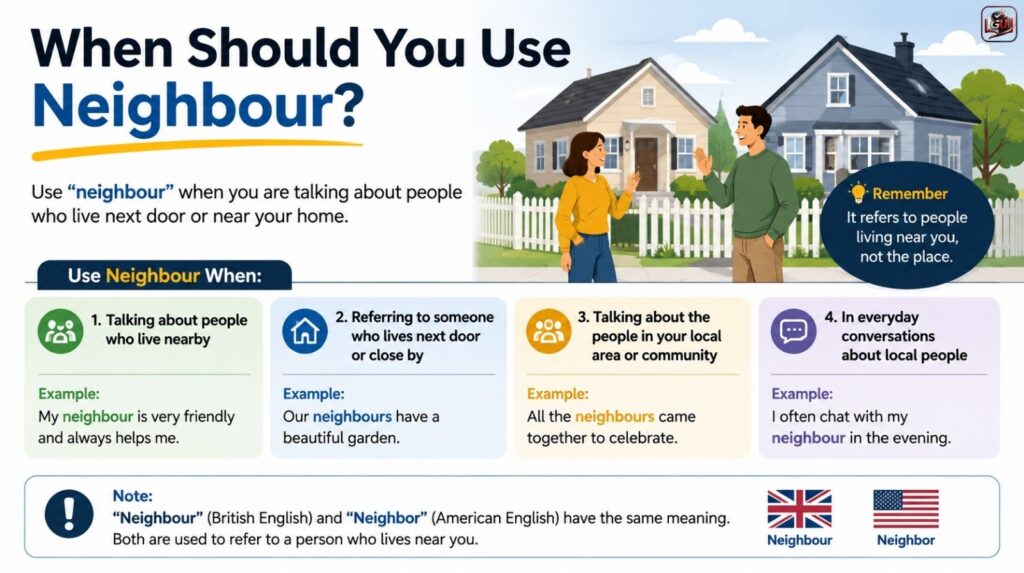
Use Neighbour in British English Writing
If your audience is primarily from:
- United Kingdom
- Australia
- New Zealand
- Ireland
then neighbour is generally preferred.
Common British Examples
- Neighbourhood
- Neighbouring countries
- Friendly neighbour
- Next-door neighbour
See Also: Seperate vs Separate: Which Spelling Is Correct?
Example Sentences
- Our neighbour always waters our plants when we travel.
- The neighbouring village is only five miles away.
- She has been my neighbour for ten years.
When Should You Use Neighbor?
Use Neighbor in American English Writing
If you’re writing for:
- United States
- American businesses
- US-based websites
- American academic institutions
then neighbor is the preferred spelling.
Common American Examples
- Neighborhood
- Neighboring states
- Friendly neighbor
- Next-door neighbor
Example Sentences
- My neighbor owns a bakery.
- The neighboring state experienced heavy rainfall.
- Every neighbor attended the community meeting.
Real-Life Example: Why Consistent Spelling Matters
A digital marketing agency in London launched a community-focused campaign aimed at local homeowners. The content team initially created blog posts using British spelling, including words like neighbour, colour, and favourite.
Later, the company expanded into the United States. To reach American audiences more effectively, they duplicated their content and localized it for the US market.
One of the biggest changes involved spelling adjustments:
- Neighbour → Neighbor
- Neighbourhood → Neighborhood
- Colour → Color
- Favourite → Favorite
After localization, the content felt more natural to American readers and aligned with their expectations. Visitors were more likely to trust information written in familiar language.
This example highlights an important lesson: while both spellings are correct, matching your audience’s language preferences improves readability, user experience, and brand credibility. Large international companies often create separate UK and US versions of their websites for this reason.
For bloggers, businesses, and content creators, consistency in spelling helps maintain professionalism and avoids confusing readers.
Neighbour vs Neighbor Comparison Table
| Feature | Neighbour | Neighbor |
|---|---|---|
| Meaning | Person living nearby | Person living nearby |
| Pronunciation | Same | Same |
| British English | ✔ Preferred | Rare |
| American English | Rare | ✔ Preferred |
| Correct Spelling | Yes | Yes |
| Formal Writing | Yes | Yes |
| Informal Writing | Yes | Yes |
Featured Snippet Answer
Neighbour and neighbor mean the same thing. Neighbour is the standard British English spelling, while neighbor is the standard American English spelling. Both are correct, but you should choose the version that matches your target audience and remain consistent throughout your writing.
Language Usage Statistics (2025–2026)
Language databases and search trend reports continue to show regional preferences in spelling.
Key Findings
- Neighbor remains the dominant spelling in the United States.
- Neighbour continues to be preferred in the United Kingdom, Australia, and New Zealand.
- International businesses often localize spelling based on geographic audiences.
- Search engines recognize both spellings as valid English words.
See Also: Muscle vs Mussel: Which Is The Difference And How To Use Them Correctly?
Recent linguistic trend data from major dictionaries and language reference platforms indicates that regional spelling preferences remain strong despite increasing globalization.
For content creators, using audience-specific spelling can improve user engagement and readability.
Common Mistakes People Make
Assuming One Spelling Is Wrong
Many learners think one version is incorrect.
In reality, both spellings are accepted.
Mixing British and American English
Switching between spelling styles can make writing look unprofessional.
Ignoring Audience Location
A US audience expects American spelling, while UK readers usually expect British spelling.
Forgetting Related Word Variations
Remember that related words also change.
| British | American |
|---|---|
| Neighbourhood | Neighborhood |
| Neighbouring | Neighboring |
| Neighbourly | Neighborly |
How to Remember Neighbour vs Neighbor
Remember the “U”
If the word contains our, it’s usually British English.
Examples:
- Colour
- Honour
- Labour
- Neighbour
No “U” Means American English
Examples:
- Color
- Honor
- Labor
- Neighbor
Simple Memory Trick
United Kingdom = Uses the “U”
United States = Usually Removes the “U”
This trick works for many British-American spelling differences.
FAQs
Q. Is neighbour or neighbor correct?
A: Both are correct. Neighbour is British English, while neighbor is American English.
Q. Which spelling should I use in school assignments?
A: Use the spelling style required by your teacher, institution, or country.
Q. Is neighbour used in Canada?
A: Canadian English often follows British spelling traditions, so neighbour is commonly used.
Q. Do neighbour and neighbor have different meanings?
A: No. They have identical meanings and pronunciation.
Q. Does Google recognize both spellings?
A: Yes. Search engines understand both spellings and treat them as valid English words.
Q. Which spelling is more common worldwide?
A: Usage depends on region. Neighbor dominates in the United States, while neighbour remains common across many Commonwealth countries.
Credible References
- Merriam-Webster Dictionary
- Cambridge Dictionary
- Oxford English Dictionary
Conclusion
The debate over neighbour vs neighbor is not about right versus wrong. Both spellings are correct and widely accepted in English.
The key difference is regional usage. Neighbour is the preferred spelling in British English, while neighbor is standard in American English. Therefore, the best choice depends on your audience and the style guide you follow.
Whether you’re writing a blog post, academic paper, business document, or social media content, consistency is what matters most. Choose one spelling style and use it throughout your writing.
If you’re targeting UK readers, use neighbour. If your audience is in the United States, use neighbor. Making the right choice helps your writing look professional, trustworthy, and polished.
👉Keep learning with more easy grammar lessons on GrammerUpdate.com

Noor Fatima is a professional blogger specializing in spelling correction and grammar guidance. She creates clear, practical content to help readers avoid common mistakes, strengthen writing skills, and communicate with confidence in everyday and professional settings.