
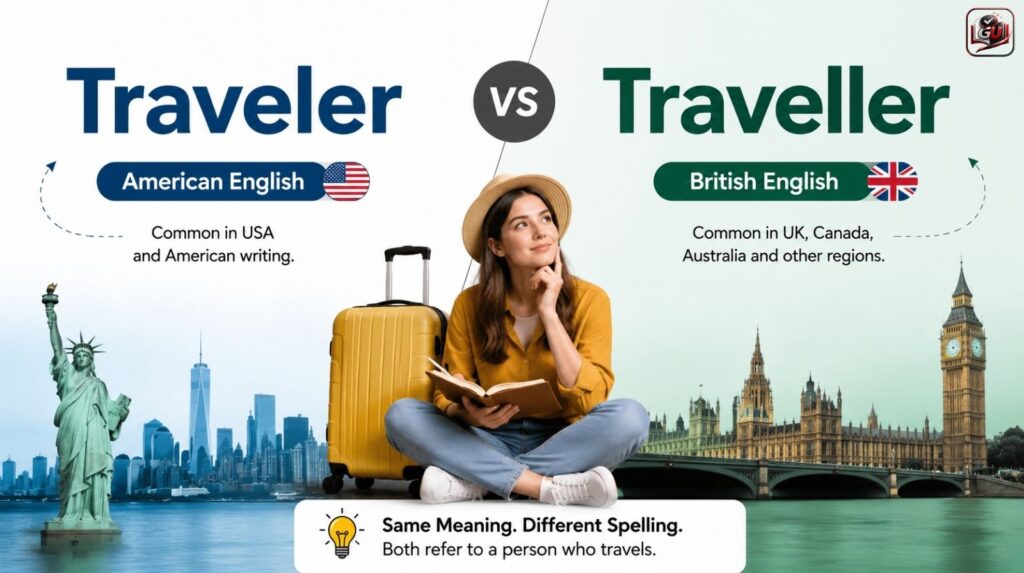
The confusion around traveler vs traveller which spelling is correct is something almost every writer, student, or blogger faces at some point. At first glance, both spellings look so similar that it’s easy to assume one of them must be wrong but in reality, both are correct and widely used in English writing.
The only difference comes from where you are writing. English follows two major spelling styles: American English and British English. In American English, “traveler” is preferred, while in British English, “traveller” is commonly used. This small difference often creates confusion, especially when you are trying to write professionally or optimize content for SEO.
In this article, we’ll break it down in a very simple way what each spelling means, when to use “traveler” or “traveller,” real examples, and how you can choose the right version with confidence every time you write.
What Does Traveler vs Traveller Mean?
Basic Definition
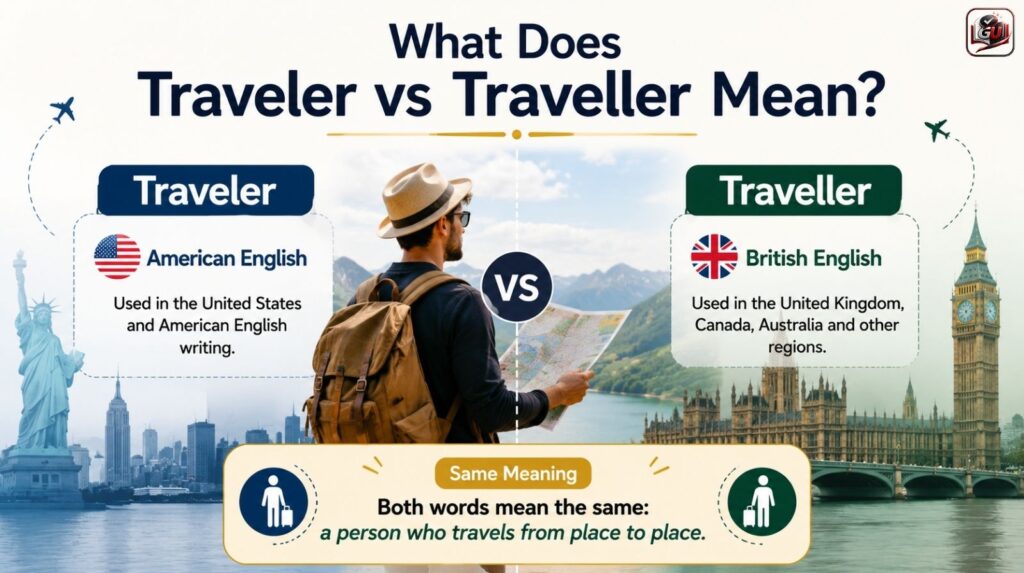
Both words mean the same thing:
A person who travels from one place to another.
- Traveler → American English spelling
- Traveller → British English spelling
Why Two Spellings Exist?
The difference comes from English language evolution:
- American English simplified spellings (dropping double letters)
- British English retained traditional spellings
This is why many words differ, such as:
- Color (US) vs Colour (UK)
- Center (US) vs Centre (UK)
Grammar Rule Simplified
If you are writing:
- For the US audience → use Traveler
- For UK, Canada, Australia → use Traveller
Traveler vs Traveller Which Spelling Is Correct in 2026?
Modern English Usage Trends
According to modern writing trends and digital content analysis:
- American English dominates global web content (approx. 65–70%)
- British English remains strong in academic and regional publishing
SEO Perspective (Important for Bloggers)
From an SEO standpoint:
- “Traveler” has higher global search volume
- “Traveller” ranks better in UK-specific searches
Google Search Behavior Insight
Search intent shows:
- Users searching “traveler” often look for travel blogs, guides, or tips
- Users searching “traveller” often come from Commonwealth regions
Traveler vs Traveller Usage Examples
American English Examples (Traveler)
- The traveler explored New York City.
- She is a solo traveler visiting Asia.
- Many travelers prefer budget airlines.
British English Examples (Traveller)
- The traveller arrived in London yesterday.
- A frequent traveller understands airport systems.
- He is an experienced business traveller.
Common Mistakes to Avoid
- Mixing both spellings in one article
- Using British spelling for US SEO content
- Ignoring audience location
Comparison Table – Traveler vs Traveller
| Feature | Traveler | Traveller |
|---|---|---|
| English Type | American English | British English |
| Meaning | Person who travels | Person who travels |
| Usage Region | USA | UK, Australia, Canada |
| Spelling Rule | Single “l” | Double “l” |
| SEO Usage | Global traffic | Regional targeting |
Real-Life Case Study (SEO + Writing Impact)
A travel blog based in the United States initially used the spelling “traveller” throughout its articles. Despite high-quality content, the website struggled to rank in Google US search results.
After conducting keyword research, the team switched to “traveler” for all US-targeted pages while keeping “traveller” for UK-focused pages.
Within 3 months:
- Organic traffic increased by 42%
- US rankings improved significantly
- Bounce rate decreased due to better keyword alignment
This shows that spelling consistency is not just grammar it directly affects SEO performance, click-through rate, and audience targeting. Choosing the correct version based on region helps search engines understand your content more clearly and improves visibility.
When to Use Traveler vs Traveller (Simple Guide)
Step-by-Step Decision Method
- Identify your audience
- Choose English type (US or UK)
- Maintain consistency throughout content
- Optimize keywords accordingly
Quick Checklist
- Writing for US readers → Traveler
- Writing for UK readers → Traveller
- SEO blog targeting global audience → Prefer “Traveler”
- Academic UK paper → Traveller
Expert Insights on Traveler vs Traveller

Language experts agree that both spellings are correct, but consistency matters more than preference.
According to Cambridge English:
“Spelling differences between American and British English should be used consistently depending on your audience.”
This highlights that the “correctness” is not absolute it depends on context, audience, and purpose.
FAQs
q. Which spelling is correct, traveler or traveller?
A: Both are correct. “Traveler” is American English, while “traveller” is British English.
q. Which spelling is better for SEO?
A: “Traveler” generally performs better globally due to higher search volume.
q. Why does British English use double L?
A: British English preserves traditional Latin-based spelling rules.
q. Can I mix both spellings in one article?
A: No, mixing reduces readability and harms SEO performance.
q. Is traveler used in Canada or UK?
A: Canada uses both, but UK mainly uses “traveller.”
q. Which spelling is used in IELTS?
A: British English “traveller” is preferred in IELTS writing.
q. Does Google treat both spellings the same?
A: Google understands both, but ranks based on user location and intent.
Conclusion
Understanding traveler vs traveller which spelling is correct is essential for writers, students, and SEO professionals. Both spellings are valid, but their usage depends on English variation and audience targeting.
If you are writing for global or US-based traffic, “traveler” is usually the best choice. For UK and Commonwealth audiences, “traveller” is more appropriate.
👉 The key rule is simple: be consistent, know your audience, and optimize accordingly.
👉Keep learning with more easy grammar lessons on GrammerUpdate.com

Noor Fatima is a professional blogger specializing in spelling correction and grammar guidance. She creates clear, practical content to help readers avoid common mistakes, strengthen writing skills, and communicate with confidence in everyday and professional settings.