
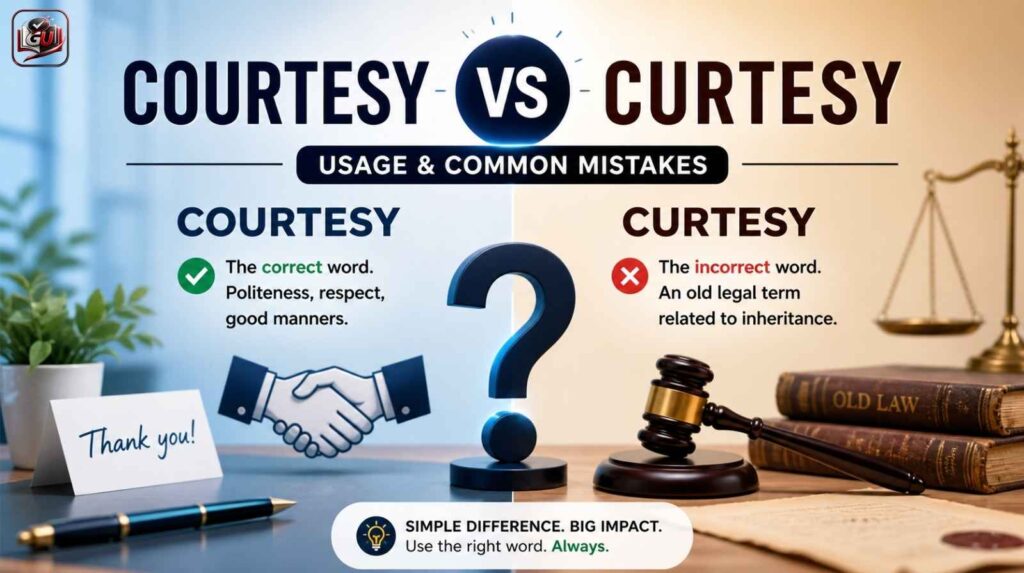
Have you ever written “curtesy” and just moved on without thinking twice? It happens more often than you might think. Many people mix up courtesy vs curtesy, not because they don’t know English, but because the two words sound exactly the same.
The problem is, only one of them is actually correct in everyday writing. Using the wrong one might seem like a small mistake, but it can quietly affect how professional and polished your writing looks especially in emails, blog posts, or formal messages.
In this guide, we’ll break things down in a simple and practical way so you can clearly understand the difference, avoid common mistakes, and use the right word with confidence every time.
In this guide, you’ll learn:
- The exact difference between courtesy and curtesy
- When each word is used (and when it’s not)
- Common mistakes people make
- Easy tricks to remember the correct spelling
By the end, you’ll never confuse these two words again.
Labelling vs Labeling: Which Spelling Is Correct And How Should You Use It?
What Is the Difference Between Courtesy vs Curtesy?
The difference between courtesy vs curtesy is simple but important:
- Courtesy = correct and commonly used word
- Curtesy = rare, outdated legal term
Meaning of Courtesy
Courtesy refers to polite behavior, respect, or good manners.
Examples:
- She thanked him out of courtesy.
- Please show courtesy to your guests.
- It’s common courtesy to say “thank you.”
👉 This is the word you should use in almost all situations.
Meaning of Curtesy
Curtesy is a legal term from old English law.
It refers to:
A husband’s legal right to his deceased wife’s property (historically).
Example:
- The estate passed to him under the right of curtesy.
👉 This term is rarely used today and mostly appears in legal or historical texts.
Quick Summary
| Word | Meaning | Usage Frequency |
|---|---|---|
| Courtesy | Politeness, respect | Very common |
| Curtesy | Old legal inheritance right | Very rare |
Eying vs Eyeing: Which Spelling Is Correct In English?
Why Do People Confuse Courtesy vs Curtesy?
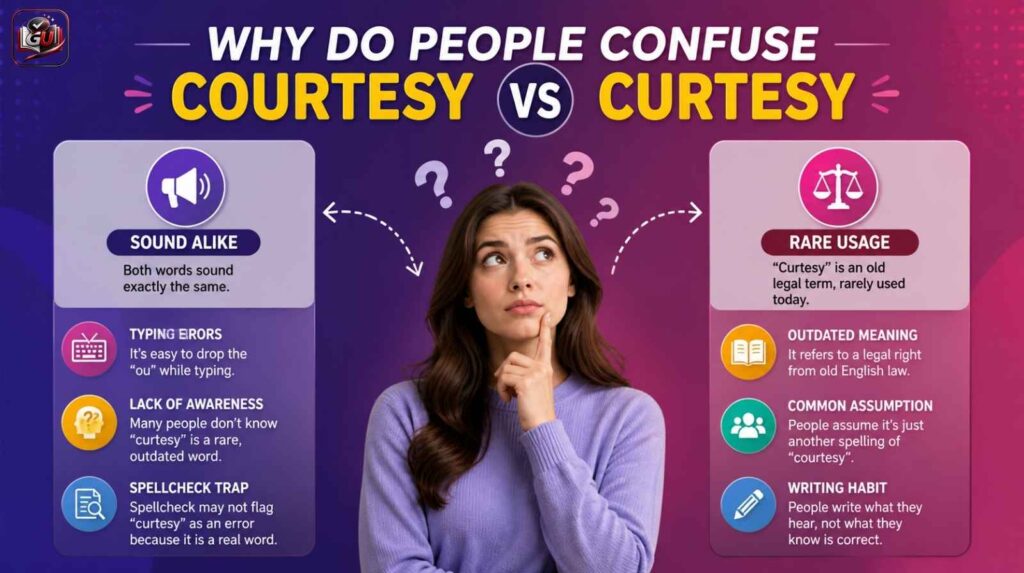
The confusion between courtesy vs curtesy comes from spelling similarity and pronunciation.
Similar Sound
Both words sound almost identical when spoken quickly:
- Courtesy → kur-tuh-see
- Curtesy → kur-tuh-see
This makes it easy to misspell when typing.
Typing Errors
Many people accidentally drop the “ou” in courtesy:
- Incorrect: curtesy
- Correct: courtesy
Lack of Awareness
Most people don’t even know “curtesy” is a real word. They assume it’s just a misspelling of “courtesy.”
Instalments vs Installments Which Is Correct And Use It?
Correct Usage of Courtesy in Daily Life
If you remember one thing, remember this:
👉 Use “courtesy” in everyday writing.
In Professional Communication
- Thank you for your courtesy during the meeting.
- We appreciate your courtesy and cooperation.
In Social Situations
- Basic courtesy goes a long way.
- Showing courtesy reflects good character.
In Customer Service
- The staff treated us with great courtesy.
- Courtesy calls help build strong relationships.
Common Phrases with Courtesy
- Courtesy call
- Courtesy email
- Common courtesy
- Professional courtesy
Honor vs Honour Which Spelling Is Correct? A Complete Guide To Understanding The Difference
Common Mistakes with Courtesy vs Curtesy
Even experienced writers make these mistakes.
Mistake 1: Using Curtesy Instead of Courtesy
❌ Incorrect: Thank you for your curtesy
✅ Correct: Thank you for your courtesy
Mistake 2: Assuming Both Words Are Interchangeable
They are NOT interchangeable.
- Courtesy = everyday use
- Curtesy = legal/historical only
Mistake 3: Spellcheck Dependence
Some tools don’t catch “curtesy” because it is technically a real word.
👉 Always double-check context.
Step-by-Step Guide: How to Always Use the Correct Word
Follow this simple checklist:
Step 1: Ask Yourself the Context
- Talking about manners or politeness? → Use courtesy
- Talking about old legal rights? → Maybe curtesy
Step 2: Check Frequency
If it’s everyday writing, it’s almost always:
👉 Courtesy
Step 3: Use Memory Trick
Courtesy has “court” in it → polite behavior in society
Step 4: Proofread Carefully
Before publishing:
- Scan for “curtesy”
- Replace with “courtesy” if needed
Acception vs Exception Difference And Usage: Complete Guide
Real-Life Case Study: How a Small Spelling Mistake Hurt Professional Image

A freelance writer once submitted a client proposal that included the sentence:
“We appreciate your curtesy and look forward to working with you.”
At first glance, it seemed fine. However, the client noticed the mistake immediately. In professional writing, even a small spelling error can raise concerns about attention to detail.
The client later shared feedback stating that while the proposal was strong, the spelling mistake reduced confidence in the writer’s professionalism.
The writer corrected the error and improved proofreading practices. Within weeks, their acceptance rate improved significantly.
Key Lesson:
Even minor mistakes like confusing courtesy vs curtesy can impact:
- First impressions
- Trust
- Professional credibility
Girlie vs Girly Which Spelling Is Correct? Complete Grammar Guide
Data & Statistics: Why Spelling Accuracy Matters (2025–2026)
Recent studies highlight the importance of correct spelling:
- According to a 2025 content quality report by HubSpot, 74% of readers trust content more when it is error-free
- A 2026 UX writing study found that 59% of users avoid brands with noticeable grammar mistakes
- Google’s helpful content guidelines emphasize clarity and accuracy as ranking factors
👉 This means:
Correct usage of words like courtesy directly impacts SEO and user trust.
Sneek vs Sneak: Which Spelling Is Correct And How To Use It?
Courtesy vs Curtesy Comparison Table
| Feature | Courtesy | Curtesy |
|---|---|---|
| Correct spelling | Yes | Rare/technical |
| Meaning | Politeness, respect | Legal inheritance term |
| Usage | Everyday language | Historical/legal only |
| Common mistake | Misspelled as curtesy | Misused instead of courtesy |
FAQs
Q1. Is curtesy ever correct?
A: Yes, but only in historical or legal contexts. In everyday writing, it’s almost always incorrect.
Q2. Why do people write curtesy instead of courtesy?
A: Because both words sound similar, and many people assume it’s just a spelling variation.
Q3. Is courtesy a formal word?
A: Yes, but it’s also widely used in everyday conversations and professional communication.
Q4. Can I use curtesy in modern writing?
A: Only if you are discussing legal history. Otherwise, avoid it.
Q5. What is the easiest way to remember courtesy?
A: Think of courtesy = polite behavior in society.
Q6. Does using the wrong spelling affect SEO?
A: Yes. Spelling mistakes can reduce readability, trust, and search rankings.
Conclusion
A: Understanding courtesy vs curtesy is simple once you know the key difference:
- Courtesy is the correct and commonly used word
- Curtesy is a rare legal term you’ll almost never need
Using the correct spelling improves:
- Writing clarity
- Professional credibility
- SEO performance
So next time you write, take a second to double-check. A small correction can make a big difference.
👉 Start applying this today, and your writing will instantly feel more polished and professional.
👉 Keep learning with more easy grammar lessons on GrammerUpdate.com

Noor Fatima is a professional blogger specializing in spelling correction and grammar guidance. She creates clear, practical content to help readers avoid common mistakes, strengthen writing skills, and communicate with confidence in everyday and professional settings.